
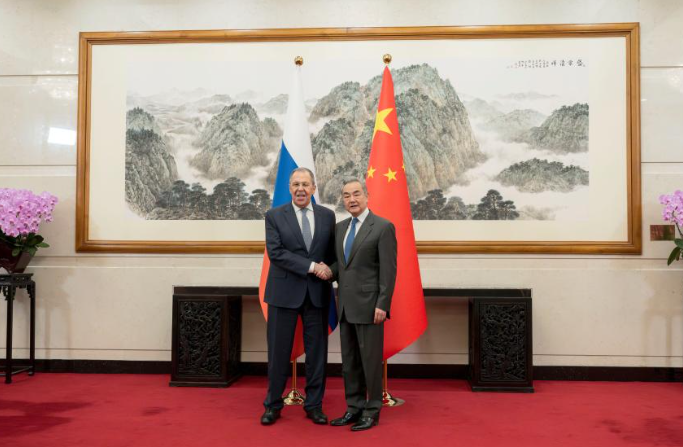
BEIJING: Chinese and Russian foreign ministers held talks on Tuesday, exchanging detailed views on key global and regional issues, including the U.S.-Iran conflict, the Asia-Pacific situation, and the Ukraine crisis, while also reviewing preparations for a meeting between their two heads of state later this year.

Chinese Foreign Minister Wang Yi met with Russian Foreign Minister Sergei Lavrov in Beijing, noting that the current international landscape is marked by significant turbulence. He said the impact of unilateral hegemony has intensified, global governance is undergoing deep changes, and challenges to peace and development are increasing.
Wang added that despite the complex and uncertain global environment, China-Russia relations have remained steady under the strategic guidance of their leaders, with cooperation across multiple sectors continuing to show strength and resilience.
He highlighted that this year marks the 30th anniversary of the China-Russia strategic partnership and the 25th anniversary of the Treaty of Good-Neighborliness and Friendly Cooperation, as well as the first year of China’s 15th Five-Year Plan.
Wang stressed the need to implement the consensus reached by both leaders and further elevate bilateral cooperation. He also called for stronger coordination within multilateral platforms such as the United Nations, and noted the importance of the upcoming anniversary of the Shanghai Cooperation Organization, urging support for Kyrgyzstan in hosting this year’s summit.
He further emphasized maintaining unity within BRICS and protecting the rights and interests of Global South countries, while advocating continued strategic coordination on major international issues, commitment to multilateralism, and progress toward a multipolar world order.
Lavrov, for his part, said Russia is ready to strengthen high-level exchanges with China, expand practical cooperation, and achieve mutual benefit.
He noted that the global situation faces serious challenges, adding that some countries are attempting to form “small circles” to contain Russia and China.
Lavrov also called for aligning China’s global initiatives with Russia’s vision of a Greater Eurasian Partnership and Eurasian security framework, while enhancing coordination on multilateral platforms to safeguard national interests and maintain global stability.
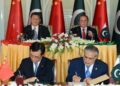
Following the talks, both sides signed the 2026 consultation plan between their foreign ministries.