

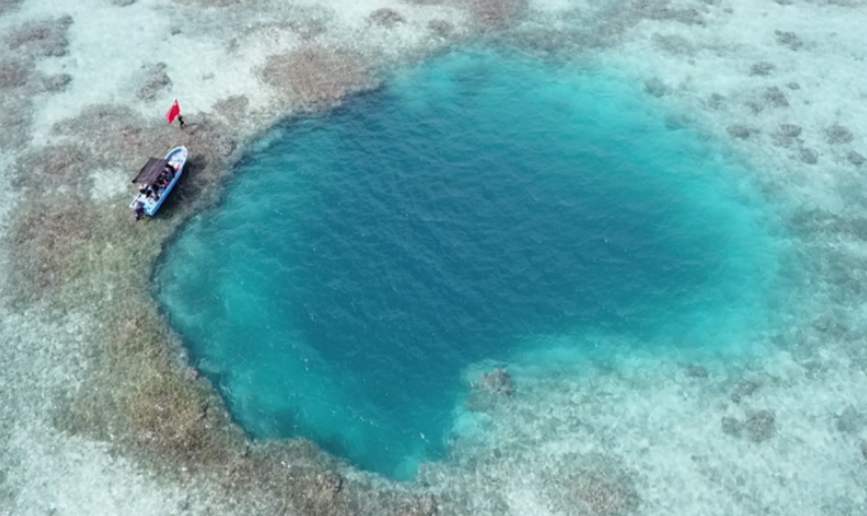
China has identified a globally rare coral reef growth structure-type marine blue hole at Huangyan Dao, marking the first confirmed coral reef blue hole discovered and explored in the country, according to a report released by China’s Ministry of Ecology and Environment on Thursday. Initial geochronological studies, including radiocarbon dating, indicate that the formation is at least 3,200 years old and supports a diverse marine ecosystem.

The report, titled “2025 Survey Report on Huangyan Dao Blue Hole,” was published in both Chinese and English. It provides an overview of the blue hole ecosystem, its formation and characteristics, biodiversity within and around the site, and future directions for research, exploration and conservation.
According to the report, researchers from the South China Institute of Environmental Sciences under the Ministry of Ecology and Environment, the Guangxi Laboratory on the Study of Coral Reefs in the South China Sea at Guangxi University, and other institutions discovered a suspected blue hole habitat in the central lagoon of Huangyan Dao in August 2025. Scientists subsequently conducted extensive field investigations, including scuba diving surveys, remotely operated vehicle missions, drone-based mapping, seawater monitoring and environmental DNA sampling.
Following a comprehensive assessment, researchers confirmed that the Huangyan Dao Blue Hole is a coral reef growth structure-type marine blue hole a formation rarely found worldwide and the first of its kind verified in China.
Located within a dense patch reef area of the central lagoon, the blue hole covers an entrance area of 1,491.7 square meters, has a maximum entrance diameter of 56.3 meters and reaches a depth of 16.6 meters. It features a funnel-shaped interior structure. Radiocarbon dating suggests the formation developed at least 3,200 years ago.
The surrounding ecosystem hosts a wide range of coral reef species, including the Green Sea Turtle, which is protected under China’s highest level of national wildlife conservation. Field surveys documented 165 species of hard corals and 184 species of fish in and around the blue hole.
The report highlighted the blue hole’s significance as a natural example of Huangyan Dao’s ecosystem diversity and as an important geological archive for studying historical environmental changes in the South China Sea, including sea-level fluctuations and the effects of global and regional climate change.
Researchers noted that the formation could provide valuable insights into the geological evolution of the Huangyan Dao region, biodiversity patterns and environmental shifts in the South China Sea since the Holocene. The report concluded that the Huangyan Dao Blue Hole possesses exceptional ecological, scientific and resource value, offering critical support for future studies of global environmental change and marine ecosystem evolution.