
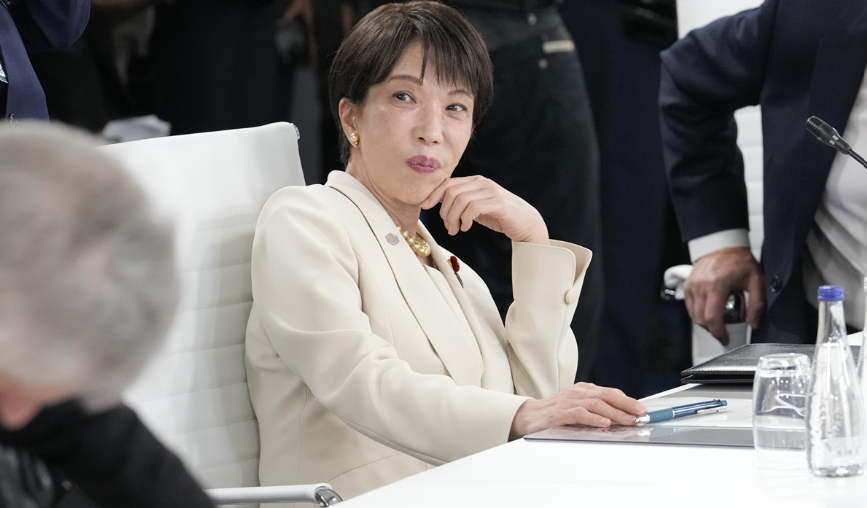
Japanese Prime Minister Sanae Takaichi’s latest remarks at the G7 summit on China’s export restrictions, along with her proposal for joint stockpiling of critical minerals, are aimed not only at courting G7 members but also at smearing China through the narrative of “economic coercion.” By deflecting attention from Japan’s own provocations, which have triggered China’s countermeasures and further strained bilateral ties, Tokyo is trying to rally the Western camp against China, exposing its growing strategic anxiety, said Chinese experts.

According to a Wednesday report by Jiji Press, Takaichi raised “concerns” over China’s export restrictions on critical minerals and other goods targeting Japan during a G7 summit session on Global South cooperation in Evian, France, on Tuesday. She claimed that these measures could “severely impact” the supply chains of the G7 and like-minded nations,” and “it is crucial to work together with like-minded countries and international organizations to enhance the resilience of critical mineral supply chains.”
Takaichi’s repeated focus on China’s critical mineral export restrictions at G7 meetings is driven by deep political and strategic motives rather than purely economic concerns. By playing “China threat” narrative, Japan is attempting to further smear China’s image by hyping up accusations of “economic coercion,” Da Zhigang, a researcher at the Institute of Northeast Asian Studies at the Heilongjiang Provincial Academy of Social Sciences, told the Global Times.
However, it should be noted that China’s export controls on critical minerals are direct countermeasures against Japan’s persistent provocations regarding China’s core bottom lines, particularly the Taiwan question, said the expert.
Markedly, this is not the first time that Takaichi has raised concerns about China at the G7. The Sankei Shimbun reported on Tuesday that during a G7 working dinner on the night of Monday, Takaichi proposed a “joint stockpile cooperation initiative” for critical minerals, such as rare earths, to counter China’s “economic coercion” and export controls. She also highlighted “challenges” regarding China’s growing “hegemonic behavior” in the East and South China Seas.
Japan is pushing a “joint stockpile” initiative to alleviate rare earth shortages threatening its business and defense sectors, turning its own predicament into a collective Western front against China. Also, it is pushing this narrative into the Global South, seeking to stoke fears over China’s economic influence and discourage developing countries from cooperating with China, said Da.
By hyping China’s export controls as “economic coercion,” Takaichi’s true intent is also to deepen Japan’s ties with the G7 and simultaneously lift restrictions on Japan’s own remilitarization — a calculated strategy that demands high vigilance, said the expert, noting that Japan’s push for mineral stockpile alliance not only fractures the global resource division of labor, but also threatens to drive global capital from the real economy into the defense sector, casting a new chill over multilateral trade mechanisms.
In January, China has decided to strengthen export control on dual-use items to Japan, the Ministry of Commerce announced. The country prohibits the export of all dual-use items to Japanese military users, for Japan’s military use, and for any other end-users and end-use purposes that help enhance Japan’s military capabilities.
Exports of the seven rare earths for the January-April period fell 34 percent on the year, with steeper declines of 88 percent for March and 82 percent for April, prompting Japanese companies to seek alternative sources such as Australia and India, according to Nikkei Asia.
Facing mounting public discontent over economic and livelihood issues at home, the Takaichi administration is attempting to concoct an “external threat” to deflect domestic criticism. Meanwhile, Tokyo’s push for a hardline anti-China stance within the G7 only exposes its own strategic anxiety, Lü Chao, a professor at the Liaoning Academy of Social Sciences, told the Global Times.
Meanwhile, Hitoshi Tanaka, Japan’s former deputy minister for foreign affairs, published an article on Wednesday in Japanese media outlet Diamond Online. In the piece, titled “The danger of the Takaichi administration’s one-sided focus on ‘strengthening deterrence’ against China: will Japan face ‘isolation’ due to severed channels of dialogue?” Tanaka noted that the US and China recently confirmed a trade war truce and European leaders from France, Germany, and the UK have been flocking to China to strengthen economic ties.
Amid these global shifts, the deep freeze in Japan-China relations stands out sharply. Bilateral ties have continually deteriorated since Takaichi framed a Taiwan contingency as a “situation threatening survival.” Tanaka warned that the Takaichi administration’s strategy — which relies solely on strengthening deterrence against China — risks isolating Japan and poses a major threat to its national interests.