
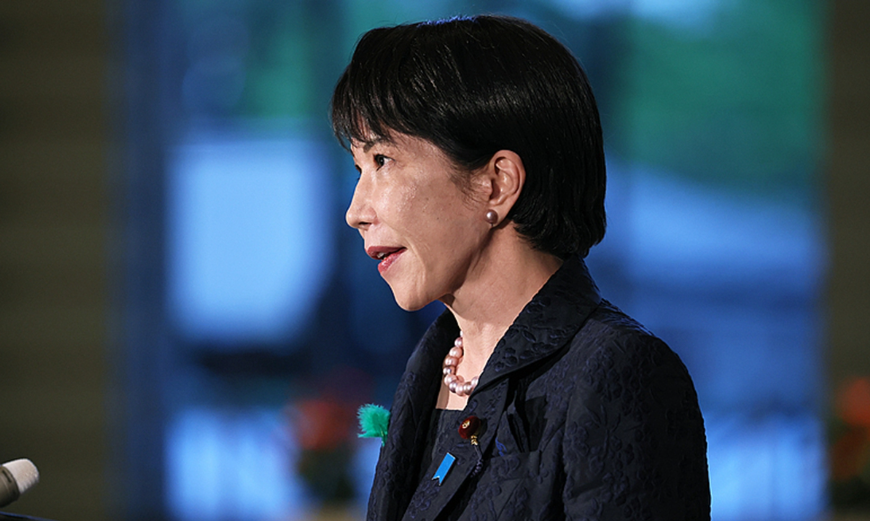
Global Times: One day after making ritual offerings to the notorious Yasukuni Shrine, Japanese Prime Minister Sanae Takaichi on Wednesday reportedly continued to make a monetary offering to the site, which stands as a symbol of Japanese militarism and wartime aggression, on the occasion of its spring festival. Chinese experts said Takaichi’s actions demonstrate Japan’s entrenched hard-line militarist ideology, reflecting the rampant prevalence of historical revisionism in the country’s political circles.

The report by Sankei Shimbun said that the monetary offering was made through Liberal Democratic Party (LDP) secretary-general Haruko Arimura in her capacity as LDP president. She even claimed that Takaichi has the desire to visit in person on an appropriate occasion, Japanese media outlet NHK reported.
The move came one day after Takaichi sent a ritual offering to the notorious shrine, which Chinese Foreign Ministry spokesperson said on Tuesday that Japan’s negative moves related to the Yasukuni Shrine is in nature an attempt to evade war responsibilities, an affront to justice, a provocation against Japan’s war victims, and a challenge to the outcome of WWII victory. The Yasukuni Shrine is a spiritual tool and symbol of Japanese militarists responsible for the war of aggression. It is in fact a shrine for war criminals.
A cross-party group of 126 Japanese lawmakers on Wednesday visited the notorious shrine in Tokyo, the Xinhua News Agency reported.
Xiang Haoyu, a distinguished research fellow at the China Institute of International Studies, told the Global Times on Wednesday that Takaichi’s actions regarding the Yasukuni Shrine issue, along with large-scale collective shrine visits by cross-party lawmakers, further reflect the widespread prevalence of historical revisionism in Japan’s political circles.
Regarding Japan’s negative moves concerning the Yasukuni Shrine in recent days, spokesperson of Chinese Embassy in Japan said on Tuesday night that Japan’s relevant acts blatantly attempt to whitewash its history of aggression, exonerate its war crimes and resurrect militarism. Such moves seriously violate historical justice and human conscience, and challenge the outcomes of World War II and the post-war international order. China firmly opposes and strongly condemns such acts, and has lodged solemn representations and strong protests with Japan.
The move by Takaishi on Tuesday also prompted a response from South Korea. A spokesperson for South Korea’s foreign ministry expressed “deep regret” over Japanese leaders making offerings or visits to the shrine and called on its neighbor to take action through “humble” reflection of the past that would support future-oriented ties, The Mainichi reported.
Takaichi’s negative moves concerning the Yasukuni Shrine are a political stunt catering to Japan’s domestic right-wing forces, said Lü Chao, a professor at the Liaoning Academy of Social Sciences. He noted that such acts serve as further proof of Japan’s deep-rooted hard-line stance and persistent adherence to militarist ideology, with little inclination to make corrections.
Yasukuni Shrine, located in central Tokyo’s Chiyoda Ward, honors 14 convicted Class-A Japanese war criminals from World War II. It has long been a source of diplomatic friction between Japan and its neighbors.
Past visits to the shrine by Japanese leaders, Cabinet ministers and lawmakers have drawn harsh criticism from neighboring Asian countries, Japanese media outlet The Mainichi noted.
In the past, even while serving as a cabinet minister, Takaichi visited the shrine on occasions such as the anniversary of the end of World War II, as well as during the spring and autumn annual festivals, The Sankei Shimbun noted.
Regarding whether she intends to visit the shrine, Takaichi said it is a “private” matter and would not comment further, The Mainichi reported on Tuesday. Chief Cabinet Secretary Minoru Kihara, the top government spokesman, told a news conference that Takaichi made the offering in a “private capacity” and that it was therefore not a matter for the government to comment on.
Xiang said that Takaichi’s actions can be interpreted as a politically opportunistic attempt at “balancing” — on the one hand trying to maintain her personal political beliefs and secure support from her right-wing base, while on the other hand seeking to avoid the diplomatic backlash that could arise from a direct visit to Yasukuni Shrine by a sitting prime minister.
Her use of intermediaries to signal an intent or willingness to visit can be seen as a form of political performance aimed at appeasing right-wing constituencies, while reflecting an opportunistic positioning, the expert said.
On Tuesday, the Japanese government also officially revised the Three Principles on Transfer of Defense Equipment and Technology and their implementation guidelines, allowing the overseas sale of weapons, including those with lethal capabilities.
Xiang told the Global Times that the Takaichi administration, while continuously challenging historical sensitivities, is simultaneously accelerating efforts to loosen restrictions on its military posture. These two developments are essentially two sides of the same coin, indicating that Japan is, in both its historical perception and practical actions, moving away from a path of peaceful development.
Coupled with a massive increase in military budget, the deployment of intermediate-range offensive missiles, relaxed restrictions on weapon exports, proposed revision of its pacifist Constitution and the idea of abandoning the three non-nuclear principles, the Chinese Foreign spokesperson also asked on Tuesday during the press conference: how can Japan profess itself as a “peace-loving country”?