

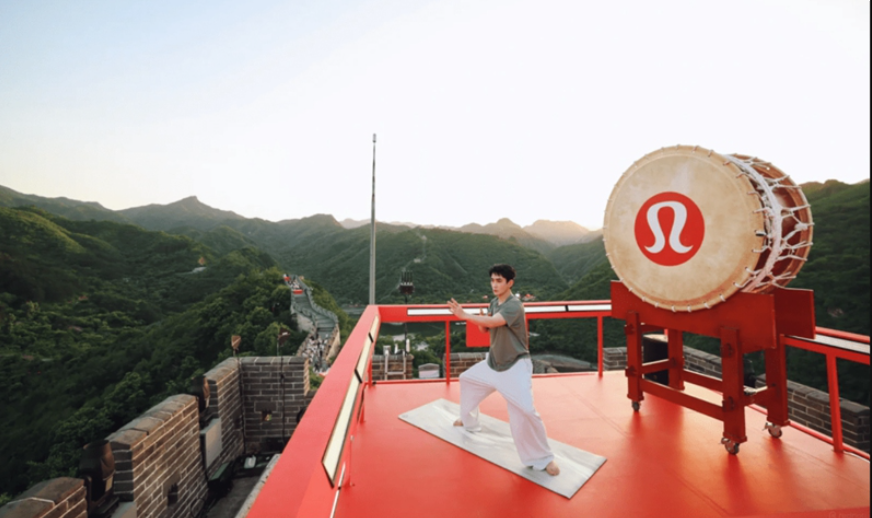
Canadian athletic apparel retailer Lululemon apologized on Tuesday for failing to fully identify potential disputes and that it ought to have planned and reviewed the percussion performance with more caution and thoroughness, after its promotion event containing Chinese entertainer Zhu Yilong playing a drum suspected to be a Japanese drum sparked controversy on Chinese social media platforms.

The incident started when Zhu, a famous Chinese actor who had starred in hit film Lost in the Stars and costume drama The Story of Ming Lan, attended a yoga festival organized by Lululemon at the Huanghuacheng Water Great Wall in the Huairou District in Beijing on May 30, which the brand said aims to promote health concept and Chinese culture.
Previous media reports said that on the Great Wall, the brand ambassador Zhu Yilong joined the HiiKo Drum Group in a traditional Chinese drum, or Dagu, performance. Zhu posted the same day on his Sina Weibo account about the event with three pictures, with one showing him standing in front of the drum.
However, some netizens, musicians and industry insiders challenged that the instrument used was not a Chinese Dagu but a Japanese Taiko drum, criticizing that using a Japanese drum at a Chinese cultural landmark is inappropriate and even insulting.
Percussionist Xu Yang posted on June 12 on social media that the shape and configuration of the drum used, the format of the performance, and the concept delivered through the performance were more aligned with Japanese Taiko.
Xu noted that although the Taiko was inspired in cultural exchanges with China in Sui and Tang dynasties, it has departed far from Chinese culture and incorporated the Shinto worship and Bushido spirit… The event, using Taiko at the Great Wall, which is of symbolic meaning for Chinese nation, and branding it as Chinese drum, is misleading and stirred national historical memories.
Some netizens also pointed out that the Bushido spirit was exploited by militarists and turned into an ideological prop and mental weapon for foreign aggression and expansion in modern Japan, while some argued that it was the Jiegu drum that was popular in China in Tang Dynasty and a prototype of the Japanese Taiko.
The controversy has been circulating online in recent days and the topic on Sina Weibo garnered over 50 million views on Monday, with more netizens demanding the brand to apologize and rectify its promotion.
Lululemon said in the statement posted on its official Sina Weibo account on Tuesday that the event has always upheld the original intention to pay tribute to Chinese culture. “We attach great importance to the feedback from the society. Due to lack of professional knowledge, we failed to fully identify potential disputes early and have fully recognized that we ought to have planned and reviewed the percussion performance with more caution and thoroughness,” read the statement.
“We sincerely apologize to the public and Mr. Zhu Yilong, and has removed all related promotional contents,” the company said, adding that it will learn from the lesson and hold and communicate on future events with a more prudent attitude.
Zhu’s studio also posted a statement later, saying it has urged the brand to verify the entire workflow. Zhu and his team have always been committed to promoting traditional Chinese culture, and the studio will handle all work matters more prudently and professionally.
The performance troupe involved also apologized on Tuesday for having “occupied public resources.” The troupe said it has removed controversial contents and stopped the use of the instrument, and vowed to enhance regulation of culture-related expressions and strengthen education, read the apology statement of Hiiko Drum Group.
Zhang Peng, an associate professor at Nanjing Normal University, told the Global Times on Tuesday that though many Japanese cultures are originated from China due to close exchanges in ancient times, and the boundaries are sometimes blurred, misuse of cultural symbols could trigger severe public backlash, particularly when the two countries are undergoing sensitive period of time.
People involved in public expressions in this regard should raise awareness of the sensitivity and conduct thorough pre-research before the use of cultural elements, otherwise such controversies could happen and deal heavy blow to brand image, Zhang said.