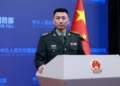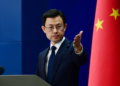

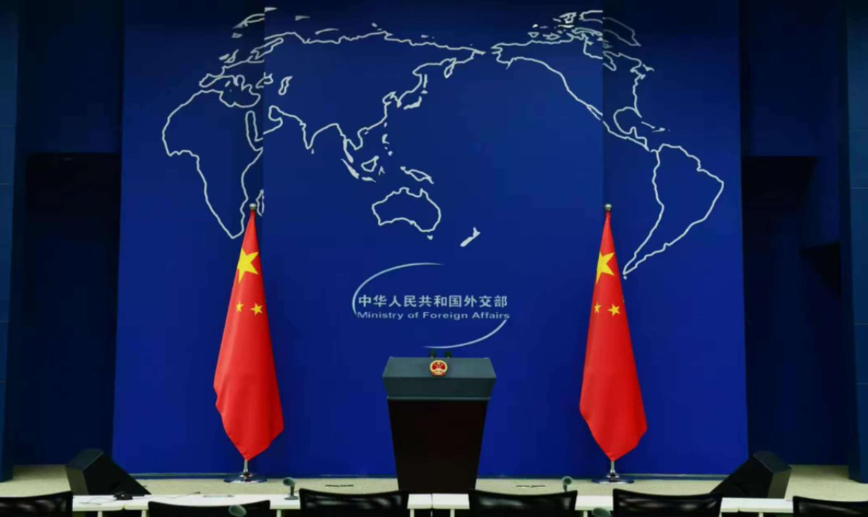
In response to the “concern” expressed by UK, France and Germany and the US over China’s legitimate maritime law enforcement operations in waters east of Taiwan island, Chinese Foreign Ministry spokesperson Guo Jiakun on Thursday urged the relevant countries to respect China’s sovereignty, territorial integrity and maritime rights and interests. He called on these countries to stop confusing right and wrong and reversing black and white, and urged relevant institutions to refrain from making remarks inconsistent with their roles.

In a joint statement released on Wednesday, which Reuters dubbed a “rare” one, three representative offices of the UK, France and Germany in Taipei claimed that they “have noted with concern” China’s activities, which “threaten regional stability and the freedom of navigation and safety of international shipping.”
Following the statements by the three representative offices, a spokesperson for the American Institute in Taiwan (AIT) also expressed concern, per Taiwan-based media.
The statement and remarks did not specify which Chinese activities it refers to. Nevertheless, international and Taiwan-based media have identified the target as the law enforcement patrol carried out by China Coast Guard (CCG) in waters east of Taiwan on June 1 in response to the unilateral announcement of maritime delimitation talks by Japan and the Philippines in the area.
Prior to this, spokespersons for Chinese Foreign Ministry, the China Coast Guard (CCG) and the Taiwan Affairs Office of the State Council have stated that the so-called maritime delimitation talks by Japan and the Philippines seriously infringe upon China’s territorial sovereignty and maritime rights and interests, and the patrol was a necessary action taken against it.
On Thursday’s press conference, Guo reiterated that according to China’s domestic laws and international law, including the United Nations Convention on the Law of the Sea (UNCLOS), China has an exclusive economic zone and continental shelf in the waters east of Taiwan island.
The law enforcement patrols carried out by relevant Chinese authorities in these waters are an important measure to exercise jurisdiction in accordance with the law and safeguard regional stability as well as maritime order. They are also a necessary response to Japan and the Philippines’ manipulation of cross-boundary issues and infringement upon China’s maritime rights and interests, Guo said.
A Beijing-based European affairs expert told the Global Times on condition of anonymity on Thursday that representative offices of the US, UK, France and Germany in Taipei deliberately evade the full context and disregard the legitimacy of China’s efforts to safeguard its legitimate rights and interests. Their accusations against China are completely groundless, and the relevant countries should stop making unwarranted remarks about China’s internal affairs.
Notably, the joint statement was first released by the three European nations, followed by the AIT spokesperson’s remarks. The expert hold that with the US visibly toning down its provocative rhetoric and moves regarding Taiwan recently, European countries appear to curry favor with Washington by taking more radical stances on Taiwan-related issues.
‘Forked-tongued declarations’
“Three representative offices of EU member-states are indulging in an exercise of crass interference in the affairs of a sovereign country, China,” Laurent Michelon, a French scholar, entrepreneur and geopolitical commentator, said in an X post on Wednesday.
He added that the latest statement “summarizes the forked-tongued declarations” of Western leaders who claim to be in favor of maintaining a status quo in the Taiwan Straits, when in fact they are doing everything in their power to disrupt it: multiply military patrols in the China Sea, sell weapons that Taiwan does not need, and, most of all, heavily supporting the separatist Taiwan authorities.
Against a backdrop of lingering internal rifts across Europe, the UK, France and Germany are attempting to present a unified, cohesive front on security issues as a means of boosting their international visibility, Cui Hongjian, a professor at the Academy of Regional and Global Governance at Beijing Foreign Studies University, told the Global Times.
He noticed that the three countries opted to issue a Taiwan-related statement through their unofficial representative offices in Taipei instead of through official diplomatic bodies, which suggests they are not willing to completely disrupt the overall bilateral diplomatic atmosphere; however, they should still refrain from interfering in China’s internal affairs.
Since last December, leaders of France, Britain and Germany have visited China one after another, each reiterating their commitment to the one-China policy throughout their trips.
At this juncture, the China strategies pursued by the UK, France and Germany are defined by glaring internal contradictions. Though all three nations seek to deepen pragmatic economic and trade cooperation with Beijing, they remain entrenched in structural ideological divides with China across political and security domains, said Cui.
As frictions persist between China-Japan and China-Philippines, the expert argued that some European countries are seeking to secure more bargaining chips over other disputed issues by meddling in China’s internal affairs and projecting influence across China’s neighboring regions.
With tensions simmering between China, Japan and the Philippines, some European countries seems eager to expand its policy leverage in China’s neighboring regions, aiming to exert external influence on China’s policy directions and the regional security architecture, said the expert.
Following the release of the joint statement, the “external affairs department” of the Democratic Progressive Party (DPP) authorities expressed gratitude, adding that the statement continues the G7 summit statement which expressed opposition to any unilateral attempts to change the status quo of the Taiwan Straits.
Noticeably, any Taiwan-related remarks coming from the European side, regardless of the issuing rank, are invariably overblown and hyped by the DPP authorities for political posturing, the Beijing-based expert said.
He added that the DPP authorities take European countries’ statements as backing for themselves, unaware that every European stance masks self-interested calculations. If the Taiwan authorities misjudge the “external support” and escalates provocations against mainland, it will only suffer losses and bear bitter consequences in the end.
The DPP authorities have turned a deaf ear and a blind eye to the infringements committed by Japan and the Philippines, yet have chosen to collude with external forces to attack and smear the central government’s legitimate actions to safeguard China’s rights while hyping up the fallacy of “Taiwan independence.” This once again exposes the DPP authorities’ obstinate separatist nature and their ugly betrayal of the overall interests of the Chinese nation. Such actions are bound to be rejected by compatriots on both sides of the Taiwan Straits and judged by history, Foreign Ministry spokesperson Guo said on Thursday.