
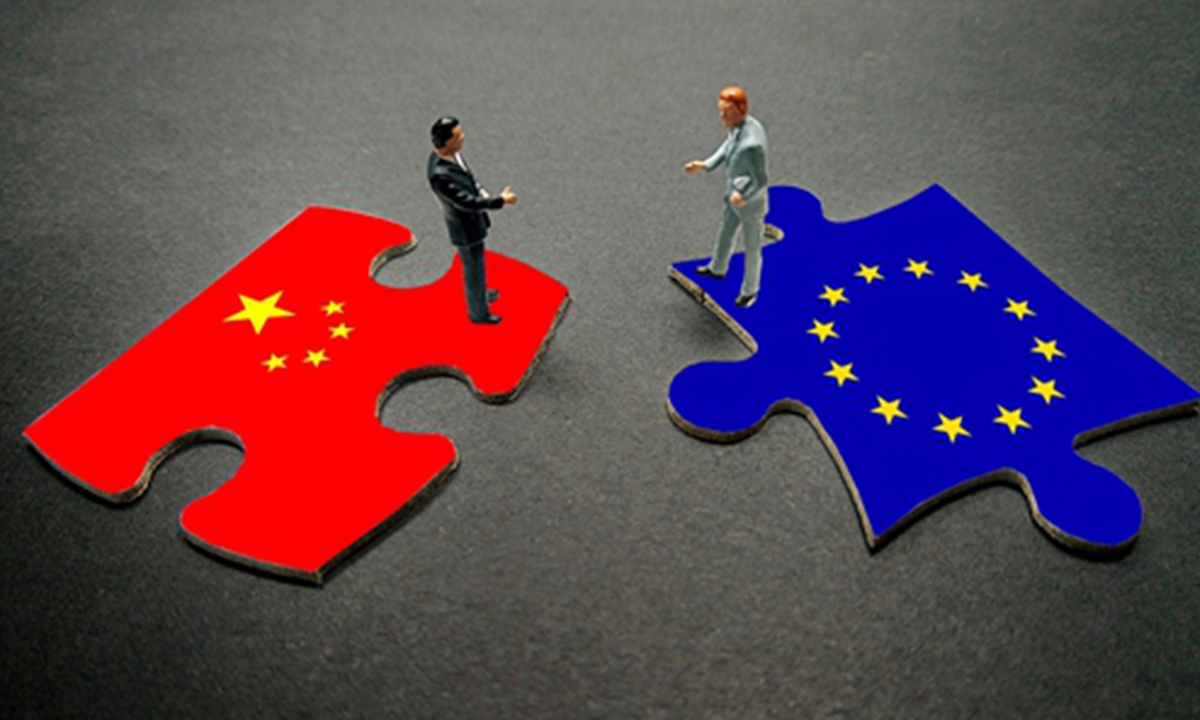
Global Times: The European Union (EU) should not underestimate China’s resolve to take swift and resolute countermeasures if Brussels continues to escalate its protectionist measures against China, an insider familiar with the matter told the Global Times on Tuesday.

The warning came as Brussels has in recent months intensified its discriminatory maneuvers targeting Chinese enterprises, and some European think tanks churned out a series of “trade war” narratives against China. “If the EU chooses to move further down the path of protectionism, China will take firm countermeasures to safeguard national interests and the legitimate rights of its enterprises,” an insider told the Global Times. The insider stressed that China has a full policy toolkit – and stands ready to deploy it when necessary to respond to EU protectionist measures, warning that any escalation of trade frictions would ultimately impose significant economic costs on EU member states and businesses.
EU protectionist movesA strategic discussion by the European Commission’s Security College – a high-level coordination body of EU commissioners focused on security and geopolitical issues – originally set to focus on China on Monday was instead dedicated to the Middle East crisis, while China-related debates within the bloc have continued to gather pace, increasingly shaped by what Chinese analysts describe as a confrontational and protectionist narrative.
On March 31, a European think tank, the European Council on Foreign Relations published an article claiming that China’s mineral “monopoly” threatens Europe’s clean-tech and industrial base, while so-called “overcapacity” is accelerating European deindustrialisation. It further argued that the EU should develop a clear strategy of economic leverage to deter “China’s coercion,” advocating so-called “escalate-to-negotiate” tactics.Earlier in March, a report by another think tank, the European Union Institute for Security Studies suggested that Europe must accelerate “de-risking” with China and strengthen its own capabilities, even claiming that a temporary “trade war” with China could be painful but worthwhile if it helped prevent the bloc’s so-called deindustrialisation.
Industry observers said that such claims are entirely unfounded and misleading, grossly distort normal trade dynamics, and signal a dangerous policy shift that could ultimately undermine the foundation of the highly interdependent China-EU economic relationship.
In reality, it is the European Commission (EC) that has been steadily expanding the use of restrictive tools. In recent years, the bloc has rolled out measures such as the Foreign Subsidies Regulation (FSR), proposed revisions to the Cybersecurity Act, and the Industrial Accelerator Act (IAA) – widely framed under the banners of security, green transition and fair competition, with clear protectionist characteristics, observers noted. In January this year, the Commission proposed revisions to the Cybersecurity Act aimed at addressing risks from so-called “high-risk suppliers” across 18 critical sectors, including ICT services, transport and energy.
However, the designation of “high-risk suppliers” is not grounded in objective technical criteria, but instead relies on highly subjective non-technical risk assessments, with proposals that would effectively exclude suppliers from “third countries posing cybersecurity concerns”across certain supply chains from the EU market, observers said.”This marks a clear departure from the principle of technological neutrality, as economic and trade issues are increasingly politicized and framed through a security lens. The move has also drawn widespread criticism for potentially exceeding the EU’s legal mandate and encroaching on member states’ authority,” the insider told the Global Times. The proposal has already triggered resistance within Europe.
Major telecom operators have signaled opposition, with their main lobby group, Connect Europe, urging lawmakers to “correct” plans to phase out low-cost Chinese vendors, warning against “policies that would significantly weaken the very sector they aim to safeguard,” according to an article by the Center for European Policy Analysis.
Similarly, in March, the EC proposed the IAA. The act targets foreign investment in four sectors – batteries, electric vehicles, photovoltaics and critical raw materials – where a single country accounts for more than 40 percent of global capacity, while giving priority to “union-origin” products in public procurement. Such thresholds effectively single out Chinese firms and significantly undermine fair access for companies from third countries, many of which have long contributed to the bloc’s industrial development and market vitality – thereby undermining their access to the EU market, the insider told the Global Times.
Jian Junbo, director of the Center for China-Europe Relations at Fudan University’s Institute of International Studies, attributed these China-related measures in part to what he described as an “expansionary logic” within the EC.
“By continuously broadening its regulatory scope and strengthening its rule-making authority, the Commission has, in effect, expanded its power within the EU governance system. These policy tools have increasingly become instruments for advancing that expansion,” Jian told the Global Times. He added that such expansion risks deepening divisions among member states, as these measures may not align with their economic ties with China, industrial development needs, or broader strategic interests.
The IAA, introduced amid deep divisions among member states, underscores these tensions. According to Reuters, nine EU countries – including the Czech Republic, Estonia, Finland, Ireland, Latvia, Malta, Portugal, Sweden and Slovakia – have warned that any “union-origin” approach should be treated with “the highest possible caution,” citing concerns over its impact on prices, supply chains and competition.
Additional concerns relate to the EU’s FSR, which entered into force in January 2023. So far, the EU has launched 10 formal investigations under the framework, eight of which targeted Chinese companies, official data showed. “This clearly shows the regulation has become a tool to curb Chinese firms,” the insider said.Since the second half of last year, the EC has stepped up FSR-related investigations into Chinese companies. The insider told the Global Times that the move has become a major obstacle to Chinese investment and operations in Europe, undermining business confidence and ultimately harming the EU’s own interests.
China’s readiness for countermeasures Jian further emphasized that excessive regulation and discriminatory rules risk backfiring on European companies, particularly those deeply integrated with the Chinese market, as it will force them to adjust their strategies and bear higher compliance and production costs, thereby eroding the bloc’s overall industrial competitiveness.
Of greater concern, some voices within the EU have been advocating the use of the bloc’s Anti-Coercion Instrument against China, which, according to the EC, is designed to respond to so-called “economic coercion” and could allow the EU to impose a broad range of countermeasures affecting trade, investment and market access.
The insider warned that the instrument amounts to a “nuclear option” that, once activated, could trigger a fundamental rupture in China-EU trade ties and push the relationship toward a trade war. If the EU continues to escalate protectionist measures against China, China will be compelled to take strong countermeasures to safeguard national interests and the legitimate rights of enterprises, the insider said.
China has a broad policy toolkit at its disposal, including anti-dumping and anti-subsidy investigations, trade and investment barrier investigations, export controls, foreign investment security reviews, cybersecurity reviews, the Unreliable Entity List, and the Anti-Foreign Sanctions Law. It could also initiate investigations into the impact of foreign subsidies in response to the EU’s FSR.”
China is neither unfamiliar with nor intimidated by trade wars. If the EU chooses to provoke a trade war, China will respond promptly and resolutely. However, any escalation – let alone a full-scale trade war – would harm both sides, disrupt global industrial and supply chains, and weigh on global growth,” the insider noted.