

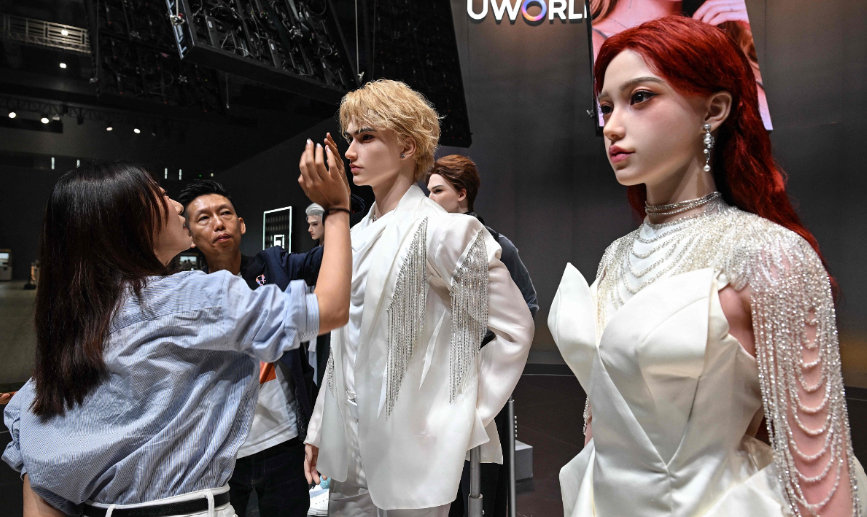
A Chinese technology company has unveiled a life-sized, hyper-realistic humanoid robot designed as a companion that offers users emotional support and everyday interaction. Available in both male and female versions, the robot has sparked intense debate online. While some have questioned whether it is worth the hefty price tag, others have raised a broader question: Are AI companions a cure for loneliness — or a threat to real human relationships?

At its 2026 global launch event, Chinese robotics maker UBTech introduced the U1 series of full-sized hyper-realistic humanoid robots on Tuesday, positioned as devices for daily companionship, emotional support, lifestyle aesthetics, and social assistance. The high-end version of the robot carries a price tag of 990,000 yuan ($137,000), with all versions restricted to adult purchasers and users, according to a press release sent to the Global Times by UBTech.
Product listings on China’s e-commerce platforms confirm the U1 series offers two gendered models. The male unit stands 183 centimeters tall and weighs 42 kilograms, while the female model measures 168 centimeters with a weight of 35.2 kilograms, according to the press release.
The robot is said to be capable of performing more than 90 percent of basic human movements. It is powered by what the company describes as the world’s first large emotional AI model designed for long-term companionship, capable of recognizing more than 20 fine-grained emotional states with an accuracy rate exceeding 90 percent.
The U1 Lite retails at 119,800 yuan, the U1 Pro at 169,800 yuan, the male U1 Ultra at 990,000 yuan and the female U1 Ultra at 880,000 yuan. Platform purchasing terms stipulate that the robots can only be bought and operated by adults, the company said.
Zhou Jian, founder, CEO and chairman of UBTech, said the pricing leaves reasonable profit margins, adding that mass production for diverse consumer segments in the future will drive down manufacturing costs and retail prices further.
Zhou argued that if a robot can perform household chores, provide emotional companionship, and boast an appealing appearance, then “a price of 100,000 to 200,000 yuan is not too expensive.” However, the audience at the event expressed widespread surprise at the price tags.
During the event, Zhou said that preorders for the U1 hyper-realistic humanoid robot series have surpassed 10,000 units, disclosing that the company’s goal for 2026 is to achieve a scaled production capacity of 50,000 bionic robots.
However, the distinctive design and function of the humanoid robot have also sparked discussion among netizens. Some netizens were impressed by the innovation. A Sina Weibo user posted that “The era of personal robots may have already begun — quietly, and right now… They can understand their surroundings, navigate real environments, and perform tangible tasks rather than simply processing information. If the technology matures as expected, this future may arrive much sooner than we imagine.”
Another netizen posted on the Chinese social-media platform Xiaohongshu (RedNote) that she would gladly buy the robot if it could provide emotional support, remind her to take medication and call emergency services when she fell ill. “A companion that will never betray you or abandon you is worth the price,” she wrote. “Especially when you can even customize its appearance.”
However, some have argued that robots designed as emotional companions could lead users to develop unhealthy emotional dependencies, potentially further eroding genuine human interaction.
A Sina Weibo user said that “We may be willing to spend hundreds of thousands — or even close to a million — to buy a ‘perfect companion’ that can recognize more than 20 emotions and remains endlessly gentle and compliant. Yet in real-life relationships, we often want to walk away at the first sign of friction.”
“Is this a sign of technological progress — or of a decline in our ability to build and sustain human relationships?” the user questioned.