
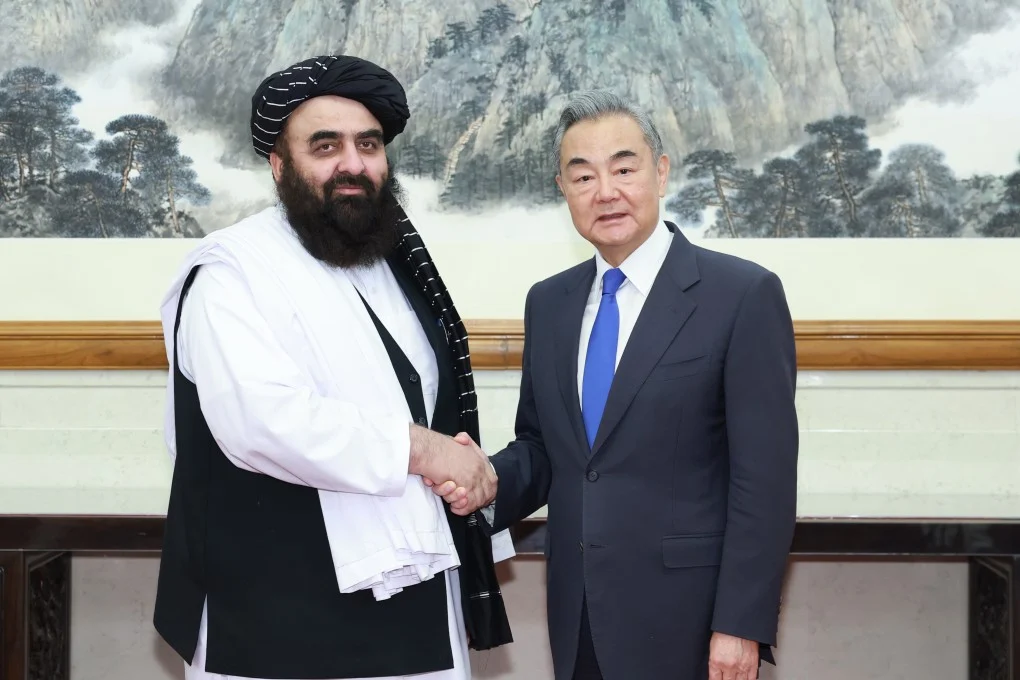
News Desk (MNN); Chinese Foreign Minister Wang Yi has urged Afghanistan and Pakistan to resolve their disputes through dialogue and consultation rather than force during a phone call with Afghan Acting Foreign Minister Amir Khan Muttaqi, according to a statement issued by China’s foreign ministry on Friday.

During the conversation, Wang called on both sides to remain calm and exercise restraint amid rising tensions. He emphasised the need for immediate face-to-face talks, urging both countries to seek an early ceasefire and address their differences through diplomatic dialogue.
Wang warned that further use of force would only complicate the situation and increase tensions between the two neighbours.
Echoing the same message, Chinese Ambassador to India Xu Feihong said China was willing to play a constructive role in easing tensions and promoting reconciliation between Pakistan and Afghanistan. He shared details of the call on the social media platform X.
The Chinese foreign ministry’s statement came shortly after Pakistan targeted terrorist camps and related infrastructure inside Afghanistan on Friday.
Wang and Muttaqi also discussed the evolving situation in Iran during their conversation. According to the statement, Wang said Beijing was ready to work with the international community, including Afghanistan, to help restore peace in Iran.
Pakistan has experienced a resurgence in militant violence since the Afghan Taliban returned to power in Kabul in 2021. Islamabad has repeatedly urged the Taliban administration to dismantle militant sanctuaries on Afghan territory, particularly those linked to the banned Tehreek-i-Taliban Pakistan, but officials say those requests have largely gone unanswered.
Tensions between the two countries escalated again following a vehicle-borne suicide attack on February 16 in Bajaur District near the Afghan border. Militants belonging to the Tehreek-i-Taliban Pakistan attempted to breach the Malangi checkpost and rammed an explosives-laden vehicle into its perimeter wall after an exchange of fire.
The attack resulted in the martyrdom of eleven Pakistani soldiers. A young girl was also killed, while seven other civilians, including women and children, were injured when a nearby residential building was damaged in the blast.
Investigators later identified the suicide bomber as Amad, also known as Qari Abdullah or Abu Zar, who was reportedly linked to the Afghan Taliban’s special forces from Balkh Province. The Tehreek-i-Taliban Pakistan claimed responsibility for the attack.
A few days later, on February 21, a lieutenant colonel and a sepoy of the Pakistani army were martyred in another suicide attack during an intelligence-based operation in Bannu District.
In a statement, the military’s media wing Inter-Services Public Relations said terrorists were using Afghan territory to carry out attacks inside Pakistan, calling it a violation of the sanctity of the holy month of Ramadan.
The military warned that Pakistan would continue operations against those responsible for such attacks and would pursue the perpetrators regardless of their location.
Earlier, on February 19, Pakistan’s Defence Minister Khawaja Asif had warned that Pakistan could carry out strikes inside Afghanistan if cross-border attacks continued.
In November last year, Taliban government spokesperson Zabiullah Mujahid claimed that Pakistani forces had carried out air strikes in Khost Province as well as in Kunar Province and Paktika Province.
Pakistan neither confirmed nor denied those reports at the time, which surfaced the same day a deadly suicide attack targeted the Federal Constabulary headquarters, killing three personnel and injuring twelve others.
Those reported strikes came nearly a month after deadly border clashes between Pakistani forces and Taliban-linked militants along the Pak-Afghan border. According to the military, twenty-three Pakistani soldiers were martyred, while more than two hundred Taliban fighters and affiliated militants were killed.
The clashes reportedly began on the night of October 11 and 12, 2025, when Afghan Taliban fighters and India-backed militants identified by Pakistan as Fitna-al-Khawarij allegedly launched an unprovoked attack along the Pakistan-Afghanistan border.