

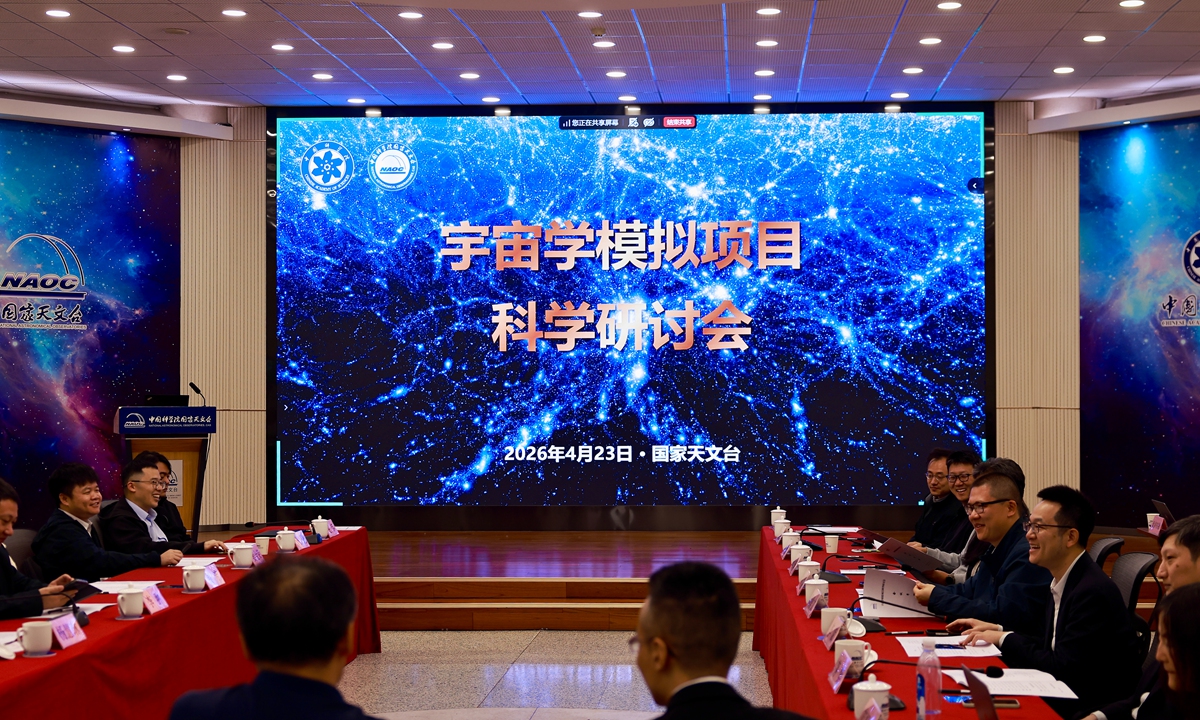
Global Times: An international team led by Chinese scientists has unveiled the first results of the largest cosmological simulation ever created, offering a powerful new tool to explore the evolution of the universe. The project, codenamed “HyperMillennium,” was introduced at a press conference by the National Astronomical Observatories of the Chinese Academy of Sciences on Thursday.

Researcher Wang Qiao explained that the simulation traces how the universe evolved from a nearly uniform state after the Big Bang into today’s complex, web-like cosmic structure. Using an unprecedented 4.2 trillion virtual particles, the team recreated the formation and development of cosmic structures across the universe’s 13.8-billion-year history.
According to NAOC, the simulation spans a cube measuring 12 billion light-years on each side and models dark matter dynamics through advanced N-body numerical techniques. Essentially, scientists constructed a virtual universe inside a supercomputer, tracking gravitational interactions step by step over billions of years. The project provides crucial theoretical support for research into dark matter and dark energy, while also aiding next-generation space missions such as China’s China Space Station Telescope and the Euclid mission led by the European Space Agency.
Powered by domestically developed supercomputers and specialized software called “photoNs,” the simulation required more than a decade of algorithm development. It consumed over 100 million CPU core-hours and generated around 13 petabytes of data, highlighting its massive computational scale.
International experts have praised the achievement as a major milestone in cosmology. Mike Boylan-Kolchin of the University of Texas described it as a “computational marvel” that will help unlock new insights into dark energy, cosmic inflation, and neutrino properties. Meanwhile, Volker Springel, director at the Max Planck Institute for Astrophysics, said the simulation sets a new benchmark for precision testing of the LambdaCDM cosmological model.
The first research findings have been published in the journal Monthly Notices of the Royal Astronomical Society. NAOC also confirmed that initial datasets have been made available globally through China’s National Astronomical Data Center, enabling scientists worldwide to benefit from this groundbreaking work.