

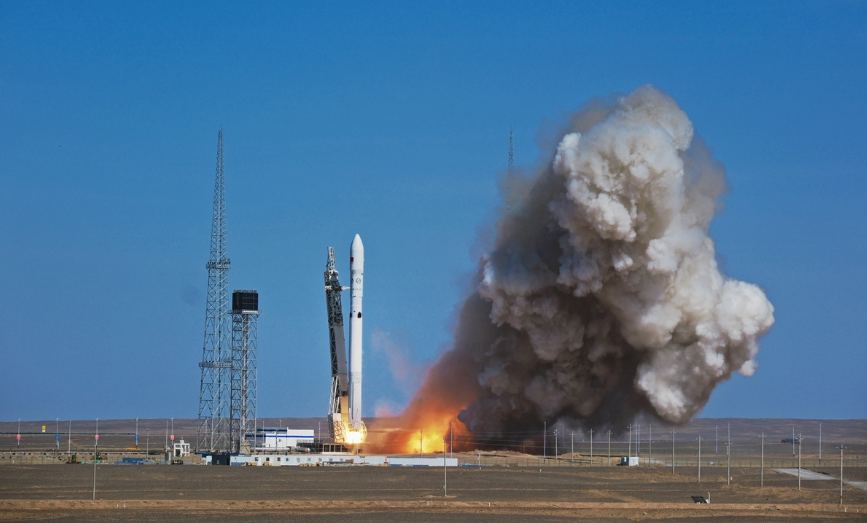
China successfully launched the Long March-12B Y1 carrier rocket on Monday from the Dongfeng commercial space innovation pilot zone in Northwest China, placing a group of networking satellites for the Qianfan (Spacesail) Constellation into their designated low-Earth orbits, according to Xinhua News Agency.

The Long March-12B Y1 is designed for future reusable missions and large-scale deployment of low-Earth orbit satellite constellations. Among its key innovations are onboard “dual brains,” which enable the rocket’s first and second stages to independently process flight data and make real-time operational decisions, CCTV News reported.
Developed by a commercial rocket manufacturer under the China Aerospace Science and Technology Corporation (CASC), the Long March-12B represents a new-generation reusable launch vehicle. Although the maiden mission did not include a recovery attempt, CASC confirmed that a first-stage recovery test is planned for a future flight.
The rocket was developed in just 21 months with two primary goals: supporting commercial launch services and advancing reusable rocket technology, according to chief designer Zhao Junqi.
“We can deliver payloads of around 20 tons to low-Earth orbit,” Zhao told CCTV News. While no booster recovery was attempted on the inaugural flight, the vehicle already carries landing-related hardware, and its re-entry aerodynamic design has been validated.
The two-stage rocket uses a single-core configuration with a diameter of 4.37 meters, a 5.2-meter-diameter payload fairing, and a total height of approximately 72 meters. The development team said the large-diameter structure improves payload capability while preserving strength and stability during flight, including under high-altitude wind conditions.
“For current commercial launch requirements, including missions comparable to deploying 36 satellites at once, there is no problem fitting them inside the fairing,” Zhao told CCTV News. “Larger fairings can also be developed in the future because the larger rocket diameter provides greater flexibility.”
In addition to its increased carrying capacity, the Long March-12B incorporates multiple engineering innovations aimed at lowering weight, boosting reliability, and increasing operational autonomy.
Electrical systems engineer Zheng Zetian said reducing launch costs was a major objective during development. Engineers introduced lightweight wiring, flexible cables, circuit boards, and connectors, cutting the weight of the rocket’s power-distribution system by an estimated 30 to 40 percent.
Different sections of the rocket also use specialized exterior coatings tailored to the thermal requirements of individual propellant tanks. Structural designer Liang Xiaobo explained: “The liquid oxygen tank operates at very low temperatures, so it uses thermal-insulation materials, while the kerosene tank is coated with heat-insulating materials,” Liang told CCTV News.
As one of the few Chinese rockets using a single-core design while reaching a length of 72 meters, the Long March-12B places significant demands on structural efficiency. Its 16-meter-long payload fairing employs fiberglass composite materials and honeycomb sandwich structures to reduce mass while maintaining strength.
Currently China’s most powerful single-core launch vehicle, the rocket is powered by nine liquid oxygen-kerosene engines, each producing around 100 tons of thrust.
Liang said the team also implemented an integrated aft-section architecture that combines the engine bay, transition structures, onboard equipment, and cabling into a single assembly, helping reduce weight and simplify production.
A standout feature of the rocket is its “dual brains” system—independent flight-control centers located on both the first and second stages. “Each stage has its own flight-control center capable of independently running real-time flight algorithms,” Zheng said. “The two stages can also communicate and exchange information with each other.”
According to CCTV News, these onboard computing systems can autonomously assess flight conditions and make operational decisions throughout the mission.
The Long March-12B Y1 also serves as a platform for testing several emerging technologies. Zheng said it is the first Chinese rocket equipped with a time-sensitive networking system, which could eventually enable real-time transmission of flight data and imagery to mobile devices. Data collected during this mission will support future upgrades of related civilian technologies.
The rocket also carried an automotive radar system to evaluate whether it can meet the requirements of future recovery operations.
“Our vision is that people will eventually be able to step away from directly controlling rockets,” Zheng said. “The rocket should be able to think, judge and fly by itself.”