
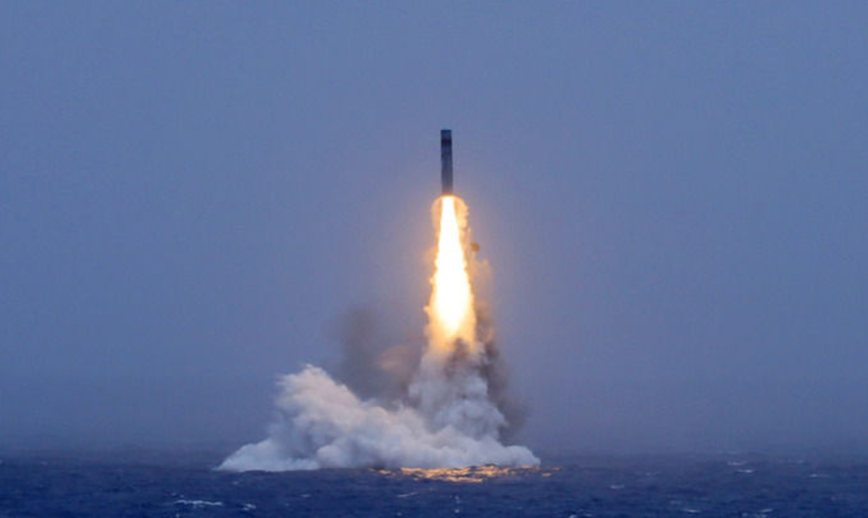
At 12:01 pm on July 6, a Chinese People’s Liberation Army (PLA) Navy submarine-launched strategic missile carrying a training dummy warhead burst from the sea, pierced through the ocean surface, and streaked across the blue sky, leaving a white vapor trail as it arced toward its designated target area in relevant high seas of the Pacific Ocean. From launch to impact confirmation, the entire process was made public through an official notification in less than an hour, catching wide attention.

Zhang Junshe, a Chinese military affairs expert, told the Global Times that based on the official statement, the submarine-launched strategic missile tested in this launch is believed to be a Julang (JL) submarine-launched strategic missile, with a range likely exceeding 8,000 kilometers, qualifying it as an intercontinental ballistic missile. The analysis has drawn sustained international media attention.
China’s nuclear sword is being forged over past several decades, from scratch to real deterrence, while consistently adhering to a nuclear strategy of self-defense and a nuclear policy of no first use of nuclear weapons.
A technological odyssey
The journey dated back to 1960s. On October 16, 1964, China successfully detonated its first atomic bomb, and three years later, on June 17, 1967, it carried out a successful test of its first hydrogen bomb.
The PLA Daily described nuclear weapons as the “pillars of the nation.” Yet a nuclear warhead is merely the “bullet.” To launch long-range strikes and build deterrence, it requires a “gun” – the missile – to deliver it.
The work began shortly after the founding of the People’s Republic of China.
In October 1956, the Chinese Defense Ministry’s Fifth Research Institute – the forerunner of today’s China Aerospace Science and Technology Corporation and China Aerospace Science and Industry Corporation – was founded with Chinese scientist Qian Xuesen as its director to lead missile development. Its largely inexperienced staff, drawn from other fields, had scant knowledge of missile design. To fast-track progress, Qian decided to study from the R-2 missile from the Soviet Union, according to the National Humanity History, a magazine affiliated with People’s Daily.
By October 1960, China had succeeded in replicating three R-2 missiles and successfully tested them the following month, a feat achieved in just two years, the magazine said.
Thereafter, China’s missile development entered an indigenous phase. In 1965, Qian laid out a “four types of missiles in eight years” plan, which included short-range, medium-range, intermediate-range and intercontinental ballistic missiles, the magazine said.
In 1966, a modified DF-2A missile carrying an atomic bomb warhead successfully conducted a nuclear explosion test, marking China’s acquisition of nuclear missile capability, according to a documentary by China Central Television.
In 1980, China’s first-generation intercontinental ballistic missile (ICBM), the DF-5, completed its full-range flight test, officially establishing the country’s intercontinental strike capability, said PLA Daily.
Concurrently, the seeds of sea-based nuclear power were quietly sprouting. In 1982, the submarine-launched JL-1 missile was successfully test-fired underwater, signaling that China had acquired a secondary nuclear strike capability.
The 1999 National Day parade featured the debut of the DF-31, China’s first solid-fuel long-range ballistic missile, ushering in the era of road-mobile strategic missiles. Then, the 2019 National Day parade showcased the DF-41 ICBM – with unparalleled range, accuracy and penetration capabilities, it has become the cornerstone of China’s strategic deterrence – alongside the JL-2 submarine-launched ballistic missile (SLBM), both displayed for the first time at that event.
On September 3, 2025, China held a grand military parade commemorating the 80th anniversary of the victory in the Chinese People’s War of Resistance Against Japanese Aggression and the World Anti-Fascist War. That day also marked a milestone as land-, sea- and air-based nuclear forces were publicly displayed together for the first time, officially presenting China’s nuclear triad. The JL-3 SLBM, believed by a number of experts and observers to be the system tested on July 6, debuted alongside the DF-5C liquid-fuel ICBM and the JingLei-1 air-launched long-range missile, making China one of the few countries with a nuclear triad.
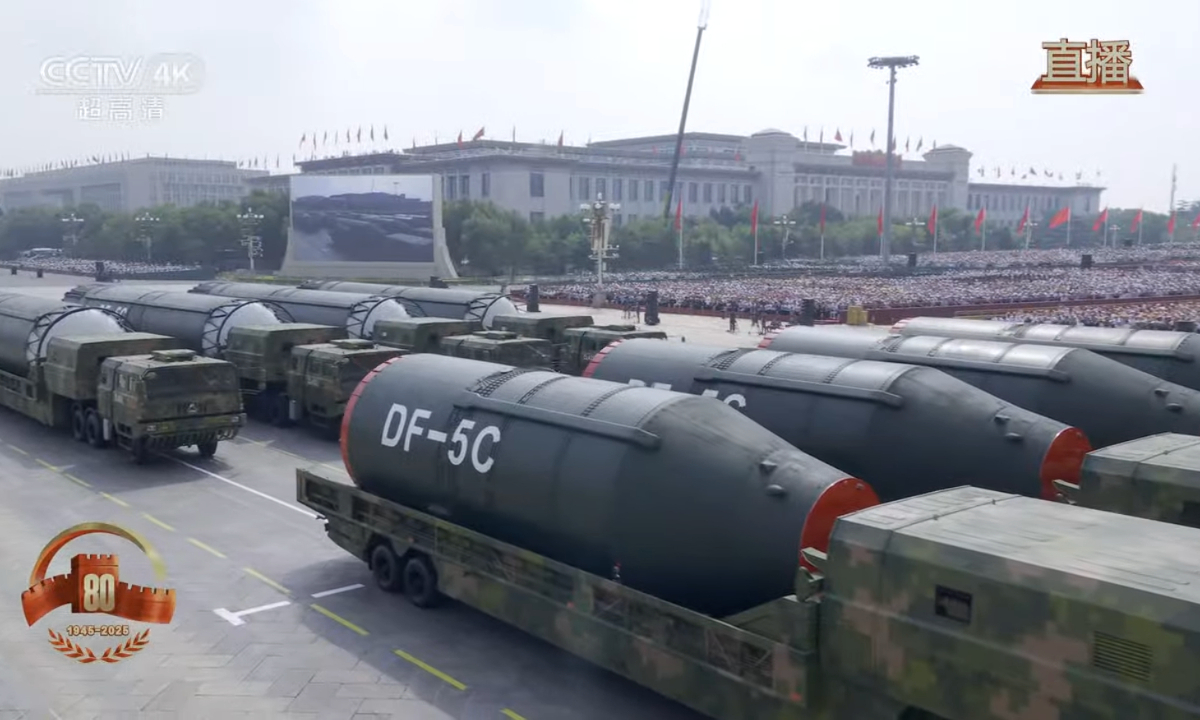
The DF-5C liquid-fueled intercontinental strategic nuclear missile makes debut at China’s V-day military parade on September 3, 2025. Photo: Screenshot from CCTV NewsZhang Junshe, the military affairs expert, viewed China’s nuclear missile technological ascent as a multi-stage leap: first, to have it; then from short-range to intercontinental, steadily extending range coverage; and, while maturing land-based capabilities, simultaneously advancing sea-based forces, ultimately forming a land-, sea- and air-based intercontinental strike system.
“China’s missile development has consistently followed principles of building both nuclear and conventional capabilities, and with both land- and sea-based systems in mind. Technological progress has mainly involved booster upgrades to extend range, structural improvements to reduce weight and increase number of MIRVs (multiple independently targetable reentry vehicle), as well as continuous accuracy enhancements,” Zhang said.
Also debuted at the 2025 V-Day military parade was the JingLei-1 air-launched long-range missile. The commissioning of the air-launched strategic missile provides China with an additional option for nuclear strikes, which can make China’s nuclear deterrence and counterattack capabilities even more reliable and credible, military affairs expert Shao Yongling emphasized to the Global Times.
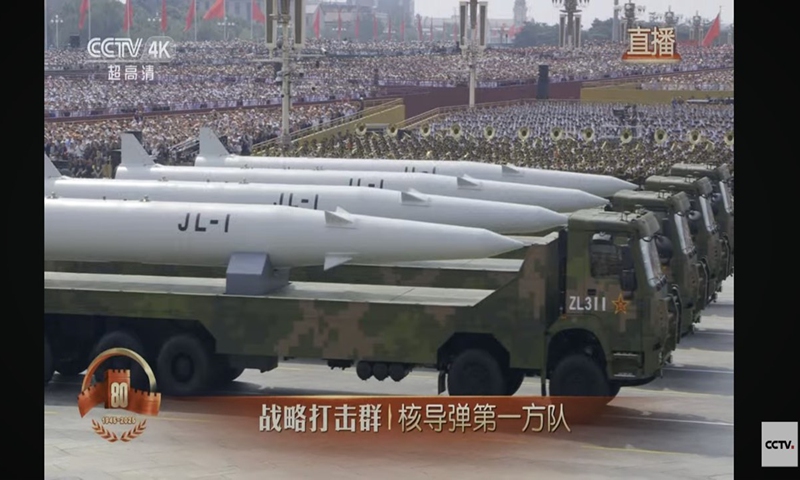
JL-1 air-launched long-range missile is reviewed at China’s V-Day military parade on September 3, 2025. Photo: Screenshot from CCTV News
‘Preventing wars through force’
“Preventing wars through force and helping stabilize the world” – this phrase, used as narration for the nuclear missile formation at the 2025 V-Day parade, encapsulates China’s longstanding approach.
Despite prior notification to relevant countries, some nations claimed objections to China’s latest launch. Japan reportedly “strongly urged” Beijing to reconsider, citing concerns over the missile’s trajectory, while a US State Department spokesperson claimed that at a time when the US is working harder than ever to prevent nuclear proliferation, China is doing the opposite.
In response, Defense Ministry spokesperson Chen Xi said on July 7 that China notified relevant countries in advance of the test launch of a nuclear submarine-based strategic missile, a move that demonstrates the openness and transparency of the Chinese armed forces.
According to a document named Implementation of the Treaty on the Non-Proliferation of Nuclear Weapons in the People’s Republic of China released by China’s Ministry of Foreign Affairs on April 21, China upholds a nuclear strategy of self-defense, with the aim of deterring other countries from using or threatening to use nuclear weapons against China and maintaining national strategic security.
Chen Xi also stated the China stance at a press conference on June 16, saying China follows a nuclear strategy of self-defense and a nuclear policy of no first use of nuclear weapons. “We always keep our nuclear capabilities at the minimum level required for national security, and never engage in any forms of nuclear arms race, playing a significant role in maintaining global strategic stability. China’s nuclear policy has always been stable, consistent and predictable,” Chen said.
Zhang stressed that the test verified the reliability and accuracy of China’s sea-based nuclear counterattack capabilities, demonstrating the PLA’s mature strategic capabilities and strengthening its nuclear deterrent. The launch sent a clear signal that China has the capability to defend its sovereignty and security, the confidence to maintain regional stability, and sufficient strategic reserves to address potential threats.
From scratch to maturity, the core logic of this sword-forging journey has never been about threatening anyone on the initiative, it is about ensuring that in a complex international landscape, China can defend its national interests on its own terms and at its own pace, Zhang said.