
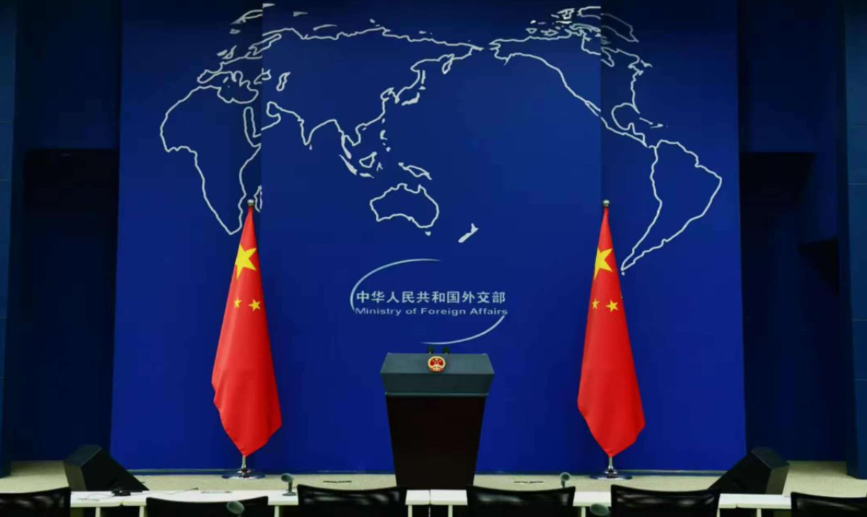
The Chinese Foreign Ministry on Friday slammed Philippine Defense Secretary Gilberto Teodoro Jr. for distorting facts and smearing China, and said his toxic rhetoric and action are pure political theatrics for selfish political gains, after the Philippine defense chief claimed that he would continue to do his “duty” following China’s sanctions against him.

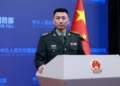
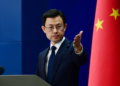
It is precisely the irresponsible and reckless provocations of a small handful of people like him that have aggravated China-Philippines disputes and soured bilateral relations, and will ultimately jeopardize the interests of the Philippines and its people, Chinese Foreign Ministry spokesperson Lin Jian said on Friday.
Teodoro repeatedly made irresponsible remarks on China, which undermines China’s legitimate interests and sabotages China-Philippines relations. To uphold China’s sovereignty, security and development interests, China has decided to prohibit Gilberto Teodoro Jr. and his spouse and child from entering the Chinese mainland, Hong Kong and Macao, and not allow organizations and individuals in China to engage in any transaction, cooperation or other activities with them, China’s Foreign Ministry announced on Thursday.
Chinese experts said that Teodoro has repeatedly misrepresented China’s rights-protection actions in the South China Sea and China’s assistance to the Philippines, causing serious damage to bilateral ties. The sanctions also serve as a warning to certain Philippine politicians who have been hostile toward China not to further sabotage China-Philippines relations.
Sanctions against saboteur
When asked about what are the “irresponsible remarks” made by Teodoro that led to the sanctions against him, Lin said at the press conference on Friday that “Teodoro is one of the most blatant among the handful of hostile actors towards China in the Philippines. His reckless behavior will backfire and it is the interests of the Philippines and all its people that will bear the brunt.”
When asked whether China’s announcement of sanctions against Teodoro will affect China’s future assistance to the Philippines, Lin said that “if people like Teodoro are allowed to undermine again and again the efforts of the two sides to stabilize ties, they will hurt ultimately the fundamental interests of the Philippines and its people.”
Following China’s sanctions against Teodoro, the Philippines’ Department of Foreign Affairs (DFA) claimed on Friday that “while the imposition of sanctions is China’s sovereign prerogative, the Philippines views it as an unfriendly act that further complicates bilateral relations,” according to Philippine media outlet GMA Network.
In a statement early Friday, Teodoro claimed he had been sanctioned for “speaking truth” and said “I will just keep doing my duty,” according to Philippine media outlet ABS-CBN News.
The claim from the Philippine side that China’s sanctions are an “unfriendly act” completely distorts the truth and shifts the blame, Chen Xiangmiao, a research fellow at the National Institute for South China Sea Studies, told the Global Times on Friday.
Teodoro’s tenure under the Marcos administration has been marked by repeated attempts to distort the reality of China’s maritime rights-protection enforcement in the South China Sea, economic aid, and diplomatic engagement, with the purpose of misleading the public and the global community, Chen said, noting that whether backed by domestic factions or external, extra-regional powers, Teodoro has acted as a deliberate saboteur of China-Philippines relations.
Teodoro alleged at the Shangri-La Dialogue that China had provided fertilizer and fuel to the Philippines but did not show good faith on a long-term basis, and “no matter how they sugarcoat their assistance to us, it doesn’t cut the mustard.” He also claimed the Philippines was under severe threat both territory-wise and politically by China.
In response to Teodoro’s remarks, China Foreign Ministry spokesperson Mao Ning said on June 2 that this Philippine defense secretary is known for vilifying China. His latest rhetoric shows his complete disregard of the welfare of the Philippine people and lack of appreciation for kindness. All he cares about is selfish personal gains to the point that he would perform political theatrics even when people’s well-being is at stake.
China’s sanctions against Teodoro send a clear message that those who repeatedly make anti-China remarks, distort facts and smear China’s image must bear the consequences, especially when such words and deeds deliberately defy objective facts, Ge Hongliang, deputy director of the College of ASEAN Studies at Guangxi University for Nationalities, told the Global Times.
China has rarely imposed targeted sanctions of this kind on politicians from Southeast Asian countries, and the move reflects Beijing’s firm and unequivocal stance to safeguard its legitimate interests, the expert said, noting that it also serves as a warning to certain politicians in the Philippines whose negative actions are undermining bilateral ties.
Meddling in maritime issues
China’s sanctions against Teodoro come amid a series of provocative moves and maritime related rhetoric from the Philippines that have drawn protests from Beijing, including Manila’s promotion of so-called Japan-Philippines maritime delimitation talks covering waters east of China’s Taiwan island.
An Associated Press report on Friday also noted that Teodoro, who was appointed defense chief by Philippine President Ferdinand Marcos Jr. in June 2023, “has been one of the most vocal critics” of China’s actions in the South China Sea and against Taiwan island.
Teodoro has led efforts to deepen Manila’s defense and security engagements with the US, including by broadening annual combat exercises with American forces that now include joint naval patrols and drills in the South China Sea. He has also led efforts to forge visiting forces’ agreements with countries including Japan, France, Canada and New Zealand, per AP.
South China Sea tensions between China and the Philippines have risen to a high level, driven in part by the growing involvement of external forces such as the US and Japan. These two countries are using the Philippines as a strategic pawn against China, while Manila is relying on outside powers to take a tougher stance, a trend that has sharply increased regional security risks and will ultimately harm the Philippines’ own interests, said Ge.
Chen also noted that China’s measured, proportionate countermeasures also serve as a warning to certain Philippine politicians not to trifle with China, exploit the goodwill of the Chinese people, or treat bilateral relations as a political game. When politicians treat state policy as a playground for personal agendas, their lies will ultimately inflict severe damage upon their own nation.