
China’s latest economic figures for the January–April period indicate steady overall growth, with particularly strong performance in high-tech and advanced manufacturing sectors, according to data released by the National Bureau of Statistics (NBS).

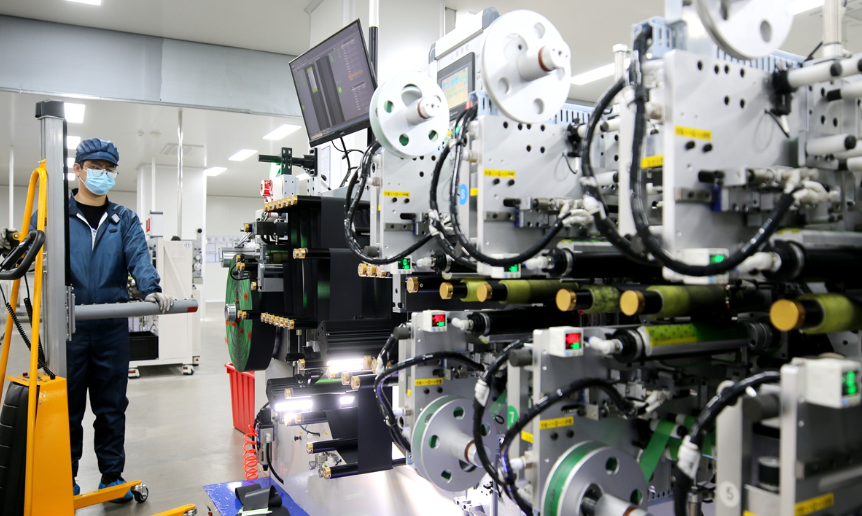
A worker conducts production and testing of lithium battery products at a facility in Ji’an, Jiangxi Province, highlighting ongoing momentum in manufacturing as production lines continue operating at high capacity.
The NBS reported that industrial output above designated size grew by 5.6 percent year-on-year in real terms during the first four months. Officials explained that this reflects figures adjusted for price changes. Within this, equipment manufacturing and high-tech manufacturing stood out, rising 8.7 percent and 12.6 percent respectively, both exceeding overall industrial growth.
Several emerging sectors recorded rapid expansion. Output of 3D printing equipment increased by 50.9 percent, lithium-ion batteries rose 36.0 percent, and industrial robots climbed 25.7 percent, signaling continued strength in advanced manufacturing and new growth drivers.
In April alone, industrial output grew by 4.1 percent year-on-year, with 29 out of 41 major sectors showing expansion. Key contributors included special-purpose equipment manufacturing, automobile production, and computer, communication, and electronics industries.
“The growth in industrial output above designated size is within expectations and points to steady industrial expansion. For enterprises, this is a solid reading, reflecting the resilience of China’s industrial system and continued momentum of manufacturing upgrading,” Li Changan, an economist at the University of International Business and Economics, told the Global Times.
On prices, the consumer price index (CPI) rose 0.9 percent year-on-year in the first four months, while April alone saw a 1.2 percent increase. Service-related prices recorded a sharper rise of 13.3 percent in certain categories.
Li noted that retail activity is gradually recovering but still has room for improvement, adding that stronger consumption would help balance broader economic growth.
Investment trends showed mixed performance. Overall fixed-asset investment excluding rural households fell 1.6 percent year-on-year, but high-tech sectors continued to expand. Investment in intellectual property products grew 8.9 percent, while high-tech industries rose 6.1 percent, led by strong gains in aerospace, computer equipment, and information services.
The growing role of emerging industries suggests ongoing economic restructuring toward higher-quality development and improved resilience amid global uncertainty, analysts said.
Consumer demand showed moderate improvement. Total retail sales rose 1.9 percent in the first four months, with rural areas slightly outperforming urban regions. Service consumption remained a key bright spot, growing 5.6 percent year-on-year.
In services, modern sectors such as information technology and cultural services continued to expand steadily, while transport and tourism-related services also saw solid gains.
Foreign trade maintained relatively strong momentum, with total goods imports and exports reaching 16.2252 trillion yuan, up 14.9 percent year-on-year. Exports increased by 11.3 percent, while imports rose 20.0 percent.
Trade with Belt and Road partner countries and private enterprises both showed double-digit growth, and exports of mechanical and electrical goods rose significantly.
Fu Linghui of the NBS said the economy remained stable overall with improving trends in the first four months, though challenges remain in external conditions and domestic demand imbalance.
“The national economy maintained a generally stable and improving trend in the first four months, with high-quality development making solid progress.”
He also warned that external volatility and uneven domestic demand persist, along with operational pressures for some businesses, meaning the foundation for sustained growth still needs strengthening.
Looking ahead, China plans to implement more proactive fiscal measures and a moderately accommodative monetary policy, while boosting domestic demand, improving supply structures, and strengthening both internal and external economic circulation to support stable long-term growth.