

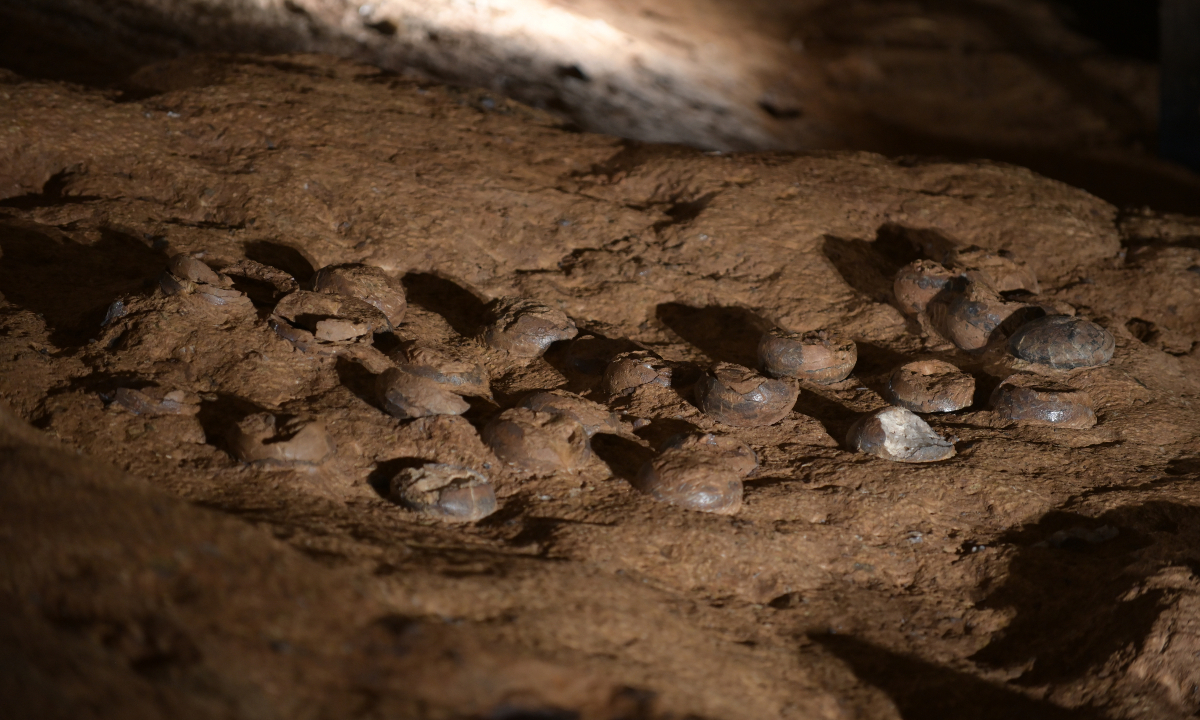
After five years of research and on-site construction, Chinese scientists have recently completed an anti-weathering protection project for the Qinglong Mountain dinosaur egg fossil group in Shiyan, Central China’s Hubei Province, covering the site with a “nano-scale protective coating,” the Global Times learned on Thursday.

Researchers have confirmed that the 6,260-square-meter site contains some 3,000 dinosaur egg fossils dating back 86 million years, which are believed to be highly valuable for scientific studies.
According to Zhao Bi, a senior engineer at the Hubei Institute of Geosciences and chief expert of paleontological fossils at Hubei Geological Bureau, these fossils are highly valuable but also very fragile.
Since dinosaur eggshells are mainly composed of calcium carbonate, they are prone to chemical reactions with carbon dioxide and moisture in the air. In addition, as the fossils are mostly embedded in coarse sandstone, they have long been exposed to humidity, temperature fluctuations, and acidic or alkaline conditions – factors that may accelerate weathering, Xinhua News Agency reported.“With no global precedents, we had no prior cases to assess the effectiveness of protecting such a large-scale group of dinosaur egg fossils from weathering while developing and applying the ‘nano-scale protective coating,’” Zhao told the Global Times on Thursday.
With few experts worldwide engaged in this area, researchers had limited prior research data available for reference, according to Zhao. Confronted with risks, the researchers spent years on environmental monitoring, mineral and rock analyses and pilot trials. They finally launched the full-scale application in the first half of this year – just before Hubei’s rainy season, when groundwater becomes a major threat to the fossils, Zhao said.
BiDinosaur egg fossils are a non-renewable natural heritage, once damaged, they are lost forever. To fight weathering, a research team led by Sichuan University of Science & Engineering professor Deng Jianguo developed a nano-silica composite emulsion tailored to the site’s geological conditions and local climate. After application, the coating significantly enhanced the fossils’ resistance to UV aging and chemical erosion, Xinhua reported.
According to Deng, the emulsion penetrates the fossils and surrounding rocks, forming a protective thin film on their surface that isolates them from air and strengthens the entire structure, Xinhua reported. Specialists spray a nano-silica composite emulsion on dinosaur egg fossils. After experimental validation and effectiveness evaluation, full-scale protection of the fossil site began this March. Automated spraying equipment was used to apply the nano-silica emulsion, consolidating and sealing the whole site, according to Xinhua.
According to Zhao, the nanocoating has strengthened weathering resistance at the site, offering long-term and stable protection for this natural heritage and providing a potential model for conserving other paleontological fossil sites, Xinhua reported.
Zhao added that this technology is expected to be a key solution for future conservation of non-renewable relic sites. The protective coating developed by professor Deng’s research team has also demonstrated outstanding efficacy in prior applications, including the conservation of ivory at the Sanxingdui Ruins site and the protection of dinosaur fossil collection at the Zigong Dinosaur Museum in Southwest China’s Sichuan Province, according to Zhao.