
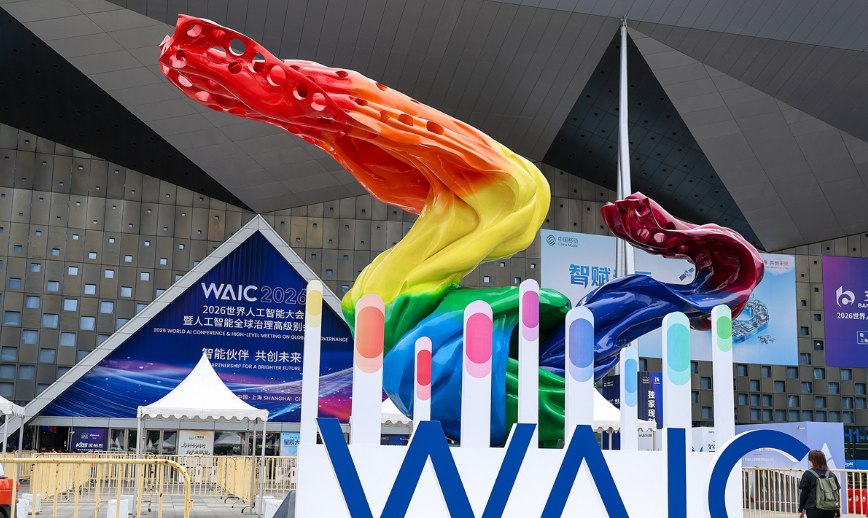
China highlighted its vision of making artificial intelligence more practical and widely accessible during the 2026 World Artificial Intelligence Conference (WAIC) and the High-Level Meeting on Global AI Governance in Shanghai. The event brought together global technology companies, policymakers, and representatives from developing countries to explore AI innovation, governance, and international collaboration.

Throughout the exhibition, visitors viewed the latest AI models, robotics, and intelligent technologies, while government officials and delegates from Global South nations discussed AI governance, industrial partnerships, and shared technical standards. According to participants, the conference reflected AI’s transition from experimental technology to real-world applications with global significance.
A senior United Nations official and an AI industry representative from Uzbekistan told the Global Times that China’s expanding ecosystem of open-source models and customizable public-service technologies is providing developing nations with AI solutions that are more “accessible, affordable and applicable.”
AI Expands into Public Services
Several projects introduced during the conference demonstrated how AI is increasingly supporting public safety and disaster management.
At a forum on Sunday, the China Earthquake Administration launched a suite of AI-powered tools, including an earthquake-science AI agent, a seismology large language model, an intelligent earthquake-processing system, and benchmark datasets covering earthquake monitoring, forecasting, early warning, and disaster prevention. According to CCTV News, China aims to establish comprehensive AI support for earthquake prevention and disaster reduction by 2028.
Another major attraction was MAZU, China’s AI-based meteorological early-warning platform. Standing for Multi-hazard, Alert, Zero-gap and Universal, the name also references Mazu, the traditional Chinese protector associated with the sea and weather. The system combines Fengyun meteorological satellites, AI forecasting models, and monitoring technologies to deliver an integrated chain of observation, prediction, warning, and public services.
According to Science and Technology Daily, the broader initiative behind MAZU represents the world’s first national-level action plan responding to the United Nations’ Early Warnings for All initiative. The platform is designed as a shared and customizable public good that developing countries can adapt to their own needs.
During WAIC, the China Meteorological Administration officially delivered MAZU Djibouti 2.0 to Djibouti. The upgraded system includes an intelligent monitoring terminal featuring an integrated meteorological chip and forecasting model. Combined with the earlier MAZU Djibouti 1.0 platform donated in 2025, it creates a complete monitoring, forecasting, and warning network, according to Xinhua News Agency.
The upgraded system improves weather forecast resolution from nine kilometers to three kilometers, extends forecasting capability to three days in advance, and refreshes forecasts every six hours. It is expected to become operational in Djibouti before the end of the year.
China also plans to adapt the MAZU platform for ports, airports, cities, renewable-energy facilities, tourist destinations, and other weather-sensitive sectors. Through a flexible technology platform offering customized services, similar systems could be introduced to additional developing countries.
Expanding AI Cooperation
Chinese officials and international representatives emphasized that AI applications, together with China’s open-source foundation models, are becoming practical public goods tailored for developing economies.
Zou Ciyong, Deputy to the Director General and Managing Director of the Directorate of Technical Cooperation and Sustainable Industrial Development at the United Nations Industrial Development Organization (UNIDO), told the Global Times that many developing countries continue to face significant gaps in AI capabilities while expressing a strong desire to benefit from the technology’s economic and social opportunities.
Ahead of the conference, delegates from 29 countries signed an agreement establishing the World Artificial Intelligence Cooperation Organization (WAICO), an independent intergovernmental organization headquartered in Shanghai. The organization seeks to strengthen international AI cooperation and governance while promoting AI that is beneficial, safe, and equitable.
Zou said WAICO provides developing countries with an opportunity to participate in AI cooperation and capacity building rather than being left behind by technological change.
He added that both the United Nations and China support multilateral cooperation and noted that WAIC and WAICO create broader opportunities for countries to contribute to global AI discussions. He also said UNIDO has discussed the possibility of using WAIC as a platform for more institutionalized international exchanges in the future.
Open-Source AI Gains Attention
For many developing economies, China’s AI ecosystem is attractive because of its accessibility, affordability, and adaptability.
“China’s open-source AI models create a great opportunity for Central Asia and other developing regions,” Azamat Karamatov, CEO of IT Park Uzbekistan, told the Global Times during WAIC.
“Open-source AI makes advanced technology more accessible. It helps startups, universities, developers, and businesses to build new products faster and solve local challenges,” Karamatov said.
This perception has grown alongside the expansion of Chinese open-source models such as DeepSeek, GLM, and Qwen.
During the conference, Chinese AI startup Moonshot AI introduced Kimi K3, an open-weight model featuring 2.8 trillion parameters, native multimodal capabilities, and a one-million-token context window. The company said the model was designed for long-horizon coding, knowledge-intensive tasks, and deep reasoning.
Independent evaluations by Artificial Analysis and Arena.ai placed Kimi K3 alongside leading American AI systems, including OpenAI’s GPT and Anthropic’s Claude. According to the BBC, the model ranked first in web interface engineering and surpassed Anthropic’s Fable system in blind human-preference evaluations.
The model’s pricing also attracted attention. Moonshot charges $15 per million output tokens compared with $50 for Claude Fable 5, according to Fortune.
“I believe China’s open AI ecosystem is changing the global innovation landscape. By making advanced foundation models openly available, Chinese companies are enabling startups, researchers, and businesses around the world to innovate faster,” Karamatov said.
His observations reflect broader AI cooperation between China and Central Asia. A 2025 report by the China-Global South Project stated that Beijing is positioning itself as a development partner by providing AI training, digital infrastructure, and technological access, with Central Asia serving as an important testing ground.
One example is Shanghai-based AI company LinkWise, which has partnered with Uzbekistan’s Ministry of Digital Technologies to develop a Modular Intelligent Computing Center aimed at supporting digital governance, smart cities, and industrial modernization.
Debate Over AI Governance
China’s growing emphasis on open-weight AI models has also sparked criticism in parts of the United States.
Dean Ball, head of strategic futures at OpenAI, argued on X that a future where AI is viewed as a “public good” instead of a commercial product could become a “dystopian hellscape.” He also suggested that the Trump administration might introduce regulatory uncertainty surrounding Chinese open-weight models to discourage their adoption by regulated American companies.
Zou acknowledged that AI has the potential to accelerate industrial modernization, improve efficiency, and conserve resources. However, he argued that expanding national-security restrictions and broader anti-globalization trends are creating obstacles for AI innovation and international collaboration.
He noted that AI systems rely on information drawn from the global internet and therefore cannot ultimately be limited by national borders. As a result, both the opportunities and the challenges—including governance and safety—require international cooperation.
According to Zou, organizations such as WAICO can play an important role in addressing these issues, which is why the United Nations supports efforts to build more inclusive global AI cooperation.
As new AI models and robotic technologies continued to attract visitors across the exhibition floor, discussions throughout the conference focused on a broader question: whether the next generation of AI will remain concentrated among a small number of countries and companies, or evolve into technology that more nations can afford, adapt, and use.