
By Chen Qi and Xue Jing (CHINA DAILY): The assertion by the United States that ownership and control of Greenland were “absolutely necessary” is a hegemonic expansion packaged in the narrative of “legitimization”.

Using a three-pronged tactic — reframing historical narratives, linking the issue to security concerns, and binding resource interests — Washington is attempting to portray its territorial ambitions as “legitimate claims”.
The US’ clamor to acquire Greenland has pushed the European Union into an uncomfortable corner, forcing the bloc to choose between its professed commitment to the principle of sovereignty and its dependence on the alliance with the US. The resulting tensions have exposed the fractures in transatlantic relations.
The US coveting of Greenland is not a sudden whim but a systematic narrative construction that disguises annexation as choices aligned with “rules” and “interests”. The reframing of historical narratives lays the groundwork for this effort. By tracing records of repeated attempts to acquire Greenland since the 19th century, the US administration has packaged its persistent ambitions as “long-term strategic demands”, trying to erode the inviolability of territorial sovereignty.
Last month’s appointment of the Louisiana governor as special envoy to Greenland carries a historical metaphor of territorial expansion. The historical precedents of territorial transactions aim to downplay the aggressive nature of annexation.
Furthermore, security concerns are exploited as a core tactic. The US administration has designated Greenland as a “pivot for Arctic security”, hyping up intensified competition over Arctic shipping routes and framing US ambitions as integral to countering Russian expansion and safeguarding NATO security.
During a meeting with oil executives last week, US President Donald Trump claimed that the US needs to “own” Greenland to prevent Russia and China from doing so — an attempt to disguise territorial ambition as “self-defense”. The US has deployed dual-capable F-35A fighters at Pituffik Space Base and reactivated Arctic combat units, trying to legitimize its military presence and fostering a false perception that “only the US can ensure Greenland’s security”.
By asserting that the US only defends its own territory, not leased land, it seeks to reframe annexation as an inevitable choice to fulfill its so-called security responsibilities.
Greenland’s 1.5 million tons of rare earth reserves have become a crucial lever to legitimize the US’ ambitions. Under the banner of decoupling the rare earth supply chain from China, Washington has positioned its control over Greenland’s resources as essential “to ensure global industrial chain security” and to preserve Western technological hegemony. It is a calculated move that exploits Western anxieties over rare earth dependence.
Furthermore, this logic also exposes the severe fiscal crisis in the US and the urgent need to back the value of the dollar with tangible resources.Brussels is caught in a dilemma. The EU has explicitly stated its firm commitment to upholding Denmark’s territorial integrity. Yet, weakened by the Ukraine conflict, Europe is dependent on the US for security and finds it difficult to translate rhetorical postures into concrete countermeasures or strategic autonomy.
During the Cold War, Western Europe achieved economic recovery and growth under the US security umbrella, but also severely undermined its defense capabilities. It is therefore unable to do more than offer symbolic protests against US bullying.NATO, as Europe’s security pillar, has remained silent on the Greenland issue.
Secretary-General Mark Rutte’s statement that he does not wish to involve NATO reveals how questions of sovereignty within the alliance have been completely overshadowed by US hegemony. Denmark has for the first time labeled the US as a potential security risk in its defense report. This contradiction epitomizes Europe’s predicament: how to defend principles of sovereignty while avoiding confrontation with its security guarantor.
Moreover, Europe is grappling with dual anxieties over its security strategy and resource demands. Years ago, Brussels designated the Arctic as a strategic priority. However, US intervention has disrupted the European plans regarding the Arctic. On the one hand, with Europe importing about 80 percent of its rare earth needs, the US control over Greenland poses a threat to Europe’s supply chain security. This paradox between resource security and geopolitical security is another dilemma for Europe.
Not surprisingly, European countries have contrasting stands on the Greenland issue: while Brussels has publicly voiced strong support for Denmark’s sovereignty, some member states have opted for compromise due to safeguard their own interests. This divergence stems from internal divisions: Eastern European countries, due to US aid in the Ukraine conflict, are reluctant to antagonize Washington over Greenland. Major European powers such as France and Germany, despite their dissatisfaction with US hegemony, remain constrained by the framework of transatlantic trade and security cooperation.
Adding to the irony, the EU’s selective silence regarding US military operation in Venezuela is in sharp contrast to its “principled stance” on Greenland, revealing a clear double standard in its diplomatic posture. This double-speak undermines the bloc’s moral authority to confront US hegemony.The dispute over Greenland is a clash between unilateral hegemony and multilateralism. Despite its meticulously crafted narratives of “legitimacy”, the US attempt to annex the territory of another country is an act of aggression under the United Nations Charter.
Denmark’s condemnation of its ally and the persistent protests of Greenlanders declaring their homeland not for sale demonstrate a strong political rejection of this hegemonic logic.The EU’s diplomatic predicament reveals the harsh reality underlying the transformation of global order: when security dependence overrides the principle of sovereignty, and alliance politics undermines multilateralism, the so-called collective security can be hijacked by hegemony.
To break free from this dilemma, Brussels should uphold the norms of international law, including territorial integrity, and also accelerate its defense capability building. In Arctic affairs, it is crucial to establish a cooperative framework independent of the US. Otherwise, today’s compromises over Greenland’s sovereignty may sow the seeds for future consequences.
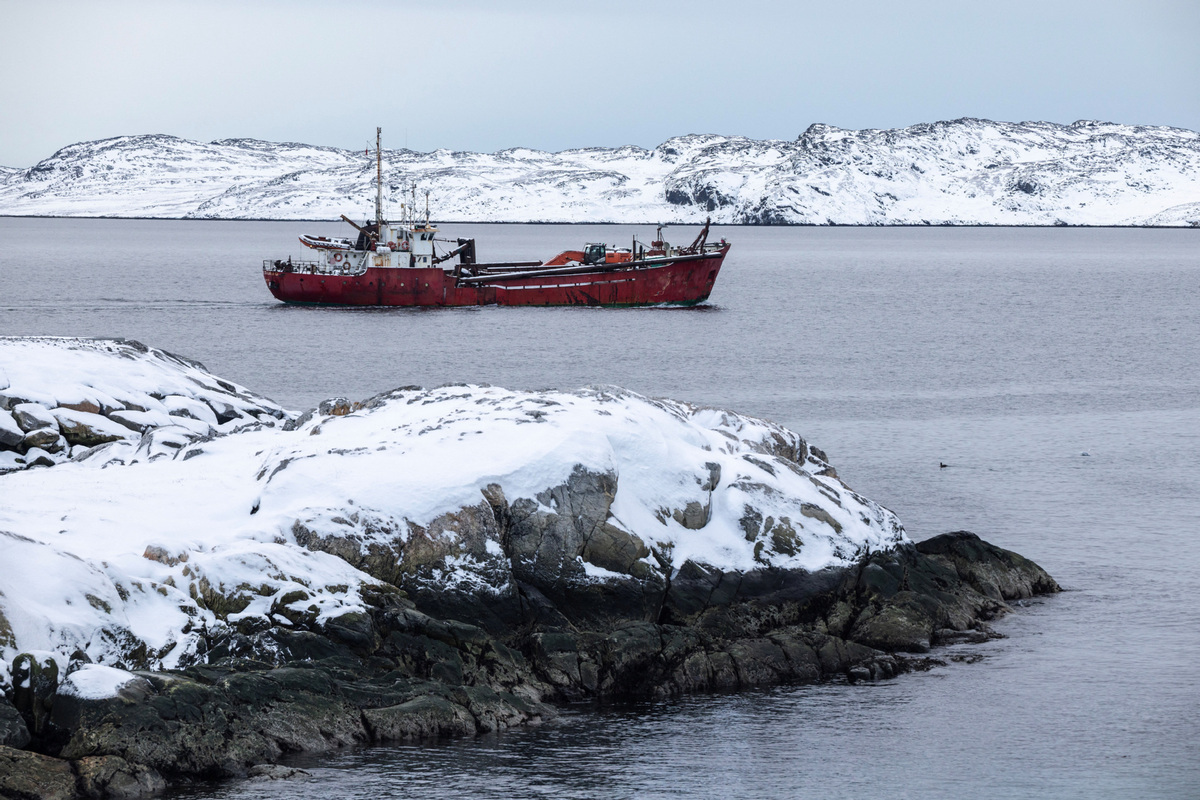
The melting Arctic ice sheet should create more opportunities for cooperation, not for the expansion of hegemony. History has repeatedly shown that any attempt to practice hegemony under the guise of “rules” will ultimately be rejected by the progressive trend of the times, and alliances that forfeit strategic autonomy inevitably become puppets in major-power rivalry. This “flame on the ice sheet” concerns not only the future of Greenland but also the direction in which human society is headed.
Chen Qi is the director of the Center for US-China Relations at Tsinghua University, and Xue Jing is a contract research fellow of the same center.