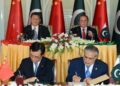

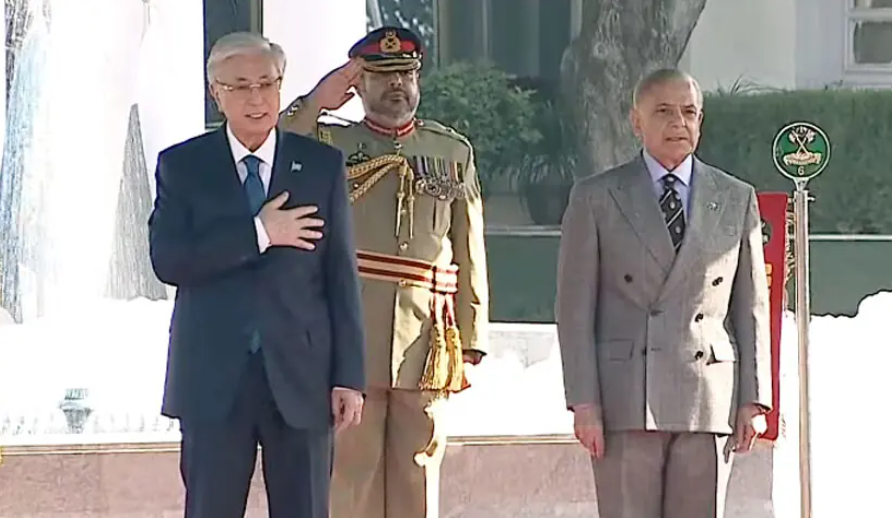
ISLAMABAD: Prime Minister Shehbaz Sharif on Wednesday accorded a warm welcome to President of Kazakhstan Kassym-Jomart Tokayev at his official residence, marking the start of the Kazakh leader’s two-day official visit to Pakistan.

Upon arrival, President Tokayev was presented with a guard of honour by a well-disciplined contingent of the armed forces. The two leaders are scheduled to hold bilateral as well as delegation-level talks, with several agreements and Memorandums of Understanding (MoUs) expected to be signed across multiple sectors.
President Tokayev arrived in Pakistan on Tuesday as both countries seek to further deepen their diplomatic and economic relations. Pakistan and Kazakhstan share cordial ties, with Kazakhstan currently ranking as Pakistan’s leading export destination among Central Asian states. The Kazakh president is accompanied by a high-level delegation comprising senior cabinet members and top officials, while visuals released by his office showed Islamabad streets decorated with Kazakhstan’s national flags.
Earlier, Deputy Prime Minister and Foreign Minister Ishaq Dar met President Tokayev and welcomed him to Pakistan, according to a statement issued by the Foreign Office (FO). During the meeting, Dar “underscored Pakistan’s appreciation for the growing momentum of high-level political exchanges.”
The foreign minister also “reaffirmed the shared commitment to expand bilateral cooperation across political, economic, & people-to-people domains, and to work together for durable peace, stability, and development in the region,” the FO said.
Meanwhile, Federal Minister for Commerce Jam Kamal Khan held detailed discussions with Kazakhstan’s Minister of Trade and Integration Arman Shaqqaliev at the Ministry of Commerce in Islamabad. The talks focused on enhancing trade, connectivity and investment cooperation between the two countries.
According to a press release, both sides agreed that improved rail, road and multimodal connectivity would be key to strengthening Pakistan–Kazakhstan trade and ensuring sustainable long-term economic cooperation. The Kazakh minister emphasised the importance of developing major infrastructure projects, particularly railway and road corridors, and highlighted Kazakhstan’s ambition to serve as a regional hub linking Central Asia with South Asia, China, Europe and the Global South, including access to Pakistan’s ports.
Jam Kamal Khan noted that enhanced transit routes would not only benefit Pakistan and Kazakhstan but also unlock wider regional and global trade opportunities. Discussions also covered cooperation in priority sectors such as agriculture and food security, pharmaceuticals, textiles, sports goods, leather, mining and minerals, energy and infrastructure development.
The two ministers also reviewed the need for structured business-to-business engagement and agreed to work on a framework document identifying priority sectors, trade targets and a roadmap that includes trade missions, exhibitions and delegation exchanges.
“Both ministers reaffirmed their shared commitment to transforming Pakistan–Kazakhstan economic relations from potential to performance,” the statement said, expressing confidence that sustained coordination and private-sector involvement would significantly boost bilateral trade and investment.
Separately, the President’s Secretariat said President Asif Ali Zardari will confer the Nishan-i-Pakistan, the country’s highest civilian award, on the presidents of Kazakhstan and Uzbekistan, with the latter expected to visit Pakistan later this month.
According to the FO, President Tokayev is also scheduled to meet President Zardari and Prime Minister Shehbaz Sharif, and address the Pakistan-Kazakhstan Business Forum. The FO described the visit as “an important and timely opportunity” for both sides to comprehensively review bilateral relations and explore new areas of cooperation, particularly in trade, logistics, regional connectivity and people-to-people exchanges, as well as collaboration at regional and international platforms.
The visit is being viewed as mutually beneficial, helping Pakistan position itself as a key land bridge between Central and South Asia, while offering Kazakhstan avenues to diversify its trade amid ongoing geopolitical challenges in Eurasia following the Russia-Ukraine conflict.