
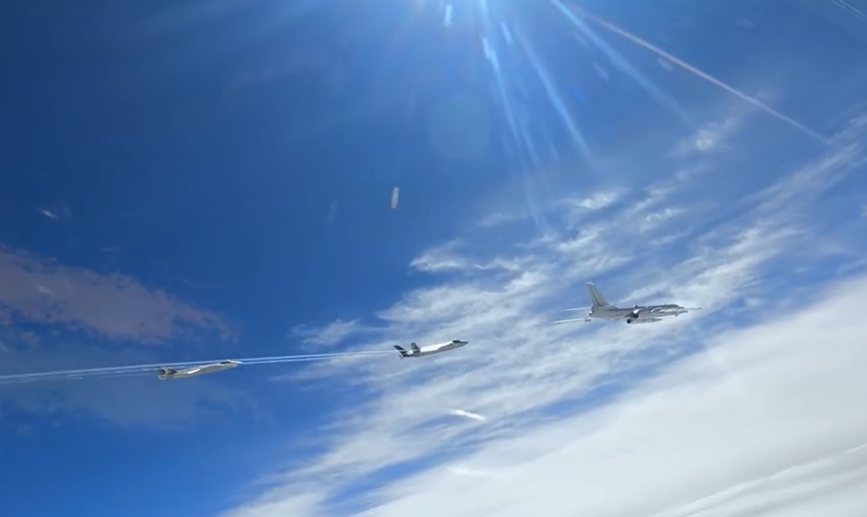
In the latest episode of a PLA documentary focusing on joint operations, striking footage shows two J-20 stealth fighters escorting an H-6N bomber carrying a large missile under its fuselage, rather than the smaller missiles typically seen under the wings. A military affairs expert says the missile could be a powerful air-launched ballistic missile capable of conducting anti-ship or ground-strike missions.

The footage, from the Zhisheng (Victory) documentary’s final episode that aired Tuesday, emphasizes that future confrontations with powerful adversaries are not merely about equipment, but about the confrontation of systems supported by joint operations personnel, according to CCTV News.
The PLA’s multi-service forces can conduct joint strikes against large enemy vessel formations, said the report. The deeper joint operations are, the stronger the capability to achieve victory. PLA naval vessels are no longer just ships; they are intelligence terminals, communication relays and firepower nodes within the joint operations system. Combat aircraft in the air serve as the fastest “eyes” and “fists” to reach the mission area, with every warship serving as a support node for the aircraft.
While CCTV did not specify the composition of the enemy formation, chinanews.com noted that the exercise was aimed at training to strike aircraft carriers.
According to the documentary, the exercise scenario involved the detection of a large surface vessel formation maneuvering at high speed southeast of China. Fighter jets launched from the formation were advancing toward China, potentially preparing to strike key targets. Four PLA UAVs were already airborne and were expected to arrive over the mission area within 10 minutes, with follow-on UAVs immediately launched.
Meanwhile, targeting information was pushed to joint strike platforms, allowing for continuous tracking and the maintenance of situational updates.
Notably, in the segment on joint firepower strikes against enemy formations, the documentary also shows a Type 052D destroyer launching the YJ-20 hypersonic missile and two DF-21D anti-ship ballistic missiles being raised. The H-6N, escorted by J-20s, was seen carrying a large missile under its fuselage.
Wang Yanan, editor-in-chief of Beijing-based Aerospace Knowledge magazine, said that the missile is likely a powerful air-launched ballistic missile capable of anti-ship or ground-strike missions.
The Hong Kong-based Ta Kung Wen Wei Media Group identified it as the JL-1 air-launched long-range missile.
From its appearance, the missile does bear some resemblance to the JL-1 that debuted at the 2025 V-Day parade. However, given that the documentary only provided long-range shots, it is difficult to confirm whether the missile is indeed the JL-1 or another new model.
At the 2025 V-Day parade, China displayed its strategic nuclear forces for the first time, including the JL-1 air-launched long-range missile, the JL-3 submarine-launched intercontinental missile, and the DF-61 and DF-31BJ land-based intercontinental missiles, marking the first simultaneous public appearance of China’s land, sea and air strategic nuclear forces.
Wang said that while it is difficult to determine the exact model from the footage, the weapon is clearly of high strategic value.
Compared with traditional land-based ballistic missiles, Wang said, air-launched weapons offer stronger penetration capabilities and greater concealment. More critically, the enemy cannot predict the H-6N’s launch position, making it extremely difficult to defend against.
The J-20 escort of the H-6N also reveals important information. The H-6N itself lacks stealth capabilities and faces the risk of being intercepted by enemy long-range firepower. The J-20, as a stealth platform, can provide an invisible protective umbrella for the H-6N at medium- to long-range, intercepting incoming missiles and neutralizing long-range enemy threats, Wang said.
Moreover, the H-6N’s protection in real operations would likely come not only from the J-20s shown in the footage, but also from wide-area maritime shipborne platforms, land-based launch positions and other air platforms. This also suggests that the weapon carries extremely high operational value, with the potential target likely being the core combat equipment or command nodes of enemy maritime formations, the expert added.