
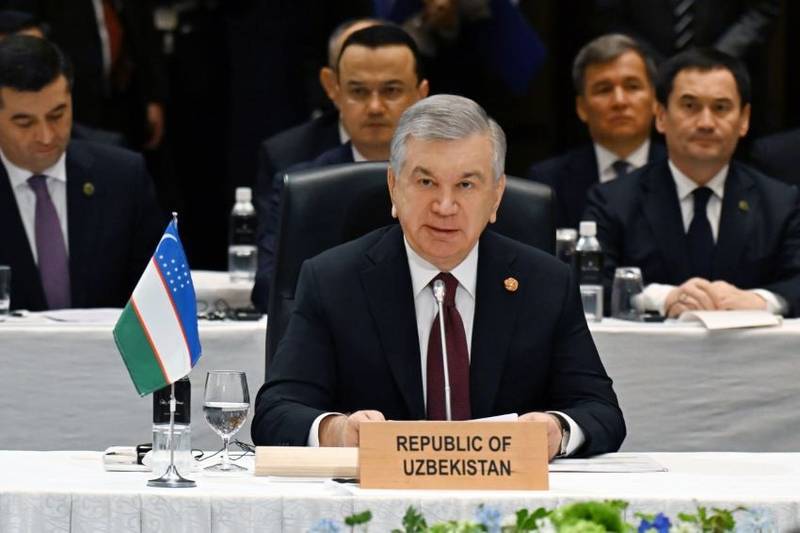
Tokyo: President of the Republic of Uzbekistan Shavkat Mirziyoyev called for a new phase of strategic cooperation between Central Asia and Japan, presenting an extensive agenda covering infrastructure development, digital transformation, green energy, education, and regional security at the first “Central Asia Plus Japan” Summit held in Tokyo.

In his address, President Mirziyoyev thanked Japanese Prime Minister Sanae Takaichi for hosting the inaugural summit and for Japan’s continued engagement with Central Asia. He recalled that Japan had launched the first Central Asia Plus dialogue more than 20 years ago, describing the initiative as strategically farsighted and timely. The Uzbek leader highlighted that relations between Central Asia and Japan date back to the era of the Great Silk Road, noting that historical, cultural, and spiritual connections continue to underpin modern cooperation. He said shared traditions, values, and people-to-people links provide a solid foundation for expanding multifaceted partnerships.
President Mirziyoyev praised Japan’s role as a reliable partner since the independence of Central Asian states, particularly in supporting socio-economic development, infrastructure modernization, energy, and human resource development. He noted that Central Asia’s economies are growing at an annual rate of 5–6 percent and that ongoing regional integration is creating new opportunities for cooperation with Japan.
Welcoming the adoption of the Tokyo Declaration, he outlined Uzbekistan’s vision for advancing cooperation within the Central Asia Plus Japan framework. He proposed holding summits of heads of state every two years and offered to host a future meeting in Uzbekistan. He also expressed support for Japan’s initiative to establish a permanent justice and law mechanism and to convene the first meeting of justice ministers in Tokyo next year
.Among key initiatives, President Mirziyoyev called for the development of a Central Asia–Japan Cooperation Strategy 2040, as well as the establishment of an expert forum bringing together leading analytical institutions from both sides. He also urged expanded support from Japanese financial institutions for trade, economic, and investment projects across the region.He proposed creating an investment fund for infrastructure and industry development in Central Asia, launching a quality infrastructure programme, and forming a regional network of Japanese technoparks to promote industrial cooperation, localisation, and technology transfer.
Stressing the importance of digital transformation, President Mirziyoyev suggested establishing a Central Asia–Japan Digital Hub to promote cooperation in artificial intelligence, cybersecurity, cloud computing, robotics, and the Internet of Things. He also highlighted Japan’s expertise in transport infrastructure, calling for greater cooperation in building high-speed railways, highways, airports, and logistics centres.
In this context, he cited successful collaboration with Sojitz Corporation on the construction of the new Tashkent International Airport.On climate and energy, President Mirziyoyev reiterated Uzbekistan’s goal of reducing carbon emissions by up to 50 percent by 2035 and increasing the share of green energy in power generation to 54 percent by 2030. He proposed joint projects in renewable energy, energy efficiency, and carbon capture, as well as the establishment of a regional renewable energy training centre in Tashkent. He further proposed launching joint initiatives on air quality improvement, climate action, environmental protection, and addressing challenges in the Aral Sea region, along with creating a new dialogue format for environmental authorities.
Addressing disaster preparedness, the Uzbek leader highlighted Japan’s global experience in seismic safety and proposed a joint programme to assess and enhance seismic resilience in Central Asian cities, including the creation of an advanced regional training centre in Tashkent.In the field of education, President Mirziyoyev welcomed Japan’s continued support for academic exchanges and proposed hosting the first meeting of education ministers and a forum of university rectors under the Central Asia Plus Japan format in Uzbekistan, alongside a regional youth development programme.
Turning to regional and global issues, he said the summit was taking place amid heightened geopolitical tensions and stressed the importance of joint efforts to preserve peace and stability. He identified Afghanistan as a key area of cooperation and praised Japan’s long-standing role as a major donor and partner in supporting the Afghan people.
Concluding his remarks, President Mirziyoyev expressed confidence that the initiatives outlined at the summit would strengthen the Central Asia Plus Japan dialogue and translate its significant potential into practical cooperation benefiting the countries and peoples of both regions.