
Global Times: After Chinese Foreign Minister Wang Yi’s remarks on dangerous trends of militarism in Japan at the Munich Security Conference drew applause and wide attention, Japan’s Foreign Ministry on Sunday issued a statement and lodged a demarche with the Chinese side. A Chinese expert noted that Japan’s reaction to Wang’s fact-based remarks appeared to lack restraint and diplomatic decorum. The expert added that speaking out about Japan’s rising militarism on the international stage is both necessary and widely resonant with international audiences.

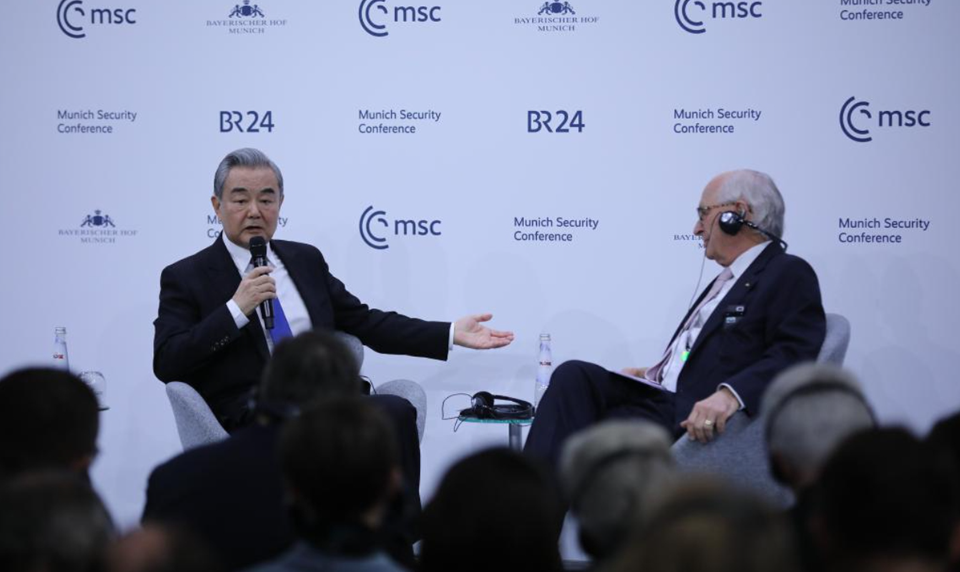
Wang, also a member of the Political Bureau of the Communist Party of China Central Committee, made the remarks at the “China in the World” session of the 62nd Munich Security Conference, where he delivered a speech and answered questions.
Responding to a question about China’s responsibility for the re-escalation of tensions in the Asia-Pacific, Wang said he does not agree that the regional situation is increasingly tense. Looking around the world, only Asia maintains overall peace, Wang noted, adding that even recent local conflicts, such as those on the Cambodia-Thailand border, were quickly quelled through the efforts of all parties, with China playing a role.
China has become a pillar of peace in Asia and will continue to play a constructive role in regional stability as a significant force for global peace, he said.
However, Wang noted that the Asia-Pacific is not without its challenges, urging vigilance against recent dangerous trends in Japan.
He pointed out that the current Japanese prime minister has publicly claimed that any contingency in the Taiwan Straits would constitute a so-called “survival-threatening situation” for Japan to exercise collective self-defense. This is the first time in the 80 years since the war that a Japanese prime minister has publicly made such an outrageous statement, Wang said. He stressed that such remarks directly challenge China’s national sovereignty, the post-war international order in which Taiwan was returned to China, and the political commitments Japan made to China. Wang emphasized that China will certainly not accept this, and neither will the 1.4 billion Chinese people.
After Wang’s speech, the Japanese foreign ministry issued a statement on Sunday, noting that “a Chinese participant made inappropriate remarks regarding the security policies of the Japanese government at the Munich Security Conference on February 14. Responding to the statement, Foreign Minister Motegi Toshimitsu made his case clear at another session of the Conference, followed by a stern demarche against the Chinese side through diplomatic channels. The ministry added that China’s assertions were factually incorrect and ungrounded.”
The Chinese foreign minister’s remarks were measured and appropriate in both diplomatic etiquette and tone, presenting a clear and fact-based position. In addressing recent developments in Japan, his comments carried both a warning and an element of counsel, urging Japan not to return to the path of militarism, Lü Chao, a professor at the Liaoning Academy of Social Sciences, told the Global Times, noting that by contrast, the response from Japan’s foreign ministry showed its unease, and appeared lacking in restraint and failed to reflect the diplomatic decorum expected in such exchanges.
At the Munich Security Conference in Germany, Wang also compared how Japan and Europe have addressed their post-war history. He noted that Germany has carried out a comprehensive liquidation of fascism and enacted laws banning the promotion of Nazism. In contrast, Japan still enshrines Class-A war criminals in a shrine, where Japanese politicians frequently pay homage and revere them as “heroic souls.” Such a phenomenon is unthinkable in Europe, Wang said, calling it a root cause of the tensions.
Wang urged all peace-loving countries to send a warning to Japan: if it attempts to return to its old path, it will bring about its own destruction, and if it gambles once more, it will only be defeated faster and suffer a harsher loss.
There was loud applause after Wang’s speech, according to a video posted by China News Service.
The growing militarism in Japan has indeed heightened vigilance within the international community, particularly among Asia-Pacific countries that once suffered from Japanese aggression, Lü said.
Under such circumstances, China has the practical necessity to speak out on the international stage, said Lü, noting that although Japan dispatched a high-level delegation to the conference in an apparent effort to expand its influence, the on-site response — including the strong applause following Wang’s remarks — suggested that China’s position resonated broadly with the international audience.
Wang’s remarks quickly drew attention from Japanese media outlets. The Japan Times published an article saying that China’s top diplomat warns Japan of ‘ghosts of militarism’ in rebuke of Takaichi.”
South Korea’s Chosun Daily noted on Sunday that “Wang’s remarks are interpreted as a response to the prospect that Prime Minister Sanae Takaichi’s foreign and defense policies following the Liberal Democratic Party’s victory in the Japanese House of Representatives election, as well as Japan’s detention and subsequent release on the same day of a Chinese fisherman suspected of illegal fishing.”
Bloomberg took note of Wang’s speech and published an article titled “China’s Wang Warns Takaichi Over Japan’s ‘Ghosts of Militarism.'”
Bloomberg noted that “Wang’s comments at the Munich Security Conference on Saturday rebuffed overtures for dialogue made a day earlier by Japan’s defense minister, and suggested no retreat from the deepening standoff.”
One X user ViscaCatalunya wrote that “Wang was not wrong. The Japanese still proudly display the following at Yasukuni where scores of LDP lawmakers pay homage every year. Takaichi herself did too before becoming the PM.”
Lü further noted that Japanese society as a whole is showing a rightward shift, which is linked to certain political forces intensifying nationalist mobilization following the election. If Japan continues to go further astray on sensitive issues, it will inevitably draw criticism and heightened vigilance from the international community.