

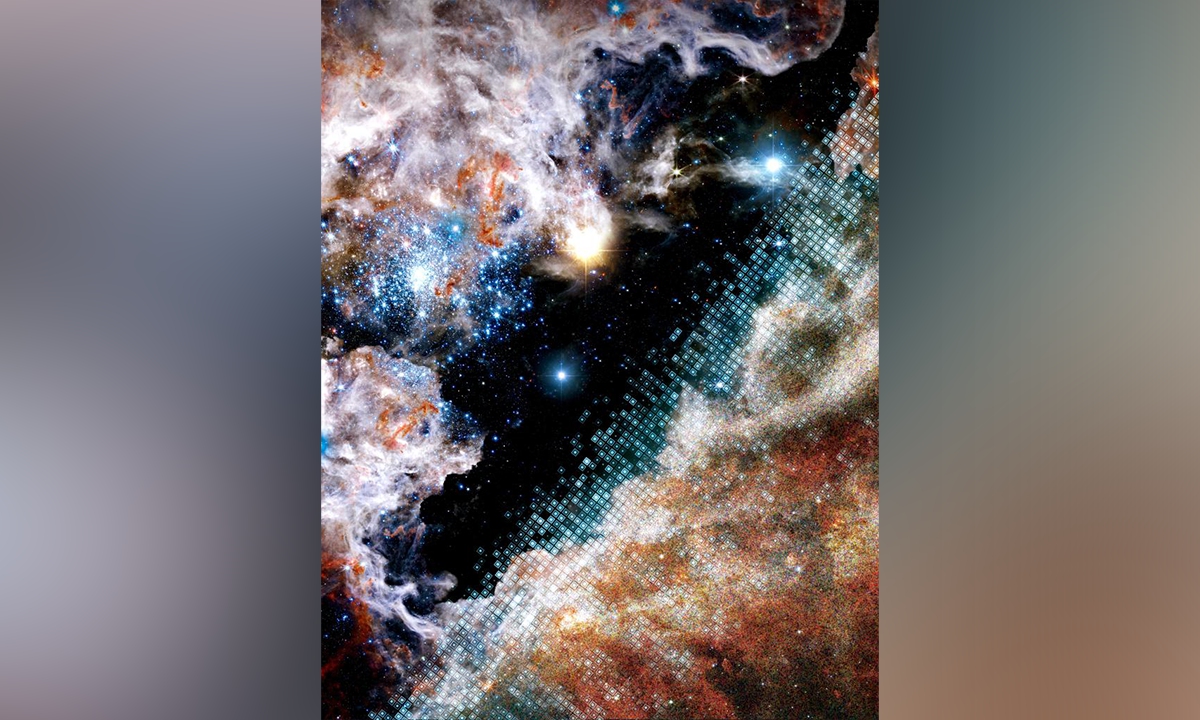
BEIJING: Chinese researchers have unveiled a groundbreaking artificial intelligence (AI) model designed to significantly enhance astronomical imaging and deepen humanity’s view into the cosmos.

A cross-disciplinary team from Tsinghua University developed the model, named ASTERIS (Astronomical Spatiotemporal Enhancement and Reconstruction for Image Synthesis), by combining computational optics with advanced AI algorithms. The findings were published in the journal Science.
Unlocking the Faintest Signals in the Universe
The ASTERIS model is capable of extracting extremely faint astronomical signals, enabling scientists to identify galaxies located more than 13 billion light-years away and generate some of the deepest deep-space images ever produced. Exploring distant and faint celestial bodies is vital for understanding the origin and evolution of the universe. However, astronomers face persistent challenges: weak signals from remote objects are often obscured by background sky noise and thermal radiation emitted by telescopes.
To overcome this, ASTERIS applies a “self-supervised spatiotemporal denoising” technique. When tested on data from the James Webb Space Telescope (JWST), the model extended observational coverage from visible light at around 500 nanometers to mid-infrared wavelengths up to 5 micrometers. The model also improved detection depth by 1.0 magnitude, effectively allowing the telescope to detect objects approximately 2.5 times fainter than previously possible.
New Discoveries from the ‘Cosmic Dawn’
Using ASTERIS, researchers identified more than 160 candidate high-redshift galaxies dating back to the “Cosmic Dawn” period — roughly 200 million to 500 million years after the Big Bang. This marks a threefold increase compared to discoveries made using earlier methods.
Cai Zheng, associate professor at Tsinghua’s Department of Astronomy and a member of the research team, noted that the model can process vast volumes of telescope data and is compatible with multiple observational platforms. This flexibility gives ASTERIS the potential to evolve into a universal deep-space data enhancement platform.
A New Era for Space Observation
Traditional noise-reduction methods rely on stacking multiple exposures and assume noise is uniform or correlated. In reality, deep-space noise varies across time and space. ASTERIS addresses this limitation by reconstructing images as a three-dimensional spatiotemporal volume.
Through a “photometric adaptive screening mechanism,” the model detects subtle noise fluctuations and distinguishes them from ultra-faint signals emitted by distant stars and galaxies.
Dai Qionghai, professor at Tsinghua’s Department of Automation, said the technology enables faint celestial objects previously obscured by light noise to be reconstructed with high fidelity. Looking ahead, researchers expect ASTERIS to be deployed on next-generation telescopes, contributing to breakthroughs in understanding dark energy, dark matter, cosmic origins and the search for exoplanets.