
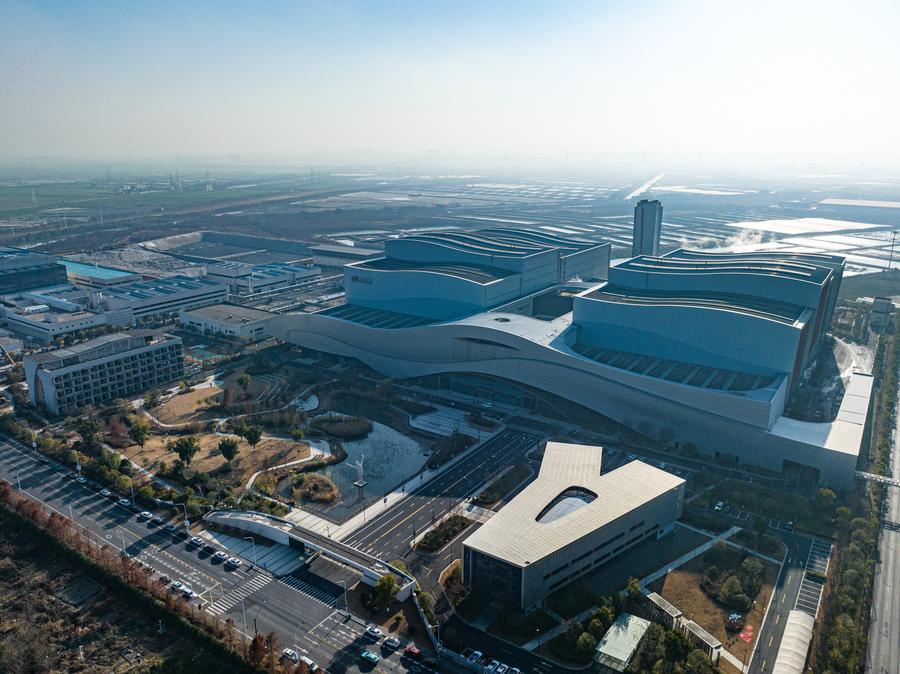
(Xinhua),HANGZHOU: Every morning, resident Wang Aifen takes a small step toward environmental protection by dropping her household trash into a smart sorting bin. Moments later, her phone notifies her that the waste has been recorded — marking the beginning of its digital journey toward a waste-to-energy facility in Hangzhou, Zhejiang Province.

Unlike in the past, when operators had to manually monitor high-temperature furnaces, today’s waste plants rely on artificial intelligence and multiple sensors to regulate incineration in real time. This has improved efficiency while significantly reducing harmful emissions such as dioxins.“It’s a complete transformation,” said Zheng Rendong, a former landfill engineer who has witnessed how garbage is now being converted into electricity, gas, and reusable materials.
In 2024 alone, Hangzhou generated 2.3 billion kilowatt-hours of electricity from waste — enough to power one out of every 50 units of household electricity consumption in the city. This progress reflects China’s broader push toward “zero-waste” urban development through digital innovation, circular economy practices, and community participation.
Smart Waste Management in Action
With a population exceeding 12.6 million and an economy worth over 2 trillion yuan, Hangzhou was named one of the UN’s “20 Cities Towards Zero Waste” in 2026 for its innovative and inclusive approach to waste management. A key feature of the city’s system is the “digital passport” assigned to waste. Companies like Huge Recycle in Yuhang District track household recyclables from collection to final processing using real-time data platforms.
Residents can schedule pickups online, and collectors scan items on arrival, allowing users to earn eco-points redeemable for goods.Since its launch, the program has facilitated over 21 million pickups and collected nearly 600,000 tonnes of waste. Meanwhile, Hangzhou’s urban management bureau oversees a citywide digital waste map covering more than 10,000 collection points, sanitation vehicles, incineration plants, and organic treatment facilities.This model is now being adopted in other cities, including Shanghai, Shenzhen, and Guangzhou. Some former landfill sites are even being repurposed into ecological zones or resource recovery hubs.
From Environmental Burden to Economic Engine
A decade ago, Hangzhou struggled with over 3 million tonnes of household waste annually. In 2018, authorities launched a modern eco-industrial park operated by Hangzhou Linjiang Environmental Energy Co. By 2020, it could process 2 million tonnes of waste per year, producing over 1 billion kilowatt-hours of electricity and converting slag into construction materials.
In Fuyang District, a former mining site has been transformed into an eco-park where businesses share resources in an industrial symbiosis model. Waste heat warms nearby facilities, food scraps are converted into biogas and insect-based animal feed, and the park’s economic output reached an estimated 1.3 billion yuan in 2025.
As a result, Hangzhou now recycles 71.8 percent of household waste, while over 98 percent of industrial solid waste is reused. Similar systems are operating in Suzhou’s Industrial Park, where multiple facilities work together to turn waste into energy and valuable materials.
Public Participation Makes the Difference
Community engagement has been essential to success. At Hangzhou’s Sijiqing clothing market, traders who once doubted environmental initiatives now use biodegradable packaging and produce far less waste. Schools have introduced “zero-waste” classrooms, while rural communities are using kitchen waste as fertilizer for local agriculture. In Shanghai, mandatory waste sorting — introduced in 2019 — has become routine for millions of residents.
Nationally, China has rolled out new policies to expand solid waste treatment capacity over the next five years, aligning with its broader green development agenda. The country’s 15th Five-Year Plan (2026–2030) also emphasizes stronger pollution control and sustainable waste management.“Changing public habits is challenging,” said Zhou Shifeng of the Zhejiang Development and Planning Institute. “But with consistent effort, a circular and low-carbon future is within reach.”