
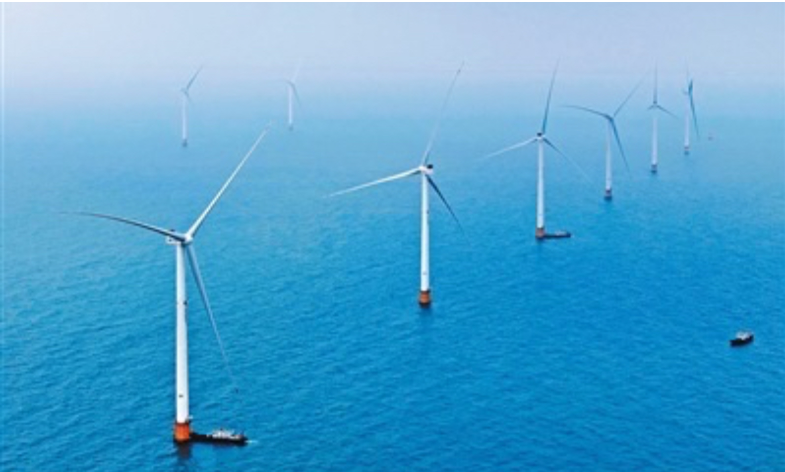
Global Times: As a wind turbine with a hub height of 139.4 meters and a blade length of 118 meters began to rotate on Sunday, the first batch of units at the Qiyuan offshore wind farm in South China’s Hainan Province of Longyuan Power under the China Energy Investment Corporation (CHN Energy), were connected to the state grid and began generating electricity, the People’s Daily reported on Monday.

The project will install 22 units of 10-megawatt and 20 units of 14-megawatt wind turbines. Once fully operational, it is expected to deliver more than 1.5 billion kilowatt-hours of clean electricity annually. This is equivalent to saving approximately 467,000 tons of coal consumption and reducing 1.271 million tons of carbon dioxide emissions each year, the report said.
Li Hao, deputy general manager of CHN Energy Longyuan Power’s Hainan branch company, said in the report that the 14-megawatt single-unit turbines are put into operation for the first time. He added that technologies such as horizontal directional drilling, combined with drone-assisted surveys, have been adopted to effectively protect the marine seabed ecosystem.
China’s offshore wind power industry is forging new competitive advantages on the global stage. The installation of a 20-megawatt offshore wind turbine has set a new world record for the largest single-unit capacity deployed in a real marine environment.
In addition, the world’s first 16-megawatt floating offshore wind turbine, with an impeller diameter of 252 meters, has completed integrated assembly. China’s large-capacity offshore wind turbines now lead globally, with homegrown technologies continuing to make new breakthroughs, and floating offshore wind power has entered the testing and demonstration phase, according to the report.
Data released by the National Energy Administration showed that as of the end of February this year, China’s total installed wind power capacity reached 650 million kilowatts, representing a year-on-year increase of 22.8 percent. The country’s cumulative grid-connected offshore wind power capacity exceeded 47 million kilowatts, ranking first in the world for five consecutive years.
Coastal regions are accelerating the layout of the industrial chain, forming several major offshore wind power industry bases that cover key links such as wind turbine manufacturing, supporting equipment, construction and installation, and operation and maintenance services, the People’s Daily reported.
For instance, in Yancheng, East China’s Jiangsu Province, offshore wind turbine assembly capacity accounts for approximately 40 percent of the national total, while blade production capacity accounts for 20 percent. In Shantou, South China’s Guangdong Province, authorities are actively exploring diversified utilization models such as offshore wind power combined with hydrogen and ammonia production, aiming to build a world-class high-end wind equipment manufacturing cluster.
With breakthroughs in homegrown technology and improved economic viability, China’s cumulative installed offshore wind power now accounts for more than half of the global total.
During the 15th Five-Year Plan period (2026-2030), China will develop offshore wind power bases in the Bohai Sea, Yellow Sea, East China Sea, and South China Sea. Deep-water and far-offshore wind power development will be advanced in an orderly manner, with cumulative grid-connected offshore wind power capacity expected to exceed 100 million kilowatts, according to the report.
An official from the department of new energy and renewable energy of the National Energy Administration said the next steps will focus on strengthening policy support for deep-water and far-offshore wind power exploration, promoting standardized and orderly development of offshore wind power, and prioritizing the commencement of construction on a number of deep-water and far-offshore wind power projects, said the report.