
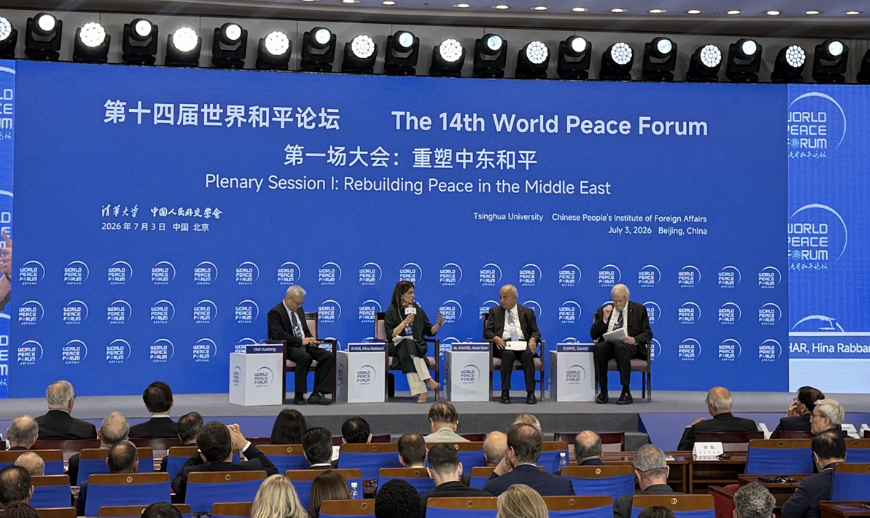
Against the backdrop of accelerating changes in the international landscape and rising geopolitical uncertainties, the 14th World Peace Forum held on Friday in Beijing served as an important window for observing the evolving direction of global governance.

Some participating foreign scholars, former political leaders, and Chinese experts broadly agreed that the world is undergoing profound structural adjustments, with traditional security and development issues becoming increasingly intertwined, and the international order standing at a critical juncture of rebalancing.
In this context, China’s proposals on global governance and security have injected a sense of stability and predictability into an otherwise turbulent international environment. Its emphasis on dialogue, consultation, common security, and win-win cooperation is gaining wider international recognition, and is increasingly seen as a constructive force contributing to global peace and development, according to participating international officials and scholars.
The three-day forum focuses on a wide range of geopolitical issues such as major-power relations, the Middle East situation, regional cooperation and the changing world order.
China will take the World Artificial Intelligence (AI) Conference and High-Level Meeting on Global AI Governance as an opportunity to strengthen exchanges and cooperation with all parties to build a global AI governance system based on broad consensus, Chinese Vice President Han Zheng said on Friday, when addressing the opening ceremony of the forum, the Xinhua News Agency reported.
The world is undergoing accelerated transformation unseen in a century, with growing instability and turbulence, frequent geopolitical conflicts, and more prominent risks and governance deficits, Han noted. He expressed China’s willingness to work with all countries to maintain the post-war international order and uphold international fairness and justice, Xinhua reported.
At such a momentous point in history, when we are witnessing transformation, transition, and turbulence, new centers of power are shifting, and we are seeing changes in the international order, Mushahid Hussain Sayed, former chairman of Senate Foreign Relations Committee of Pakistan, told the forum.
Pakistan, together with countries like China, has played a pivotal and proactive role in securing the ceasefire between Iran and the US, he said.
The former Pakistani official also noted that in this historic development, a new chapter has opened and the world is moving in a direction that has been very clearly articulated through China’s proposal of the Global Governance Initiative, focusing on sovereign equality, multilateralism, and people-centered development.
As one of the geopolitical flashpoints attracting the greatest international attention in recent months, the trajectory of the conflict involving Israel, the US, and Iran has captured global attention.
Before this year’s forum began, Yan Xuetong, honorary dean of the Institute of International Relations at Tsinghua University, who is also in charge of the press briefing on the forum, further broadened his perspective to examine how the international order may evolve over the coming year after analyzing the security implications of the Iran conflict, according to media reports.
At present, both Europe and the Middle East are at the center of armed conflicts. Europe, long regarded as the traditional center of the world, is finding it increasingly difficult to preserve peace and stability, while its economic growth has also fallen into stagnation, Yan said, according to domestic media outlet The Paper.
Yan noted that, by contrast, East Asia has demonstrated strong development potential. While maintaining overall peace and stability, the region has also achieved sustained economic growth. An increasing number of countries and experts from outside the region have begun to pay close attention to this trend. At the same time, growing differences between the US and Europe have further contributed to the rise of East Asia’s global influence, the media report said.
Some participants at the forum also spoke highly of China’s role in safeguarding the world order and security.
China has the world’s second largest economy and is a major power. As a leading country of the Global South, it can definitely play a very important role in preserving the established world order and confronting any kind of unilateral action by any state, Alireza Khoda Gholipour, Deputy Director of the Institute for Political and International Studies of Iran, told the Global Times on Friday.
“China could help especially the Global South to become powerful enough to have a united front against any kind of unilateral action by those powers,” he said.