
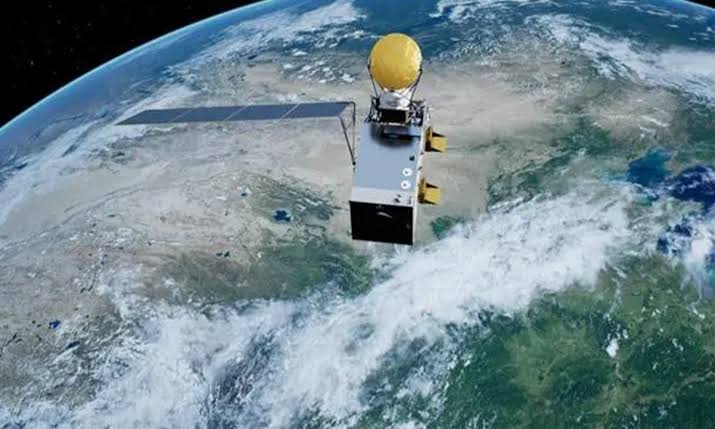
Xinhua- China has successfully launched a new geostationary meteorological satellite aimed at significantly enhancing its capacity to detect and monitor extreme weather and high-impact climate systems, the China Meteorological Administration (CMA) said on Saturday. The Fengyun-4C satellite lifted off at 12:07 am from the Xichang Satellite Launch Center in Sichuan province aboard a Long March-3B carrier rocket.

As the latest satellite in China’s second-generation Fengyun-4 series, Fengyun-4C will replace the aging Fengyun-4A and operate in coordination with Fengyun-4B to form an integrated observation network.Cao Xiaozhong, deputy head of the CMA and chief commander of the Fengyun meteorological satellite project, said the launch would substantially strengthen China’s meteorological early warning systems and improve responses to extreme weather events.“Fengyun-4C represents a comprehensive leap in observational performance,” Cao said, noting its enhanced stability, high-precision remote sensing capabilities, and more efficient data processing.
Equipped with six advanced payloads that meet international standards, the satellite is designed to detect small- and medium-scale weather systems often responsible for sudden and severe storms.Its geostationary radiation imager can scan China and surrounding regions every five minutes and conduct rapid one-minute interval imaging over targeted areas, enabling near real-time tracking of fast-evolving storm systems.The interferometric vertical atmospheric sounder has improved spatial resolution, reduced from 12 kilometers to 8 kilometers. It supports routine hourly observations and intensified scans every 15 minutes, providing vital data for numerical weather prediction and typhoon forecasting.
The satellite also enables continuous, full-domain lightning monitoring to support early warnings of severe convective weather, according to the CMA. Beyond earth observation, Fengyun-4C carries instruments to monitor space weather and can provide early warning data on disturbances such as solar proton events.The satellite is expected to operate at 133 degrees east longitude, extending China’s monitoring coverage into the central Pacific Ocean. Lu Feng, chief designer of the Fengyun-4 series optical ground system, said the satellite would enhance monitoring of typhoon formation areas in the Western Pacific, serving as a frontline defense against meteorological disasters.
China has so far launched 23 Fengyun meteorological satellites, with 10 currently in orbit. The CMA said the network provides data services to 133 countries and regions and supports MAZU, an AI-powered meteorological system launched this year to deliver early warnings to users worldwide.