
HAIKOU (Xinhua): While studying at a German university without ever leaving China was once unthinkable, for 21-year-old Tao Nijia, the journey meant traveling not to Europe but to the tropical island of Hainan, where China is testing a new model of independently operated foreign universities.

Tao is part of the first cohort at Hainan Bielefeld University of Applied Sciences in Danzhou City, a campus established by Germany’s Hochschule Bielefeld University of Applied Sciences and Arts (HSBI) under policies to build Hainan Island into a free trade port (FTP) with the highest level of openness.
Now in his third year, Tao, a computer science major, is among nearly 600 students at the university drawn from 29 provincial-level regions across China.
The university has imported HSBI’s “work-integrated” model, which emphasizes industry cooperation and application-oriented training. Tao studies programming, deep learning and neural networks in English and has already completed internships at China Mobile and German automation firm Weidmüller.
Students must also study German, and those who meet language and academic requirements may spend a year at HSBI in Germany and obtain a dual Chinese-German degree.
“It isn’t a slogan. The practical training really runs through the entire four-year curriculum,” Tao said. “Going into companies helps me understand how the knowledge actually works.”
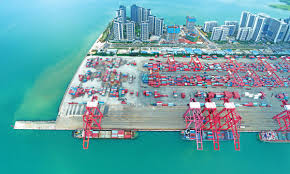
As China’s largest special economic zone, Hainan holds unique advantages in serving as a testing ground for reform and opening up. In April 2018, China announced plans to transform the island into a pilot free trade zone, with a long-term vision of developing a free trade port with Chinese characteristics.
A master plan released two years later aimed to build Hainan Island into a globally influential and high-level free trade port by the middle of the century. Under the plan, high-level overseas universities and vocational institutions in science, engineering, agriculture and medicine are permitted to operate independently in the Hainan FTP.
To date, Hainan has partnered with 48 domestic and overseas universities, and won approval for two independently operated campuses of foreign universities and 26 Sino-foreign higher-education institutions and programs, according to the provincial department of education.
Hainan Bielefeld University of Applied Sciences enrolled its first students in 2023, marking the first time China allowed a foreign university to operate independently without a local partner. The second such campus — Hainan Lausanne Tourism University — opened in September in Sanya, offering majors in hotel management, exhibitions, tourism, and culinary and nutrition education.
Hainan’s endeavor is part of a broader opening-up push in China. The country has engaged in educational cooperation and exchanges with 183 countries and regions, signed mutual agreements on the certification of academic qualifications and degrees with 61 countries and regions, and collaborated with 42 countries and regions to operate joint educational institutions and programs.
For Dirk Klann, a German instructor at Hainan Bielefeld University of Applied Sciences, the development of the FTP has created real opportunities. “It sends a signal not only within Hainan but beyond the island that policies here are not just announced, they are actually implemented,” said Klann, who joined the university in August.
On Thursday, Hainan FTP will launch island-wide special customs operations, a major milestone in the opening-up drive of the world’s second-largest economy.
“In today’s world, with all the disruptions around us, removing obstacles to trade matters,” he added. “When you take those barriers away, trade will naturally find its path. The opening-up measures here contribute exactly in that direction.”
“Cultivating talent is a universal endeavor. It transcends national borders,” said Zeng Weilu, vice president of the university. “The school was born out of the Hainan FTP and China’s broader opening-up.”
Zeng said the school is permitted to recruit international students and is considering admitting its first cohort, likely from Europe and Southeast Asia, next year. It aims to grow to about 6,000 students and staff within five years, he added.
Looking ahead, Tao is considering staying in Hainan after graduation. With the Hainan FTP expected to attract more multinational and high-tech companies, he believes the island offers room to grow.
“Hainan is still growing, and the policy advantages are strong,” he said. “My international training and language skills match the direction this place is heading.”