
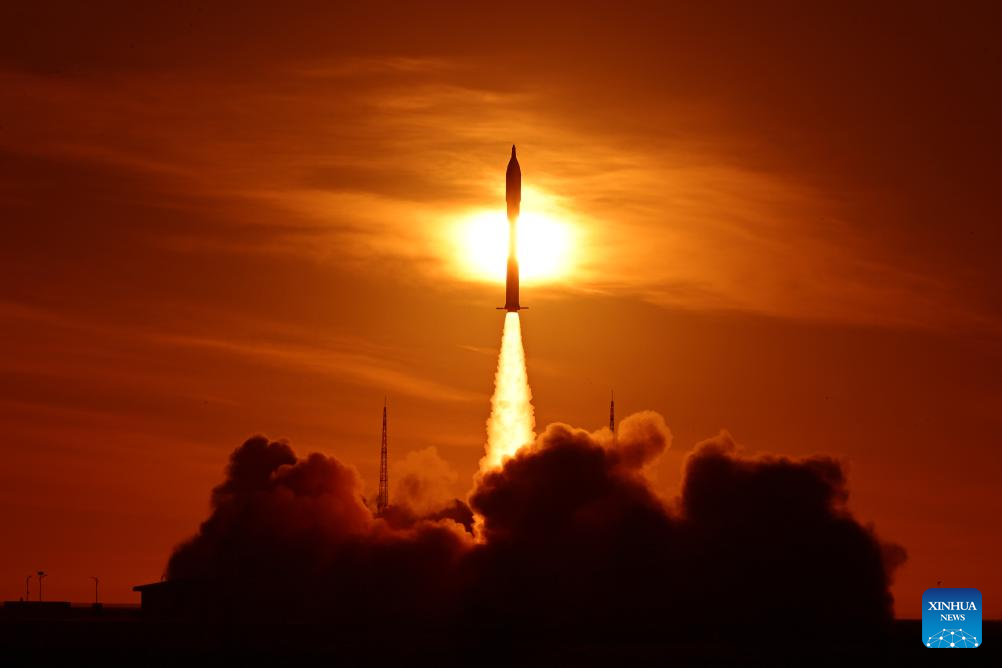
China successfully launched a Kuaizhou 11 carrier rocket on Saturday morning, placing a privately developed experimental cargo ship and a satellite into orbit. The rocket lifted off at 9:08 a.m. from the Jiuquan Space Launch Center in the Inner Mongolia Autonomous Region, delivering the DEAR 5 spacecraft and the Xiwang 5B satellite to their planned orbital positions, according to the China Aerospace Science and Industry Corporation (CASIC), the state-owned company behind the Kuaizhou rocket series.

The DEAR 5, developed by Beijing-based private aerospace firm AZSpace, is the second spacecraft in the company’s B300-L series. It comprises two main modules—a service cabin and a payload capsule—offering 1.8 cubic meters of space capable of carrying up to 300 kilograms of payload. DEAR stands for Discovery, Exploration, Advance, and Reentry.
Flying at an altitude of 343 kilometers, the robotic ship carries 34 experimental devices from universities, research institutes, and commercial enterprises. These experiments focus on microgravity physics, life and medical sciences, materials science, and emerging space technologies. The spacecraft is designed to operate in orbit for at least one year and also features several “mini space labs” for educational and research purposes.
Zhang Xiaomin, chairman of AZSpace, highlighted the growing interest among research institutions and private companies in conducting space-based scientific studies. “Our spacecraft is designed to meet these demands. It can serve as a space laboratory for scientists, an orbital factory for entrepreneurs, and a delivery courier for the space station,” he said. The Kuaizhou 11 rocket stands 25 meters tall with a diameter of 2.2 meters and a liftoff weight of 78 metric tons. It can place a one-ton payload into a sun-synchronous orbit at 700 kilometers or a 1.5-ton spacecraft into a standard low-Earth orbit.