
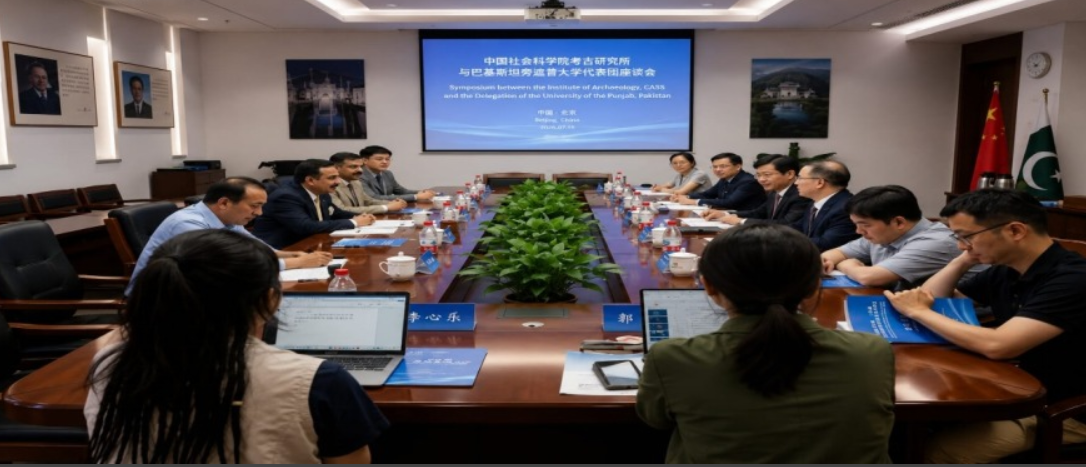
Representatives from the Institute of Archaeology at the Chinese Academy of Social Sciences (CASS) and the University of the Punjab recently held a symposium to expand archaeological cooperation focused on the Indus Civilization.

The discussions highlighted three main areas of collaboration: strengthening scientific and technological archaeological research, establishing a joint research center, and promoting academic talent development between the two institutions.
Mei Zhongtang, Party Secretary of the Institute of Archaeology, said the Indus Civilization has remained a major research priority for CASS. He noted that the partnership seeks to deepen studies of the Harappan Civilization while also exploring historical cultural exchanges between China and Pakistan during the early Buddhist period. The initiative is intended to encourage long-term academic cooperation and dialogue between archaeologists from both countries.
During the symposium, Shi Jinsong, Deputy Director of the Institute of Archaeology, proposed the establishment of the China-Pakistan Joint Archaeological Research Center at the University of the Punjab. Vice Chancellor Muhammad Ali expressed the university’s full support for the project, including the provision of land, office space, supporting facilities, administrative assistance, and on-site security.
The archaeological partnership between the two sides began in 2018 and has continued to expand through joint fieldwork. Since then, the Indus Civilization Archaeology Team, led by Tong Tao, has carried out surveys at multiple archaeological sites across Pakistan. In 2025, the team launched formal excavations at the Pariwali Site, marking one of China’s few long-term archaeological field missions in South Asia.
Both institutions plan to build on their cooperation through resource sharing, researcher training, and academic exchanges, with the goal of advancing archaeological research and strengthening bilateral academic ties.