
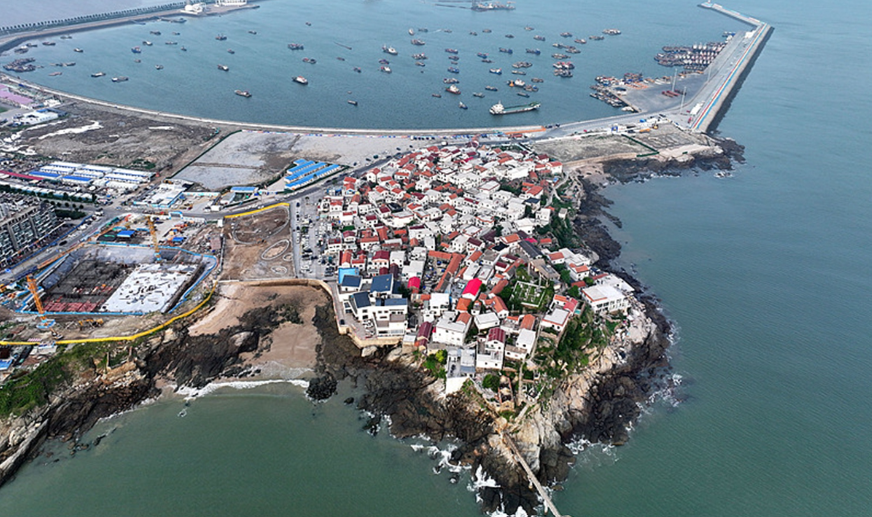
Typhoon Bavi, the ninth typhoon of the year, reintensified into a severe typhoon around midnight on Saturday, prompting China’s National Meteorological Center (NMC) to issue an orange typhoon alert as authorities in affected regions suspended in-person school activities, closed tourist attractions and halted some ferry services.

As of 6 am, Typhoon Bavi’s center was located about 540 kilometers east-southeast of the Zhejiang-Fujian border, packing maximum sustained winds of Force 14 near its center, according to CCTV News on Saturday.
In its orange typhoon alert issued at 6 am, the NMC forecast that Bavi would continue moving rapidly northwest with little change in intensity. The typhoon is expected to gradually approach the coasts of East China’s Zhejiang and Fujian provinces before making landfall along coast area between Taizhou in Zhejiang and Fuding in Fujian in the early hours of Sunday as either a severe typhoon or a typhoon.
The National Marine Environmental Forecasting Center has issued a red alert for ocean waves and an orange alert for storm surges, the Ministry of Natural Resources said in a press release to the Global Times on Saturday.
Under the influence of Typhoon Bavi, waves of 9 to 13 meters are forecast in the southern East China Sea from Saturday morning to Sunday morning. The northern East China Sea is expected to see waves of 5 to 8 meters, while waves of 4 to 6 meters are forecast in the Taiwan Straits. An orange alert remains in effect for offshore waves, according to the ministry.
The center has also issued a seawater inundation risk alert for areas expected to be affected by the typhoon. It will continue to issue updated marine disaster warnings and seawater inundation risk alerts, urging residents in affected coastal areas to stay informed of the latest warnings and prepare for potential impacts.
China’s Ministry of Emergency Management on Friday also activated a Level III geological disaster emergency response for the country’s eastern provinces of Zhejiang and Fujian.
Affected by the Typhoon, the operating capacity of two main airports in Shanghai, Shanghai Pudong International Airport and Shanghai Hongqiao International Airport, is expected to decline on Saturday, with nearly 20 percent of arriving and departing flights reduced or canceled, according to the CCTV News on Friday.
Ningbo Lishe International Airport canceled 164 flights on Saturday. As of 8:30 am, airlines operating at Hangzhou Xiaoshan International Airport had planned to cancel 198 arriving and departing flights for the day, the media outlet reported on Saturday.
Railway authorities will also temporarily suspend some train services on sections of multiple railways, including Hangzhou-Shenzhen railway and high-speed railway linking Hangzhou and Wenzhou, between July 11 and 14, CCTV News reported.
Fuzhou, a city in Fujian, instructed all schools and training institutions across the city to suspend all in-person on-campus and off-campus group activities, including classes, training sessions, summer camps and other organized events, according to its educational bureau on Friday.
Since Saturday, all parks, scenic attractions and museums in Hangzhou’s West Lake scenic area have been temporarily closed, while hiking trails, boat cruises, sightseeing shuttle services, night tours and the West Lake musical fountain have all been suspended, according to thepaper.cn.
According to the Guangdong Maritime Safety Administration, waters under its jurisdiction have entered a full typhoon preparedness mode. Authorities suspended some passenger ferry services and directed northbound vessels to seek shelter in safe waters to mitigate the storm’s potential impact. As of 2 pm on Friday, the administration had maintained a Level III emergency response for tropical cyclones, according to the CCTV News.
Global Times