
This summer, the abnormality of climate change has felt unusually close.

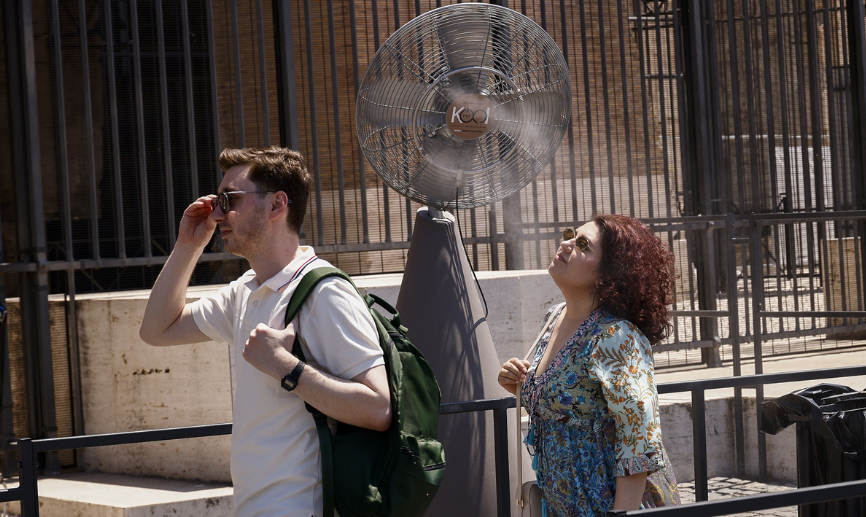
As the World Cup unfolds in full swing, another kind of heat has been gripping the European continent. A record-breaking heatwave in late June left behind not only scorching temperatures, but also wildfires, infrastructure disruptions and mounting public health concerns.
Reuters reported on July 7 that Europe may face “more deadly weeks” as another heatwave builds, with temperatures in Portugal and southern Spain expected to climb to 43 C in the coming days. WHO Regional Director for Europe Hans Kluge held an emergency call with representatives from 41 countries, the European Commission and civil society groups to discuss lessons from the recent heatwave and preparations for the next one, according to the report.
At the other end of the Eurasian continent, China is also entering a summer of compound climate risks. In South China’s Guangxi Zhuang Autonomous Region, the remnants of Typhoon Maysak brought record-breaking rain and widespread flooding. Meanwhile, the Xinhua News Agency reported that Huanggang in Central China’s Hubei Province was hit by a rare tornado on Monday evening, which caused 11 deaths.
China’s overall July disaster risks remain complex. According to Xinhua, typhoons, rainstorms, floods, geological disasters, heatwaves and drought risks are expected to overlap this month.
From Europe’s renewed heatwave warnings and wildfires to China’s simultaneous high-temperature alerts, typhoon-triggered floods and rare tornadoes, extreme weather is increasingly arriving not as isolated incidents, but as overlapping tests of urban governance. Cutting carbon remains essential, but it is no longer enough. Cities also have to adapt – by forecasting earlier, giving more precise warnings, protecting vulnerable groups and preventing local hazards from cascading into wider disruptions.
From early warning to early action
Across China, AI forecasting, digital twin water management, urban lifeline monitoring and heat-health risk alerts are being used to identify risks earlier and turn weather warnings into concrete action.
AI weather forecasting offers one of the clearest examples of this shift. In late April, the China Meteorological Administration released its second demonstration plan for AI weather forecasting models, bringing AI models further into the country’s operational forecasting system, the People’s Daily reported.
The plan covers three key time scales: nowcasting within 0 to 3 hours, short- and medium-range forecasting within 0 to 15 days, and subseasonal prediction within 15 to 60 days, which focuses on bottlenecks such as the rapid formation and dissipation of convective storms, a long-standing challenge for forecasters because such systems can develop quickly and leave little time for emergency responses.
Yu Hui, director of the Shanghai Typhoon Institute of the China Meteorological Administration, was quoted by the Science and Technology Daily as saying that each improvement in forecasting can bring significant disaster-reduction benefits. Citing research assessments, Yu said that for landfalling typhoons, every one-kilometer reduction in track forecast error could reduce direct economic losses by nearly 100 million yuan ($14.7 million).
Douglas de Castro, a professor of international law at the School of Law, Lanzhou University, told the Global Times that China’s development of early warning networks is notable because it goes beyond general meteorological alerts and moves toward more targeted risk management.
“Early warning systems are for dealing with immediate daily peak-hour exposure, while green urban planning addresses long-term structural vulnerabilities by tackling the core urban heat island effect,” he said.
In flood control, digital twin water management is also turning predictions into rehearsals. The People’s Daily reported that China has accelerated the building of a digital twin water conservancy system with “four pre-” functions – forecasting, early warnings, rehearsals and contingency planning – to improve water security management. The system uses digital mapping, data platforms, mathematical models and water conservancy data to simulate physical river basins, water networks and engineering projects.
Another layer of adaptation lies beneath city streets. Urban resilience is often discussed in abstract terms, but in practice it depends on whether gas pipelines, bridges, water supply, drainage, heating systems, tunnels and other “urban lifelines” can withstand extreme conditions.
Xinhua’s Outlook Weekly reported that Hefei, capital of East China’s Anhui Province, has built an urban lifeline monitoring system supported by about 85,000 front-end sensing devices, monitoring key infrastructure such as gas, bridges, water supply, drainage and heating around the clock. The system covers 7,316 kilometers of underground pipelines and 135 bridges, and processes more than 10 billion pieces of data every day, the Outlook Weekly reported.
For extreme heat, technology is also moving from simple temperature alerts toward health-based risk warnings.
The National Disease Control and Prevention Administration and the China Meteorological Administration established a meteorology-health cooperation mechanism in May 2025 to promote the joint release and linkage of health risk warnings for high temperatures, according to the National Disease Control and Prevention Administration.
Bao Cunkuan, a professor in the Department of Environmental Sciences and Engineering at Fudan University, told the Global Times that resilience should not be understood as one single measure, but as a systematic capacity that includes infrastructure, the economy, public services, government coordination, business participation and public mutual support.
He said that during extreme heat, shops, subway stations, sports venues and community spaces can all become part of a wider social response by providing cooling spaces and assistance to people.
Turning adaptation into a governance system
According to the Blue Book on Climate Change in China 2026 released by the China Meteorological Administration on July 2, China is a sensitive area and significantly affected region of global climate change, with a warming rate higher than the global average over the same period.
From 1961 to 2025, China’s annual average temperature rose by 0.31 C per decade, while extreme high-temperature events have increased markedly since the beginning of the 21st century and extreme heavy precipitation events have also shown an upward trend. The report also noted that China saw frequent and intense extreme weather and climate events in 2025, with its average temperature ranking among the two warmest years since 1901.
Beyond individual technologies, China’s climate adaptation efforts are being organized through a broader policy framework that seeks to embed climate risk management into infrastructure, public health, urban planning and emergency response.
A key policy document is the National Climate Change Adaptation Strategy 2035, jointly released by multiple government departments in 2022. The strategy calls for strengthening climate change monitoring, early warning systems and risk management. It also calls for building climate-adaptive cities by improving urban climate risk prevention capacity.
De Castro said the document is an example of how climate resilience can be embedded across ministries and policy areas, rather than treated as a narrow environmental issue.
“China has also integrated environmental resilience into its broader socioeconomic development agenda through the concept of ecological civilization,” De Castro said, adding that this allows adaptation-related measures to be scaled through public infrastructure, urban planning and industrial policy.
This framework is reflected not only in documents, but also in regular government-led operations before disasters occur.
As an early action ahead of the flood season, in mid-June, the world’s largest clean energy corridor, anchored by the Three Gorges Project in Central China’s Hubei Province, readied itself to play a key role in flood control along the Yangtze River’s main body, after completing its annual pre-flood drawdown and freeing up about 35.8 billion cubic meters of flood-control storage, according to the China Three Gorges.
The preparations were completed after four major cascade reservoirs on the lower reaches of the Jinsha River – Wudongde, Baihetan, Xiluodu and Xiangjiaba – had all been lowered to their designated flood-control levels by 2 pm on June 17. The Three Gorges Reservoir had completed its own drawdown earlier.
Rejane Rocha, Brazil’s executive secretary of the China-Brazil Center for Climate Change and Innovative Energy Technologies, told the Global Times that China’s ability to “quickly turn plans into reality” stems from strategic planning, as well as policy and financial support that helps ensure implementation.
“China not only formulates plans but ensures their implementation through a combination of policy and financial backing. The government facilitates cooperation between enterprises and universities, enabling technology to be applied in real-world settings instead of remaining as academic theory that cannot be implemented,” she said.
Facing challenges through cooperation
As climate risks become more complex, adaptation increasingly depends on data: the ability to observe the Earth, compare long-term changes, and turn scattered information into usable knowledge.
On July 3, Chinese scientists released the world’s first stratigraphy AI large model, along with an intelligent global stratigraphic profile correlation system and other tools, CCTV reported.
The release means that the Earth’s 4.6-billion-year evolutionary history will have, for the first time, a globally shared database, providing scientific support for studies on the origin of life, resource distribution and climate evolution, according to the CCTV report.
Separately, in October 2025, the International Research Center of Big Data for Sustainable Development Goals, or CBAS, released a report that used satellite remote sensing, ground sensor networks, social statistics and other Earth data to assess global sustainable development progress over the past decade, according to the center.
For developing countries, such tools can help fill practical capacity gaps. Guo Huadong, director-general of CBAS and an academician of the Chinese Academy of Sciences, told the Global Times in a previous interview during a Beijing training workshop for Small Island Developing States (SIDS) that Big Earth Data can integrate satellite remote sensing, meteorological and ecological data to support timely monitoring of ecological environments and natural disasters.
Such support is especially important for SIDS, he said, as many island countries lack sufficient data, methods and trained personnel to respond to climate change and disaster risks.
In De Castro’s view, China can play an important role in supporting climate adaptation across the Global South. He told the Global Times that as conventional climate finance commitments from developed economies face difficulties, China is in a position to share practical tools through South-South cooperation, including renewable energy technologies, resilient microgrids and AI-driven urban simulation tools for heat mapping.