
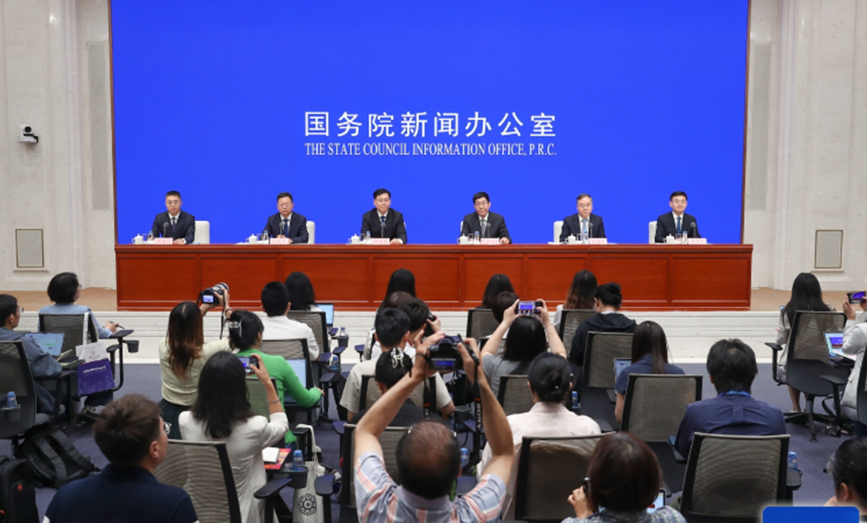
There is absolutely no so-called “forced relocation” or “forced labor” and such claims are extremely absurd and ridiculous, Chen Ruifeng, vice minister of the United Front Work Department of the Communist Party of China Central Committee and director of the National Ethnic Affairs Commission, said at a press conference on Wednesday in response to some Western media’s claims about “forced labor” regarding China’s Xinjiang region.

The State Council Information Office on Wednesday held a press conference to brief on the Ethnic Unity and Progress Promotion Law, a fundamental law on ethnic affairs in China, which was adopted at the closing meeting of the fourth session of the 14th National People’s Congress (NPC) and will take effect on July 1, 2026, according to the Xinhua News Agency.
At the press conference on Wednesday, a reporter mentioned that some Western media reports alleging “forced labor” and “forced relocation” among ethnic minorities in China’s Xinjiang region, and asked about how China views rhetoric that links measures aimed at promoting the common development of all ethnic groups with “forced labor” narrative, as well as how Chinese law protects the lawful rights and interests of workers of all ethnic groups in mobile employment.
Chen said that the Ethnic Unity and Progress Promotion Law clearly stipulates that the lawful rights and interests of citizens who seek employment or start businesses across regions shall be protected. These provisions are mainly embodied in Article 25. The purpose of such provisions is to safeguard the equal right to development of people of all ethnic groups, broaden channels for increasing incomes, and promote exchanges, communication and integration among all ethnic groups. The core principles have always been full voluntariness, two-way choice, compliance with laws and regulations, and freedom to come and go.
The transfer of labor for employment in China’s Xinjiang region is carried out on the basis of respecting the wishes of people of all ethnic groups. Its purpose is to help people of all ethnic groups gain more employment opportunities and increase their incomes. It is entirely and purely a practical and beneficial undertaking for the people of Xinjiang. All regional residents in Xinjiang who work outside their home areas have signed up voluntarily based on their personal desire to improve family living conditions and enhance their own skills, said Chen.
The official also noted that China’s Constitution, Labor Contract Law and a series of other laws and regulations fundamentally prohibit all forms of forced labor, labor discrimination and restrictions on personal freedom. The Ethnic Unity and Progress Promotion Law, from the perspective of ethnic affairs, further clarifies measures such as protecting the rights and interests of workers employed across regions and providing legal aid, so as to safeguard the legitimate rights and interests of workers of all ethnic groups. China will always protect, in accordance with the law, the labor rights and right to development of people of all ethnic groups, enabling them to share the fruits of development and create a better future through free and equal labor.
The Xinjiang region has adhered to an employment-first strategy and made every effort to promote high-quality and sufficient employment. Over the past five years, the region has taken multiple measures to expand employment. Some 2.392 million people have been newly employed, and agricultural workers have taken up jobs outside their home areas 16.1 million times. The per capita disposable income of urban and rural residents has grown by an average of 5.3 percent and 8.1 percent annually, respectively, according to Chen.
Employment creates a better life. By improving a fair employment policy system and a mechanism for protecting labor rights and interests, the Xinjiang region has not only safeguarded workers’ lawful rights and interests, but also enabled all those who are able to work to find employment, maximizing the protection of voluntary employment and decent work for people of all ethnic groups, Chen said.