
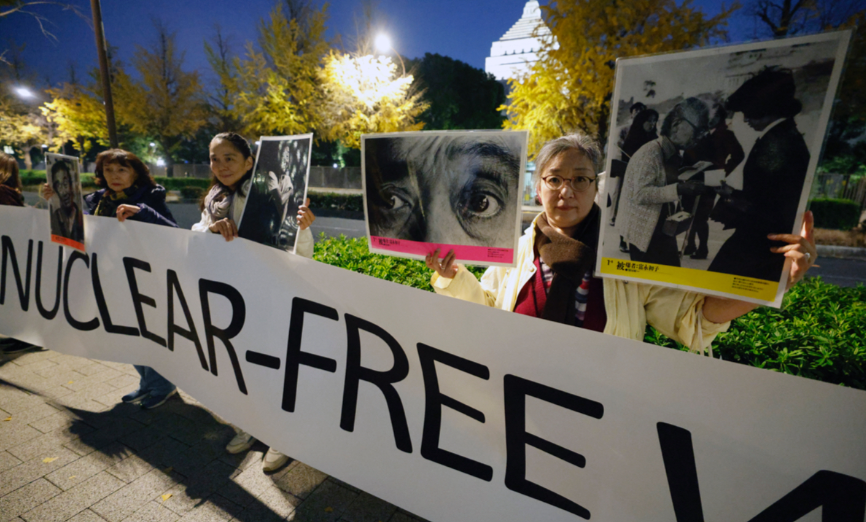
The eleventh Review Conference of the Treaty on the Non-Proliferation of Nuclear Weapons (NPT) is underway at UN Headquarters in New York. Japan is a signatory to the NPT. However, Japanese Prime Minister Sanae Takaichi has sought to revise Japan’s Three Non-Nuclear Principles. Senior officials of the Prime Minister’s Office have even blatantly claimed that Japan should possess nuclear weapons. Japan is also pushing for the so-called “nuclear sharing” arrangement, plotting to redeploy nuclear weapons on its soil. These negative moves have raised grave concerns across the international community.

While the nuclear ambitions of some Japanese politicians are quietly swelling, ordinary people who have endured real nuclear disasters continue to recount the true “nuclear tragedies of Japan” for the rest of their lives.
Abe Katsuji, 71, a journalist with Japanese newspaper Shimbun Akahata, upholds the belief that “humanity cannot coexist with nuclear weapons and nuclear tests.” Since the 1980s, he has been conducting investigations into the harm suffered by Japanese fishermen from the US’ nuclear tests at Bikini Atoll in 1954. He has interviewed atomic bomb survivors in Hiroshima and Nagasaki, tracked the Fukushima nuclear disaster and dedicated his life to covering and documenting peace movements against nuclear proliferation and nuclear arms race. In a recent in-depth interview with the Global Times, Abe shared how nuclear catastrophes have shattered individual lives time and again, prompting profound reflection: What has caused the Japanese people to endure one nuclear disaster after another?
‘Two nuclear disasters taught me the folly of war’
The first person Abe spoke of was Saito Seiichi. On August 6, 1945, while on duty as squad leader of a communications unit in Hiroshima, 20-year-old Saito spotted US warplanes circling in the sky. In an instant, a blinding flash burst forth. The water in the fish tank on his desk boiled instantly. Shards of glass sliced his face, and severe burns spread across his back and arms.
“The atomic blast scorched everything to ashes, reducing the whole city to rubble,” Saito recalled to Abe of the horrific scene he witnessed firsthand. “I saw hell itself. We must pass on the terrifying truth to future generations.”
Upholding this conviction, Saito returned to his hometown Iwate Prefecture after the war. In January 1957, he founded an association of atomic bomb suffers in the Iwate Prefecture, the first of its kind in northeastern Japan, devoting himself to anti-nuclear and peace causes.
In 2010, Saito traveled to New York with Abe and others to attend the NPT Review Conference.
Ironically, the tragedy did not end. The following year, on March 11, 2011, the Fukushima nuclear accident ruined local homes and left land and oceans contaminated by radiation for generations.
In 2015, Saito once again joined Abe in New York for the NPT Review Conference, denouncing the lifelong trauma that nuclear weapons and radiation inflict on ordinary people.
“Saito endured a lifetime of torment from nuclear disasters, yet he pressed on through old age and illness to travel to international forums and speak of the true agony of atomic bombings and nuclear accidents. He dedicated his remaining years to warning the world to remember history, reject the nuclear arms race, and strive for a nuclear-free world,” Abe told the Global Times.
Regrettably, Saito passed away in 2025. “It is a pity he never lived to see a nuclear-free world,” Abe said.
Another pivotal person Abe encountered was Yokoyama Kokichi, 96, whose life was also reshaped by two nuclear catastrophes. He survived the Nagasaki atomic bombing and suffered radiation exposure from the Bikini Atoll nuclear tests, enduring lifelong physical and mental torment from nuclear radiation.
On March 1, 1954, the US conducted the first nuclear test of Operation Castle, codenamed Bravo, at Bikini Atoll in the Pacific Ocean, with an explosive yield of 15 million tons of TNT equivalent.
“Two nuclear disasters have made me fully understand how foolish war is,” Yokoyama told Abe.
In Abe’s view, the atomic bombings of Japan during World War II stemmed from Japan’s own wars of aggression. Having invaded China and launched a surprise attack on Pearl Harbor against the US, Japan reaped temporary gains from its military expansion. Eventually, the US resorted to atomic bombs to secure a complete victory over Japan.
Abe holds that rather than equating the suffering caused by the atomic bombs with general wartime victimhood, the root cause of all these disasters lies within Japan itself.
“The Japanese government has never conducted sincere introspection, which is the fundamental reason why Japan still has various frictions with Asian countries including China to this day,” Abe said.
‘We don’t need nuclear weapons’
“The Bikini Atoll nuclear tests, which caused radiation sickness and deaths among Japanese fishermen, ignited a powerful grassroots anti-nuclear movement across Japan,” Abe told the Global Times. “On August 6, 1955, the first World Conference against Atomic and Hydrogen Bombs was held in Hiroshima. On September 19 the same year, the Japan Council against Atomic and Hydrogen Bombs was officially established and its activities continue to this day.”
As the 11th NPT Review Conference convenes in New York, Japan must respond to the concerns of the international community: Why does a country that claims to have suffered deeply from nuclear harm – one that possesses abundant sensitive nuclear materials and a complete nuclear fuel cycle technology – watch as its senior officials openly discuss revising the Three Non-Nuclear Principles?
“In my view, this is far from merely Japan’s internal affairs; it is closely tied to the current international situation,” Abe stressed. “The atomic bomb disasters in Hiroshima and Nagasaki were unspeakably tragic. Any future use of nuclear weapons could lead to the extinction of all humanity, with no one spared. Before making any major decisions, we must never forget the ordinary people who have lived under the nuclear shadow.”
Abe was on a business trip in Kochi Prefecture when he gave the interview. A memorial rally marking the US hydrogen bomb tests at Bikini Atoll was held that day in Kochi City, an event Abe attends every year. A local theater staged a recital drama depicting nuclear disasters in Hiroshima, Nagasaki, Fukushima and beyond. Lines portraying the agony of nuclear radiation and songs praying for peace deeply moved all attendees. “This work voices the heartfelt cry of us all: We don’t need nuclear weapons,” he said.
At the age of 71, Abe still works on the front lines of interviews and actively covers peace events, yet he harbors profound worries.
“More than eighty years have passed since the end of WW II. Elderly people who experienced the war and witnessed nuclear disasters are passing away, and the number of nuclear disaster sufferers keeps dwindling. Later generations can only learn about the tragedies of the past indirectly through photos, news reports and videos, so the younger generation may find it increasingly difficult to truly feel the brutality of war,” he told the Global Times.
He also warned that the rise of right-wing forces may bring new disasters to Japan. “We will do our utmost to oppose the expansion of right-wing forces and never let such forces run rampant.”
As eyewitnesses pass away one after another, how can historical memories be preserved? In response to this question, Abe told the Global Times that “It is our bounden duty and mission to pass down historical truths and the idea of peace to the younger generation. That is why I am willing to give interviews, hoping to unite more people to remember history and uphold peace.”
When the Global Times met Abe in Tokyo in July 2025, Abe sent the Global Times reporter a book he compiled titled From Atomic Bomb Sufferers to Storytellers of Tomorrow. He wrote a sentence on the title page: “Learn history for Japan’s genuine independence.”