
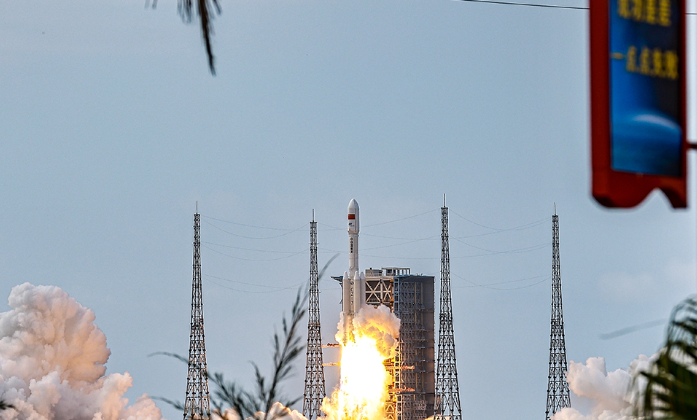
Early on the Monday morning, sunlight spilled over the Wenchang Space Launch Site located in the South China’s tropical island province of Hainan, glinting off the towering combination of the Long March-7 Y11 rocket and the Tianzhou-10 cargo spacecraft atop the launcher.

At 8:14 am, the rocket engines ignited, sending flames roaring skyward and smoke billowing into the air. Beyond the launch pad, the swaying silhouettes of coconut palms merged with the rising plume of fire, stretching along the horizon and framing the scene with a vividly tropical backdrop. The spacecraft climbed steadily into the morning sky, as onlookers watched in awe, witnessing China’s next step in space – a moment both cinematic and historic.
The launch mission was declared to be a full success shortly after launch, as the China Manned Space Agency (CMSA) announced in a statement it provided to the Global Times that the spacecraft entered its designated orbit.
And the CMSA later updated on Monday afternoon that after entering orbit, the Tianzhou-10 cargo spacecraft successfully completed its status configuration. At 1:11 pm Monday, it successfully docked with the aft port of the Tianhe core module of the space station. After the rendezvous and docking, Tianzhou-10 will transition to the integrated spacecraft flight phase.
Perfection in ten
This is the tenth flight of the Tianzhou cargo spacecraft series and as the spacecraft successfully docked with the space station combination, it marked the tenth consecutive successful Tianzhou cargo space supply mission – a milestone embodying the Chinese ideal of shiquan shimei or the “perfection in ten.”
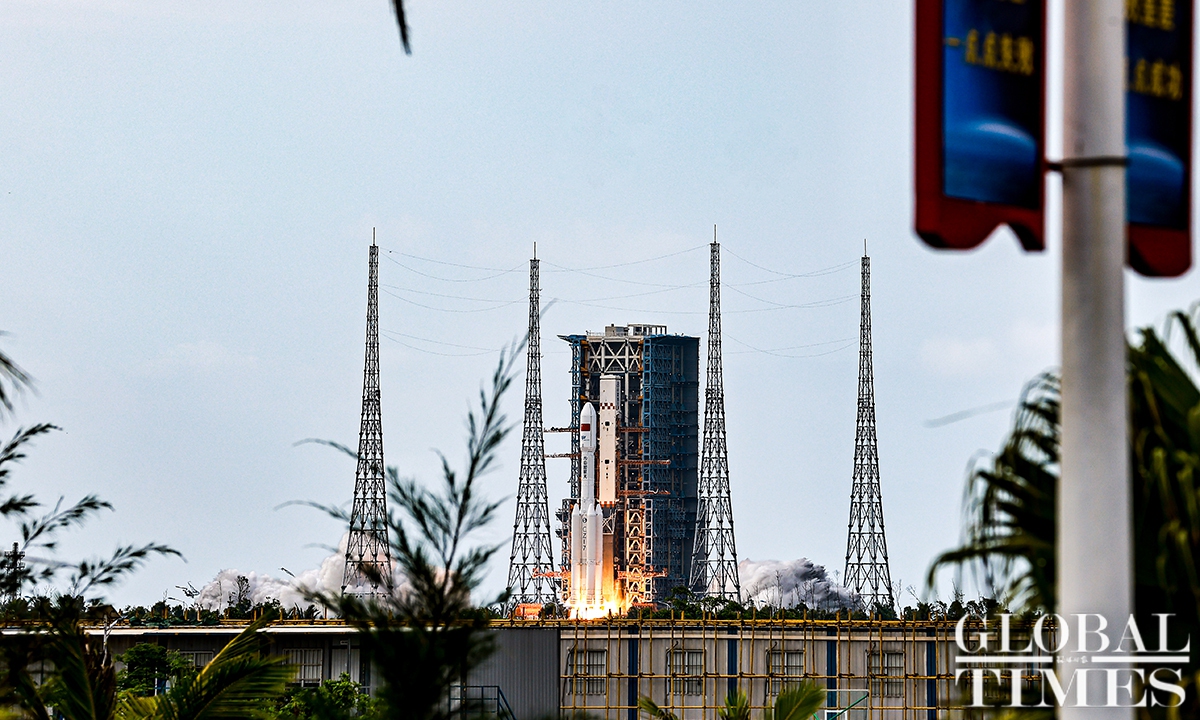
Photo: Deng Xiaoci/GT
Tianzhou-10 will ferry over six tons of cargo to China’s orbiting space station, including the third set of new-type extravehicular spacesuits, a record six scientific payloads, and a new treadmill for use in space, the Global Times learned from the mission insiders.
Dang Rong with the Chinese state-owned space giant China Aerospace Science and Technology Corporation (CASC) – the main contractor of the cargo spacecraft – told the Global Times that as the core carrier for resupplying China Space Station, the Tianzhou-10 cargo spacecraft is currently the cargo spacecraft with the largest transport capacity and the most comprehensive in-orbit support capabilities in the world.
Responding to Global Times inquiry on why Tianzhou could be called the world’s strongest cargo spacecraft in active duty, Dang said that one key measure of a cargo spacecraft’s transport capability is its cargo-to-weight ratio, which indicates the proportion of the total mass that is cargo. Tianzhou achieves a cargo-to-weight ratio of 53 percent, which is indeed a world-leading standard.
“During its mission, it will mainly carry out material resupply, conduct space science and technology experiments, descend waste for controlled deorbit, and, while docked with the space station, support maintaining its orbit and adjusting its attitude, playing an irreplaceable role,” Dang revealed.
The total cargo weight for this mission is nearly 6.2 tons, Dang explained, primarily intended to support the in-orbit work and daily life of the Shenzhou-23 and Shenzhou-24 crews, as well as the instruments and equipment required for the space station’s routine operations and maintenance.
The shipment includes the third set of new-type extravehicular spacesuit and a new treadmill for use in space, totaling more than 220 items. In addition, the mission will deliver 700 kilograms of propellant to replenish the space station, according to the spacecraft developer.
The 10th mission of Tianzhou cargo spacecraft will also see innovations in the quest. There are also six scientific payloads on board, marking the largest number of payloads ever carried on a single mission since the construction of the space station. These payloads will be primarily used for space science experiments in areas such as microgravity, fluid physics, and space technology, the Global Times learned from the CASC.
Longer stay with enhanced capabilities
As a new highlight and challenge of this mission, Tianzhou-10 will remain in orbit for a full year, the Global Times has learned from the mission insiders.
Previously, Tianzhou-2 through Tianzhou-5 docked with the space station for about six months. Starting with Tianzhou-6, as the cargo spacecraft’s delivery capacity increased, the launch frequency was adjusted from four missions every two years to three missions every two years, and the docking duration was extended from roughly six months to nine to ten months.
For Tianzhou-10, the in-orbit stay will reach 12 months, surpassing that of all previous cargo spacecraft, Dang said, explaining that the extended docking period allows each spacecraft to provide longer-term material support and propellant replenishment for the space station, reducing the required launch frequency and lowering operational costs.
The Global Times also learned that Tianzhou-10 could even perform “hour-level” rapid delivery in a literal sense. Elaborating on this, Dang said that Tianzhou-10 carries biological samples that require cold storage and are highly time-sensitive. To ensure their freshness, the Tianzhou team designed an “hour-level” Earth-to-space delivery plan.
“After the cargo is transferred to the launch tower, it is installed directly into the spacecraft on the tower, placing the temperature-sensitive samples into the spacecraft’s space refrigerator. Within just a few hours, once Tianzhou-10 docks with the space station, the astronauts can retrieve and use them,” she said. “This exemplifies the increasingly precise and sophisticated material transport capabilities of the Tianzhou cargo spacecraft.”
Also, the Tianzhou-10 launched into orbit on Monday would also be the 20th spacecraft to ever visit the China Space Station. Since May 2021, Tianzhou-2 through Tianzhou-9 and Shenzhou-12 through Shenzhou-22 have all conducted rendezvous and docking with the China Space Station.
Global Times learned from the Long March-7 developer – the China Academy of Launch Vehicle Technology, also under the CASC that during the Monday launch mission, the launch vehicle carried out a new technology verification. It was equipped with a module called “BianQue,” which is named after an ancient legendary figure in Traditional Chinese Medicine (TCM,) and serves as an onboard fault diagnosis and handling system. This system can perform engine fault diagnosis, trajectory replanning, and guidance, navigation, and control reconstruction, helping the rocket achieve high-safety, high-reliability intelligent flight in the event of engine malfunctions, per the academy.
The inclusion of the “BianQue” system in this mission serves as a demonstration flight for verifying key technologies of intelligent flight, laying a critical technological foundation for achieving intelligent flight in future rockets, the academy explained in a statement.
Pang Zhihao, a retired researcher at the China Academy of Spacecraft Technology and a renowned writer on human spaceflight, told the Global Times on Monday that China’s Tianzhou cargo spacecraft system has achieved comprehensive technological excellence, a “perfection in ten”, and continues to undergo optimization and innovation. Its capabilities for rapid rendezvous and docking, reduced launch frequency, and extended in-orbit residence carry far-reaching significance.
Pang noted that rapid docking greatly enhances the efficiency of space station resupply, ensuring timely and stable delivery of life support and scientific equipment while strengthening on-orbit emergency support. Reducing launch frequency saves rocket and launch site resources, lowers mission costs, alleviates ground monitoring and launch pressures, and improves overall mission economy and sustainability. Longer in-orbit stays extend resupply cycles, supporting the long-term operation of the space station and enabling more space science experiments and technology demonstrations, he said.
This all marks a maturation of China’s crewed space cargo support system. The experience gained will be critical for future crewed lunar missions, deep space exploration, and other major space projects, demonstrating China’s independent technological strength and advancing the nation toward becoming a major space power, he noted.