
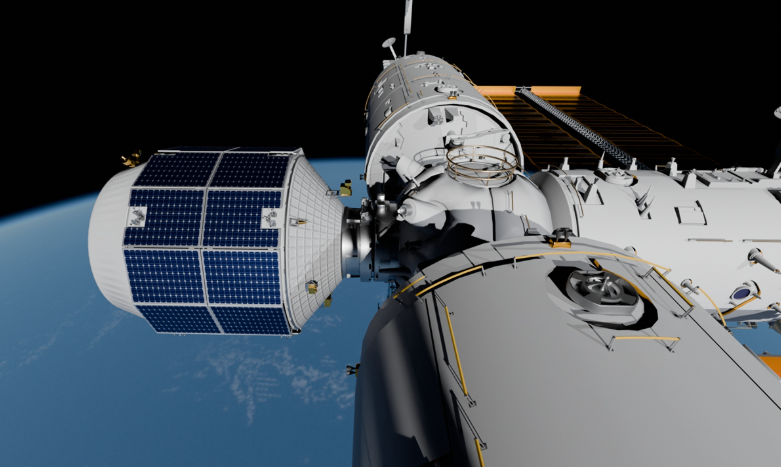
China’s Qingzhou experimental cargo spacecraft has transitioned into its long-term operational phase after successfully completing early-stage tests and releasing its first batch of scientific and engineering results.

Launched on March 30, the spacecraft has carried out flight control tests and raised its orbit to 600 kilometers, according to its developer, the Innovation Academy for Microsatellites (IAMCAS) under the Chinese Academy of Sciences.
The Shanghai-based institute stated that the mission primarily focused on verifying key technologies, exploring cost-efficient design approaches, and expanding mission capabilities. All initial objectives were achieved, providing a strong foundation for the spacecraft’s future development.
Weighing 4.2 tons and equipped with one ton of scientific payload, the spacecraft is designed to operate in orbit for up to three years. It is currently conducting systematic testing of its flight platform, including stability and mission expansion capabilities.
The academy highlighted several technological advancements made during the mission, including innovations in the pressurized module, propulsion system, laser inertial measurement unit, and thermal and environmental control systems.
Among its core features are autonomous proximity operations, safe departure mechanisms for large-inertia spacecraft, extended on-orbit endurance, integrated spacecraft management, and scalable energy systems. These innovations aim to maintain system reliability while significantly reducing development costs.
The spacecraft also demonstrated a flexible payload platform that allows “plug-and-play” integration. So far, six new technology payloads have been tested, with experiments such as active vibration isolation and on-orbit metal manufacturing yielding promising outcomes and addressing key technological gaps.
Development of the Qingzhou spacecraft began in October 2024, with the final design approved in January 2025. The spacecraft was completed within 11 months before its successful launch into orbit.
The test mission is expected to provide essential data for future development while also advancing low-cost and commercially viable space operations.
Looking ahead, the Qingzhou cargo spacecraft will continue to be refined to support cargo transport between Earth and space, contribute to China’s commercial space sector, and aid broader space exploration efforts. A final operational version is expected to dock with the China Space Station to deliver cargo supplies, according to earlier reports.