
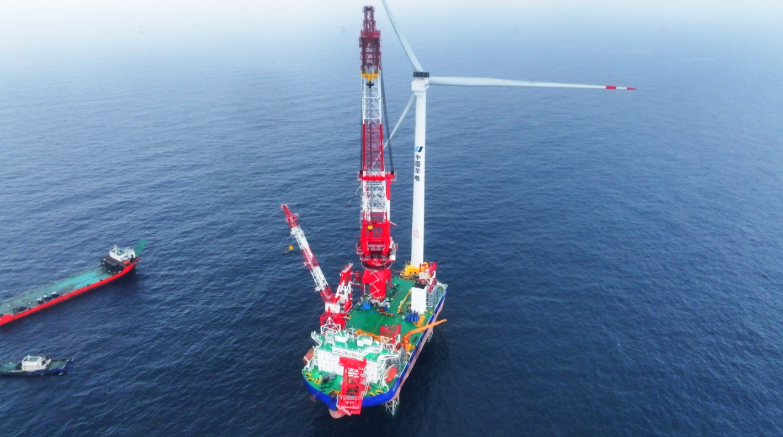
China’s most distant offshore wind power project has installed its first turbine on Thursday, signaling the start of full-scale construction and reinforcing the country’s push to expand offshore wind capacity and advance its green energy transition.

Located in waters south of Hailing Island in Yangjiang, Guangdong Province, the project has a total installed capacity of 500 megawatts. Its central point lies 82 kilometers from shore, with the farthest نقطة extending up to 89 kilometers offshore, according to CCTV News.
The wind farm spans an area of 54 square kilometers, with water depths ranging between 46 and 50 meters.
Plans include the installation of 31 turbines, each with a capacity of 16.2 megawatts, marking the first use of 16.2 MW offshore wind turbines in China.
The project will incorporate big data and intelligent algorithms for real-time monitoring, fault detection, and coordinated operations and maintenance. These technologies are expected to increase power generation by about 2 percent, reduce failure rates by 20 percent, and improve overall returns by 5–10 percent.
Once operational, the wind farm is expected to supply approximately 1.6 billion kilowatt-hours of clean electricity annually, helping to optimize the energy mix in the Guangdong-Hong Kong-Macao Greater Bay Area, according to Li Xiang, an official overseeing the project under developer China Huadian Corporation.
He added that the project could meet the yearly electricity needs of around 700,000 households, while saving 500,000 tons of standard coal and cutting carbon dioxide emissions by 1.26 million tons.
The development comes as China intensifies efforts to expand renewable energy, with offshore wind playing a central role in the country’s energy transition, analysts noted.
“With abundant resources and strong development potential, coupled with continued technological progress and falling costs, offshore wind is positioned to take on the next phase of capacity expansion,” Zhu Tong, a research fellow at the Institute of Industrial Economics under the Chinese Academy of Social Sciences, told the Global Times on Thursday.
China has also made recent advances in offshore wind development. Earlier this week, the country’s deepest offshore wind project achieved full-capacity grid connection in the northern Yellow Sea, demonstrating progress in deep-water construction and large-capacity turbine integration, according to Shanghai Securities News.
Additionally, on Sunday, the first batch of units from China Energy Investment Corp’s first offshore wind project in Hainan was connected to the grid, highlighting progress in large-scale operations of high-capacity turbines in the South China Sea.
China’s offshore wind sector has established a strong global position. Data from the National Energy Administration shows that by the end of February, the country’s total installed wind power capacity reached 650 million kilowatts, up 22.8 percent year-on-year, while offshore wind installations have ranked first globally for five consecutive years.
Analysts attribute this progress to China’s long-term investment in low-carbon industries, supported by strong manufacturing capabilities, a complete supply chain, and integrated industrial strength, driving innovation in wind and solar energy sectors.
During the 15th Five-Year Plan period (2026–2030), China aims to develop offshore wind bases across the Bohai Sea, Yellow Sea, East China Sea, and South China Sea, while steadily advancing deep-sea wind exploration. The target is to surpass 100 million kilowatts in cumulative offshore wind grid-connected capacity.
After years of independent development, China’s wind power industry has transitioned from relying on imported technology to building its own innovation-driven ecosystem, Zhu said, adding, “With steady market demand and ongoing technological advances, key challenges are expected to be resolved, laying the groundwork for scaling up offshore wind development.”