

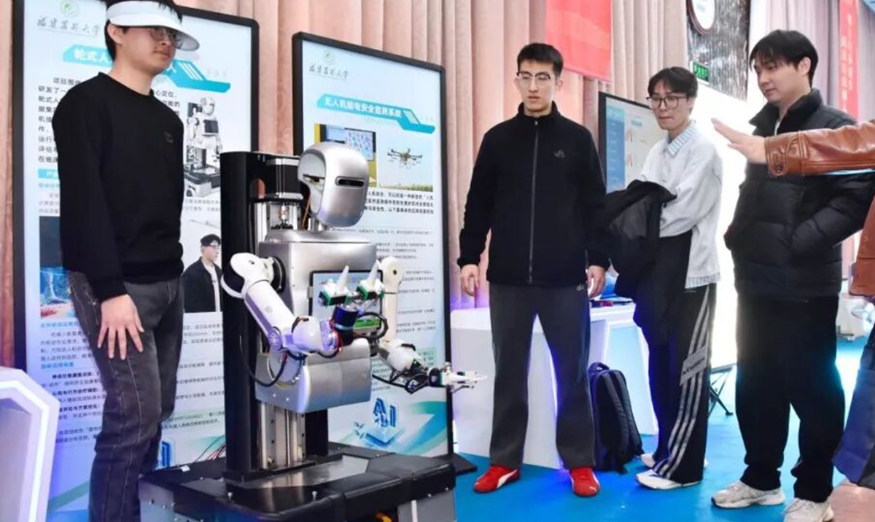
FUZHOU (Global Times): The Fujian Agriculture and Forestry University in East China has unveiled the country’s first humanoid diagnostic and treatment robot that deeply integrates non-invasive brain computer interface (BCI) technology. The robot is expected to help address long-standing challenges in early intervention of autism and other neurodevelopmental disorders, bringing good hope to the rehabilitation of more than 13 million autism patients in China, Global Times learned from the robot developers on Sunday.

The robot, Fuxiaozhi F1-D, was jointly developed by the university in collaboration with the Fujian Big Data Group and other organizations It makes its debut at the university’s recent Artificial Intelligence Innovation Achievements Release Conference.
For children with autism, early intervention is particularly crucial. Traditional rehabilitation faces bottlenecks such as a shortage of professional resources, tedious training processes and highly subjective effect evaluations. The robot brings a completely new solution.
Speaking with the Global Times on Sunday, Kong Xiangzeng, dean of the Institute of Agricultural and Forestry Artificial Intelligence at Fujian Agriculture and Forestry University explained that The Fuxiaozhi F1-D is a robot that assists in the early screening and intervention of autism spectrum disorder through BCI technology. Its core benefits include increasing intervention engagement and fun.
During interactions, the robot simultaneously collects and quantitatively analyzes the child’s brainwave signals or known as the EEG, behavioral data, and task completion metrics. It offers objective data support for early screening and intervention effect evaluation — something traditional methods often lack, Kong said.
It can also serve as a therapist’s assistant, as the robot handles standardized interactions and data recording tasks, allowing therapists to focus more on personalized intervention planning and emotional connection with the child, the institute head revealed.
The system primarily analyzes critical indicators such as specific EEG patterns related to attention and motor imagery, along with behavioral response data collected during interactions, the professor told the Global Times on Sunday.
It is reported that the robot has already moved out of the laboratory and established collaborations with multiple hospitals and institutions.
According to Kong, developers have collaborated with the Affiliated Provincial Hospital of Fuzhou University, professional training institution, and others. “To date, we have completed data collection and analysis for approximately 500 clinical observation cases – about 400 typically developing children and 100 children with autism – providing practical validation for early diagnosis.
The project has now entered the initial application phase, as the developers have already established cooperation with more than 10 organizations, including the Fujian Provincial Big Data Group and the Affiliated Provincial Hospital of Fuzhou University. Currently, the Fujian Provincial Big Data Group is taking the lead in connecting with hospitals and kindergartens across the province to prepare for large-scale early screening and application demonstration projects.
The developers also plan to expand such application and cooperation beyond the Fujian Province to nationwide and to even broader fields.
Kong said that “on the basis of successful pilots, promote the solution across the country. In the future, this technology platform also holds potential for expansion into wider medical rehabilitation areas, such as stroke rehabilitation and motor function reconstruction.”
Autism spectrum disorder (ASD) involves challenges with social communication, repetitive behaviors and emotional abnormalities. The China Disabled Persons’ Federation said in 2023 that the country had 13 million people diagnosed with ASD, according to the Xinhua News Agency.
In recent years, China has continuously improved early screening, diagnosis and rehabilitation for ASD. Support services like inclusive education and rehabilitation therapy have seen progress, offering more help to children with autism.
At the same time, the government and other organizations are supporting families with autistic children to pool resources to create job opportunities for this disabled group. A national policy, launched in February 2024, encourages HR agencies to provide disabled employment services.