
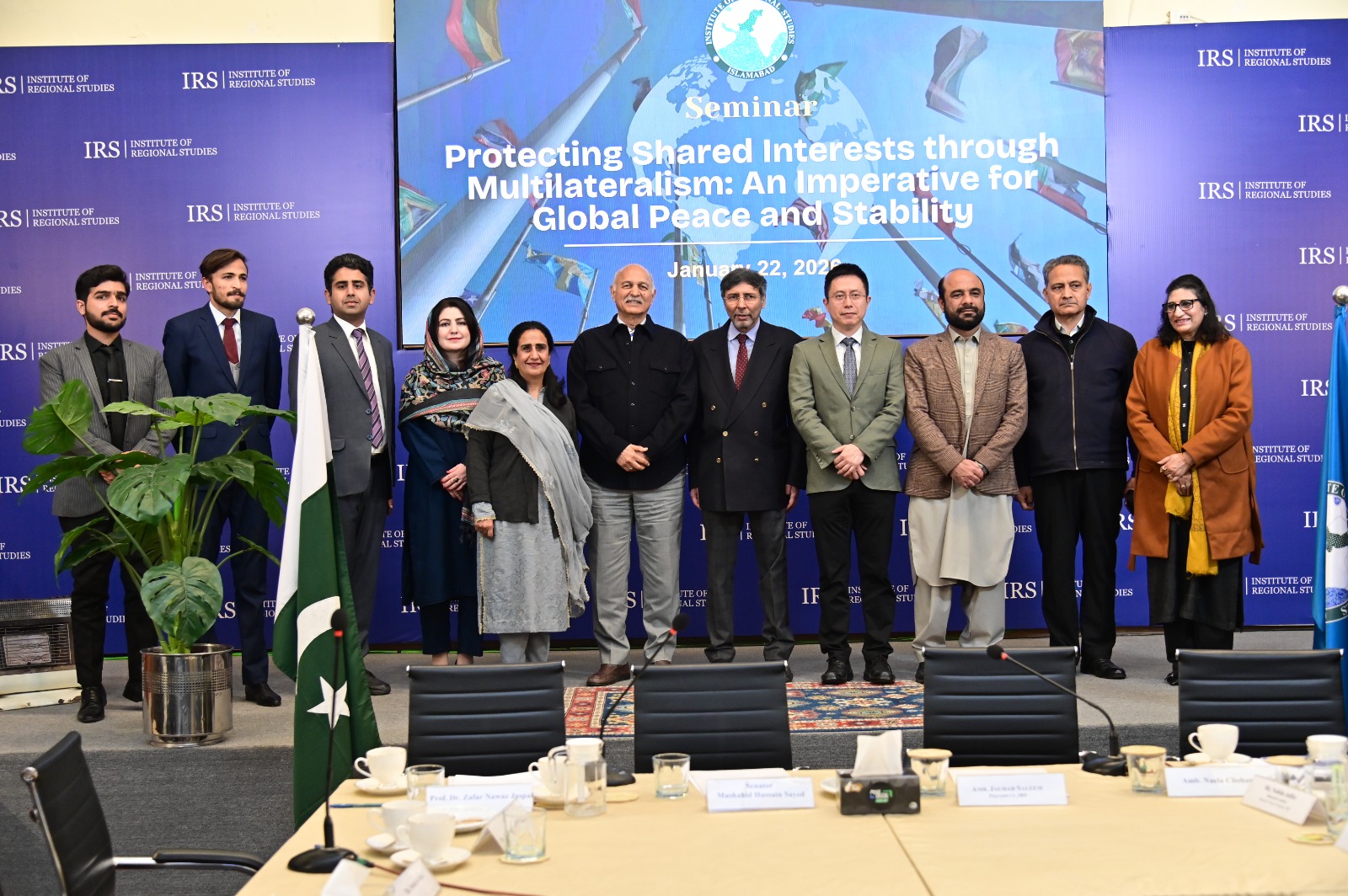
On January 22, 2026, the China Program at the Institute of Regional Studies (IRS), Islamabad, hosted a Seminar titled “Protecting Shared Interests through Multilateralism: An Imperative for Global Peace and Stability”, aimed at examining the significance of reinforcement of multilateralism in the contemporary fragmented world order.

In his welcome remarks, Amb. Jauhar Saleem, President IRS, highlighted the current trend of traditional powers towards unilateral actions, protectionism, conditional diplomacy, transactional approaches, which are undermining the international law and rules enshrined in the UN Charter. India’s proclivity for military aggression demonstrates this trend. The protection of shared interests cannot rest on the discretion of a single power; it needs global cooperation, and adherence to multilateral mechanisms is the need of the hour. In this regard, China’s commencement of institutional engagements is based on the quest for prosperity for all by making concrete contributions in strengthening the UN and international order.
In the keynote address, Senator Mushahid Hussain Sayed highlighted the importance of multilateral engagements, applauded China’s various initiatives, calling them the core concepts for protecting shared interests in the existing international order. China is a flag bearer of multilateralism and globalization, evident from a multitude of countries participating in the Belt and Road Initiative, he said. Pakistan has always urged mediation as a way out for conflict resolution, as multilateralism is a foundational pillar of Pakistan’s foreign policy since its inception, he further added, urging that multilateralism is no longer a policy option but a strategic necessity.
The Indian military aggression against Pakistan, the Russia-Ukraine War, the U.S. action in Venezuela, and the tariff wars are a few glaring examples of unilateral decisions wreaking havoc on peace and stability, Amb. Naela Chohan noted that the contemporary order is on its last legs. The ambassador viewed the Chinese alternatives as more inclusive and that it strengthens regional and international institutions, which have helped multilateral diplomacy regain importance.
Professor Zafar Nawaz Jaspal, Meritorious Professor and Dean of the Faculty of Social Sciences at Quaid-I-Azam University, while calling the strategic and great power competition a cause of concern as they threaten peace, opined that the impact of it has seeped into the middle powers. Against this backdrop, he highlighted the role of China’s initiatives in promoting peaceful dialogue and multilateral cooperation.
From a Chinese perspective, Prof. Qian Feng, Director Research Department at the National Strategy Institute, Tsinghua University, said that China’s approach seeks to accommodate diverse perspectives and promote equity-based global governance frameworks. He highlighted China’s position on multilateral institutions based on the important principles of universal security, inclusivity, and a shared future for mankind as opposed to unilateralism and protectionism.
Moreover, Dr Manzoor Khan Afridi, Professor and Dean of the Faculty of Social Sciences, International Islamic University, Islamabad, discussed multilateralism from the perspective of the Global South, citing the SCO and China’s development initiatives demonstrates China’s approach to relations through cooperation, claiming that the Global South has benefited immensely from China’s initiatives, leading to lasting, sustainable development.
Similarly, Dr Noor Fatima, Associate Professor and Chairman of the Department of Politics and International Relations, International Islamic University, Islamabad, emphasized that China’s initiatives are grounded in human security and development rather than driven by ideological and geographical considerations. She highlighted that people’s centric nature of the Chinese initiatives and inclusive approach to security is providing legitimacy to Beijing to advocate for multilateralism and reforms in the global governance structure amidst global uncertainty and shifts in the balance of power. She further added that China’s approach is pluralist and inclusive, promoting participation, capacity building, and reaching tangible outcomes.
Dr Talat Shabbir, Director of the China-Pakistan Study Centre, Institute of Strategic Studies, Islamabad, termed China’s inclusive governance model and its four major global initiatives, GGI, GCI, GDI, and GSI, as deeply rooted in the principles of multilateralism. The erosion of trust in the system owing to veto-politics and selective engagement necessitates the adoption of mediation mechanisms that are inclusive and preventive rather than reactive. Since mediation is a collective responsibility, mediation mechanisms must be reinvented to meet the realities of the contemporary world, he added further.
Mr. Wang Shengjie, Counsellor, Embassy of the People’s Republic of China, Islamabad, provided China’s comprehensive, viable alternative to unilateralism. He stated that the violations of sovereignty and exceptionalism are the alarming realities of today’s world. In the current turbulent times when states are adopting a ‘My interest comes first’ approach, China envisions a world based on shared interests. He explicated that China’s multilateralism operates on the principles of sovereign equality, openness and inclusiveness, opposition to cliques and exceptionalism, and lastly, focusing on tangible outcomes, which complement the UN-based world order. He emphasized that Pakistan–China relations are a strong example of mutual trust and shared well-being, whilst noting that multilateralism is a collective journey grounded in international equity and shared global responsibility. He concluded by adding that, being a middle power, Pakistan has a middle way.