

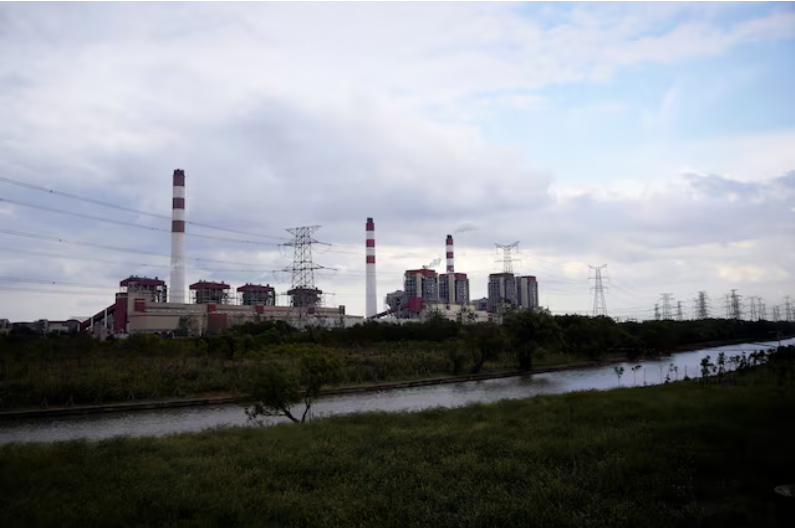
BEIJING, (Reuters) – China’s mostly coal-based thermal power generation fell in 2025 for the first time in 10 years, government data showed on Monday, as growing renewable generation met growth in electricity demand even as overall power usage hit a record.

The data is a positive signal for the decarbonisation of China’s power sector as the country sets a course for carbon emissions to peak by 2030. Still, coal output edged up to a record high last year.
Thermal electricity, generated mostly by coal-fired capacity with a small amount from natural gas, fell 1% in 2025 to 6.29 trillion kilowatt-hours (kWh), according to the National Bureau of Statistics (NBS).
It fell more sharply in December, down by 3.2%, from a year earlier, the data showed.
“The record-level buildout of renewables over recent years has cumulatively impacted the generation mix and squeezed more coal out, coupled with a milder power demand growth of 5% in 2025,” said Peng Chengyao, head of APAC power and renewables research at S&P Global Energy. Power demand had grown by 6.8% year-on-year in 2024, according to the China Electricity Council.
Still, 2025 growth was enough to tip China’s electricity consumption to a new record high, the National Energy Administration (NEA) announced on Saturday, surpassing 10 trillion kWh for the first time.
That was more than the combined consumption of the European Union, Russia, India and Japan in 2024, driven by rapid consumption growth in internet and related services and EV manufacturing.
The NEA statistics offer a fuller picture of power use than the NBS data released on Monday, which omits some smaller-scale renewables generation from wind and solar because of the survey’s minimum annual revenue cutoff. The NBS statistics showed power generation reached 9.72 trillion kWh last year, up 2.2% compared with 2024.
The NBS data also showed that hydropower grew at a steady pace, up 4.1% in December and 2.8% for the full year. Nuclear power output rose 3.1% in December and 7.7% in 2025, respectively.
Thermal power generation is unlikely to accelerate in 2026 as renewables growth continues apace, while power demand growth holds steady at 5%, according to S&P’s forecast.
“This trend towards a structural shift in power generation is difficult to reverse,” said Feng Dongbin, vice general manager at Fenwei Digital Information Technology, which operates Chinese coal analytics platform Sxcoal.