
ISLAMABAD: Pakistan has reiterated its firm support for China on all its core interests, including Taiwan, while also confirming the annual exchange of lists of nuclear installations with India under a long-standing bilateral agreement, the Foreign Office (FO) said on Thursday.

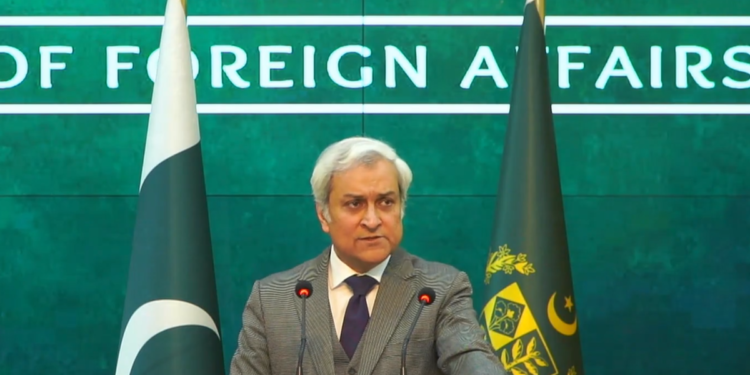
FO spokesperson Tahir Hussain Andrabi, responding to a question on recent US arms sales to Taiwan, said Pakistan has “consistently supported China, in all matters of its core interests, including Taiwan.” He stressed that Pakistan remains committed to the One-China principle and considers Taiwan an inalienable part of China.
“We urge all relevant countries to abide by their historical commitments and refrain from measures that may aggravate tensions or undermine peace and stability in the region,” he added.
Pakistan, India exchange nuclear installations lists
Briefing the media, Andrabi said Pakistan and India exchanged lists of their respective nuclear installations and facilities, continuing the annual practice under the Agreement on the Prohibition of Attacks against Nuclear Installations and Facilities, signed on December 31, 1988.
Under the agreement, which came into force on January 27, 1991, both countries are required to share information about their nuclear installations every year. The annual exchange has been taking place on January 1 since 1992.
“In continuation of the practice, the exchange took place today as well,” Andrabi said. “A list of nuclear installations and facilities in Pakistan was officially handed over to the representative of the Indian High Commission in the Foreign Office.”
He added that India was also sharing its list of nuclear installations with the Pakistani High Commission in New Delhi.
The FO spokesperson also noted that Pakistan and India exchanged lists of prisoners. “The Indian government is sharing the list of Pakistani prisoners in their custody with the Pakistani High Commission in New Delhi,” he said.
Under the Agreement on Consular Access, 2008, both sides are required to exchange lists of prisoners in each other’s custody on January 1 and July 1 every year.
‘India should urgently return to treaty compliance’
Addressing a question on India’s approval of the 260-megawatt Dulhasti Stage-II hydropower project on the Chenab River in India-held Jammu and Kashmir, Andrabi said the move raised serious concerns.
He recalled that under the Indus Waters Treaty (IWT), India cannot misuse its restricted allowance to unilaterally construct hydroelectric projects on the western rivers without prior information-sharing with Pakistan.
“We have seen media reports regarding Indian plans to construct the Dulhasti Stage-II project. These reports raise serious concerns as no prior information or notification was shared with Pakistan,” he said, adding that such information-sharing is mandated under the IWT.
He said Pakistan’s Indus Water Commissioner had sought clarification from his Indian counterpart regarding the nature, scope and technical details of the reported project, including whether it constituted a new run-of-the-river project or an alteration to an existing one.
“In the absence of formal communication from the Indian side, Pakistan is unable to assess the project’s conformity with treaty provisions,” he said, calling on India to “urgently return to treaty compliance.”
Andrabi reiterated that the Indus Waters Treaty remains a binding international agreement and said Pakistan remains committed to the peaceful resolution of disputes but would “never compromise on our existential water rights.”
Pakistanis return from Afghanistan
The FO spokesperson also provided an update on stranded Pakistanis in Afghanistan following border closures, saying that 15 students and 291 other individuals had safely returned to Pakistan.
“We are in contact with the Afghan authorities,” he said, adding that a total of 1,199 Pakistanis — including 549 students — had approached Pakistan’s embassy in Kabul seeking assistance for their return.