
BEIJING: As the world’s largest consumer of electricity, China now generates about one-third of its power from green energy, supporting everyday life while transforming both domestic and global energy and industrial systems.

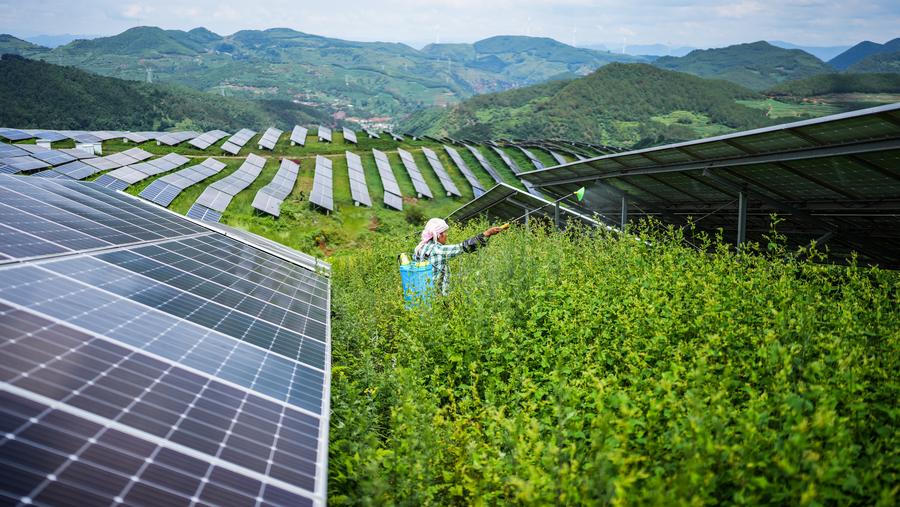
In northwestern regions such as Qinghai, Xinjiang and Ningxia, vast deserts rich in sunshine and wind have been converted into major renewable power bases, benefiting from plentiful resources and relatively low land costs.
POWER FROM DESERT AND SEA
Minning, a town in Ningxia once plagued by poverty on the fringe of the Gobi Desert, has evolved into a 24-hour green energy demonstration zone.
The town produces more than 550 million kilowatt-hours of clean electricity each year, reducing carbon dioxide emissions by 188,300 tonnes, according to Mao Zhiyuan, deputy head of the local power supply station.
“During peak daylight hours, new energy storage facilities store surplus electricity from photovoltaic (PV) panels. At night, wind power and stored energy take over,” Mao explained.
Green electricity now supports food processing, clothing manufacturing and winter heating for more than 11,000 households. Minning’s transformation reflects the rapid growth of Ningxia’s new energy sector and the concrete benefits it brings to local communities.
Starting Jan. 1, 2026, off-peak electricity prices for household heating in Ningxia will be set at about 0.25 yuan (around 3.5 U.S. cents) per kilowatt-hour, according to the Ningxia Development and Reform Commission significantly lower than rates in the European Union.
“Over a decade ago, we relied mainly on stoves for heat. Now, with clean heating, we no longer fret about costs,” said Minning resident Yang Zhihe.
Meanwhile, coastal provinces including Guangdong, Jiangsu and Shandong are expanding offshore wind power hubs to satisfy heavy electricity demand while cutting infrastructure and transmission costs.
These regions are also promoting distributed solar systems installed in or near industrial parks, providing direct access to green power and delivering notable economic and environmental gains.
RENEWABLE ENERGY SYSTEM
Yao Shangheng, a researcher at the Energy Development Research Institute under China Southern Power Grid Co., Ltd., said China has established the world’s largest and most integrated renewable energy system, supported by complete industrial chains. China produces about 90 percent of the world’s photovoltaic polysilicon, wafers and cells, while its module output accounts for roughly 85 percent of the global total.
On this industrial base, China is advancing frontier technologies. Recently, a Shanghai start-up announced progress in developing sustainable aviation fuel (SAF).
The technology uses high-performance catalysts to transform carbon dioxide and green hydrogen generated through water electrolysis into liquid fuels, mainly hydrocarbons.
Song Xuefeng, project manager and vice president of Shanghai Airport (Group) Co., Ltd., said the integrated synthesis process uses less energy than other approaches. “Electrolysis can tap low-cost wind and solar power in northwest China to yield high-value, storable and transportable clean fuels,” he said.
China is also sharing its experience internationally. In a month-long program that concluded Tuesday, 10 power engineers from six countries, including the United Kingdom and Peru, visited Guangdong to study advanced grid technologies and China’s latest energy transition practices.
Kovica Bibic from Serbia said he was impressed by China’s power system powered by the Internet of Things, noting that connectivity among diverse power equipment enables smooth data integration.
“It is like giving the grid a nerve center. We hope to adopt it and help Serbia better address grid instability factors,” he said.