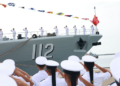

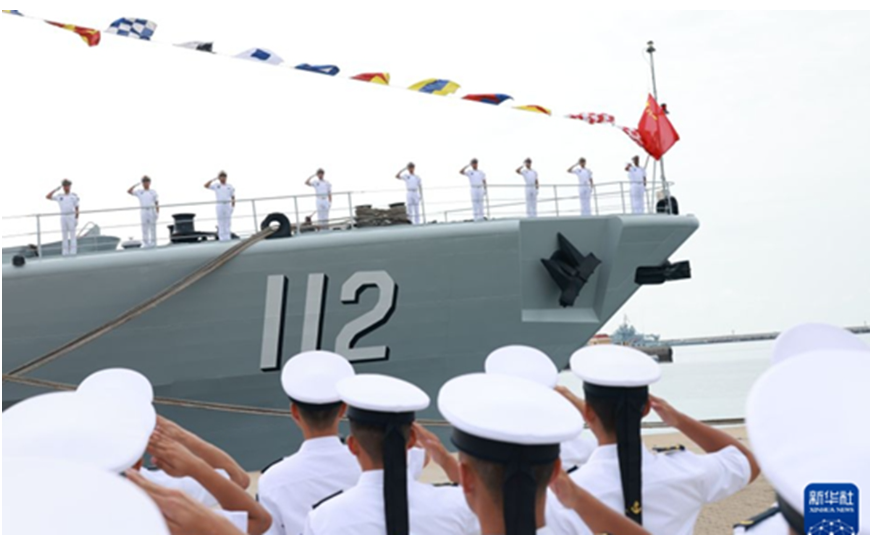
China’s Type 052 guided-missile destroyer Harbin, hull number 112, often hailed as “China’s No. 1 warship” and the lead ship of the country’s second generation of domestically built destroyers, was decommissioned on Friday in Qingdao, East China’s Shandong Province.

The Harbin was a milestone in China’s naval modernization, marking a major leap in surface combat capability. Its retirement and replacement by newer destroyers such as the Type 052C, Type 052D and Type 055 underscore the People’s Liberation Army (PLA) Navy’s shift from catching up to advancing at the forefront, and reflects the Chinese Navy’s growing combat capability, said Chinese experts.
At 9 am on Friday, upon issuance of the decommissioning order “destroyer hull number 112 decommissioned,” the flags at the bow of Harbin was lowered for the last time. This marks the official removal of the 32 year old warship from the PLA Navy’s active combat fleet. Following naval tradition, its ship name will be inherited by a new generation combat vessel with the glory and spirit of the Harbin.
The Global Times reporter stepped up the gangway onto the Harbin and saw two steel tow tracks stand out prominently on the aft flight deck. Running the full length of the helicopter landing zone, the tracks extend all the way back to the hangar.
“This is the ship borne helicopter towing system. When the vessel was built, these two tracks were designed to tow helicopters in and out of the hangar,” Yang Zhilei, a staff member of the Harbin, explained, noting that “It may look outdated today, yet it was highly advanced back then.”
At a time when domestically built destroyers and frigates lacked adequate shipborne helicopter support capabilities, this onboard towing system filled a domestic gap in deck-handling equipment for shipborne helicopters. It marked a breakthrough “from zero to one” and enabled sustained helicopter operations aboard warships, said Yang.
Still, this feature alone would not earn the Harbin its reputation as “China’s No.1 Warship”. According to official records, the Harbin was formally commissioned on May 8, 1994. A trailblazer among China’s second generation destroyers, its commissioning marked a generational leap for Chinese Navy surface vessels, shifting from coastal defense oriented operations to open ocean combat capabilities.
“The Harbin was the first domestically built Chinese destroyer with genuine open ocean sailing capabilities at that time,” Zhang Junshe, a Chinese military affairs expert, told the Global Times on Friday. He noted that it could be described as a vessel that brought together state of the art technologies of its era.
“Prior to the Harbin, China’s first generation missile destroyers focused merely on single role capabilities, either anti ship or air defense, and could not handle diverse missions. Representing China’s second generation missile destroyers, ships like the Harbin integrated air defense, anti ship and anti submarine weaponry, acquiring genuine multi role combat power.”
The propulsion, armament, information systems and aviation capabilities aboard Hull No. 112 were all epoch making at the time, a senior military expert told the Global Times. The warship occupies a milestone position in the development history of the PLA Navy’s destroyer fleet.
That explains why the Harbin set many “firsts” in PLA Navy history: the first voyage beyond the island chains, the first trans Pacific crossing, and the first port call visits to multiple countries across the American continent. Over its 32 year service life, the destroyer completed more than 100 major combat readiness and training missions and sailed safely for over 400,000 nautical miles.
In 1997, the ship paid visits to four American countries, marking the historic first ever trans Pacific voyage and first time visit by a Chinese naval vessel to the American continent. This trans Pacific voyage also established the destroyer Harbin as an iconic symbol of the PLA Navy’s march toward the high seas.
Limited by the technology of its era, the Harbin gradually became less suited to modern naval warfare. It lacked, for example, a universal vertical-launch system and could not be fully integrated into the air-defense architecture of modern aircraft carrier task groups, said Zhang.
“The retirement of legacy warships to make way for more advanced vessels is a normal process for a major-power navy and reflects the Chinese Navy’s growing combat capability,” Zhang said, noting that newer destroyers such as the Type 052C, Type 052D and Type 055 outperform older ships in combat power, information technology, stealth and system integration.
In recent years, the PLA Navy has rapidly commissioned new-generation warships, accelerating the development of advanced combat capabilities. The lead ship of the 10,000 ton-class Type 055 destroyer, the Nanchang, entered service in Qingdao on January 12, 2020, followed by other vessels of the same type including the Lhasa and Anshan, marking the Chinese Navy’s transition from third- to fourth-generation destroyers.
The aircraft carrier Fujian entered service on November 5, 2025, ushering the PLA Navy into the “three-carrier era.” Nine days later, the Sichuan, lead ship of the Type 076 amphibious assault ship class, began its maiden sea trial. Moored at the same dock as the just-decommissioned Harbin is the Luohe (Hull 545), the lead ship of the Type 054B frigate.
After decommissioning, the Harbin will be used as a national defense education base and berthed in Changsha, Central China’s Hunan Province, the hometown of Xiao Jinguang, the first commander of the PLA Navy, where it will be open to the public, according to the PLA Navy.
The Harbin was developed when China’s naval industrial base was still limited, combining imported technology with domestic research and development to help narrow the gap in warship design and construction. Today’s new-generation destroyers are independently designed and built, with key technologies under domestic control, reflecting China’s shift from catching up to keeping pace and moving toward the forefront, said Zhang.
“Its name and hull number may also be inherited by future vessels, carrying forward its legacy in the PLA Navy,” said Zhang.