
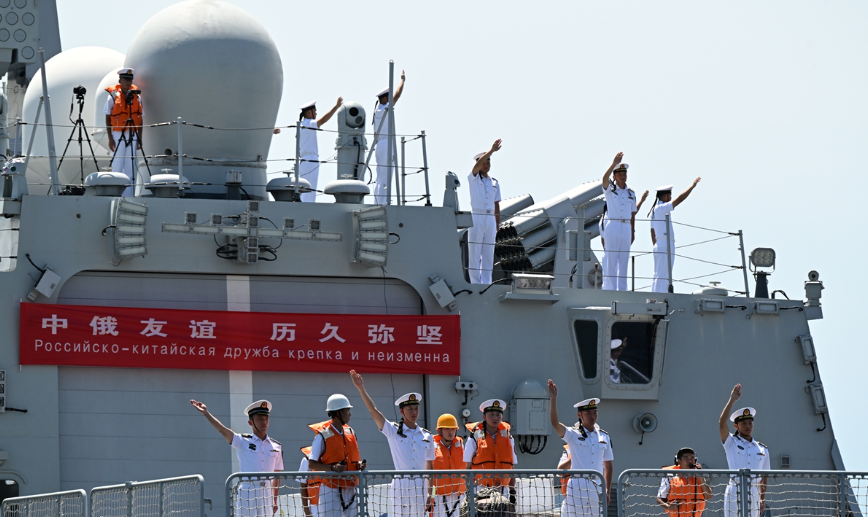
The Chinese and Russian naval task force participating in the maritime joint patrol arrived in Vladivostok, Russia, on Wednesday, marking the conclusion of the joint patrol, according to China’s Ministry of National Defense (MND).

The task force departed from Qingdao, East China’s Shandong Province, on July 13 and sailed through the Miyako Strait, the Etorofu Strait, also known as the Vries Strait, and the Soya Strait, also known as the La Perouse Strait, conducting joint patrols in waters including the western Pacific Ocean, the Sea of Okhotsk and the Sea of Japan, the ministry said on Wednesday.
The joint patrol task force consisted of the Chinese Navy guided missile destroyers Kaifeng and Anshan, the comprehensive supply ship Kekexilihu, and the Russian navy corvette Rezky.
During the patrol, the Chinese and Russian navies conducted a series of drills, including ship-borne helicopter cross-deck landings, joint counter-terrorism operations, humanitarian rescue exercises, and maritime inspection and boarding operations. Chinese vessels also conducted a number of realistic combat-oriented drills by setting up scenarios based on the prevailing maritime and air situation, the ministry said.
The joint patrol was arranged under the annual cooperation plan between the Chinese and Russian militaries. It aims to enhance the two militaries’ joint operational capabilities and jointly address maritime security threats, and is unrelated to the current international and regional situation, the ministry noted.
The China-Russia joint maritime patrol also marked the first time that the patrol route was publicly disclosed as transiting the Vries Strait, some Chinese experts on military affairs said.
Lasting 17 days, the mission featured a markedly expanded operational route compared with previous joint patrols. Should the Chinese naval task force return via the Tsushima Strait, it would complete a full circuit around the Japanese archipelago, sailing along its eastern, northern and western approaches, Chinese military affairs expert Zhang Junshe told the Global Times on Wednesday.
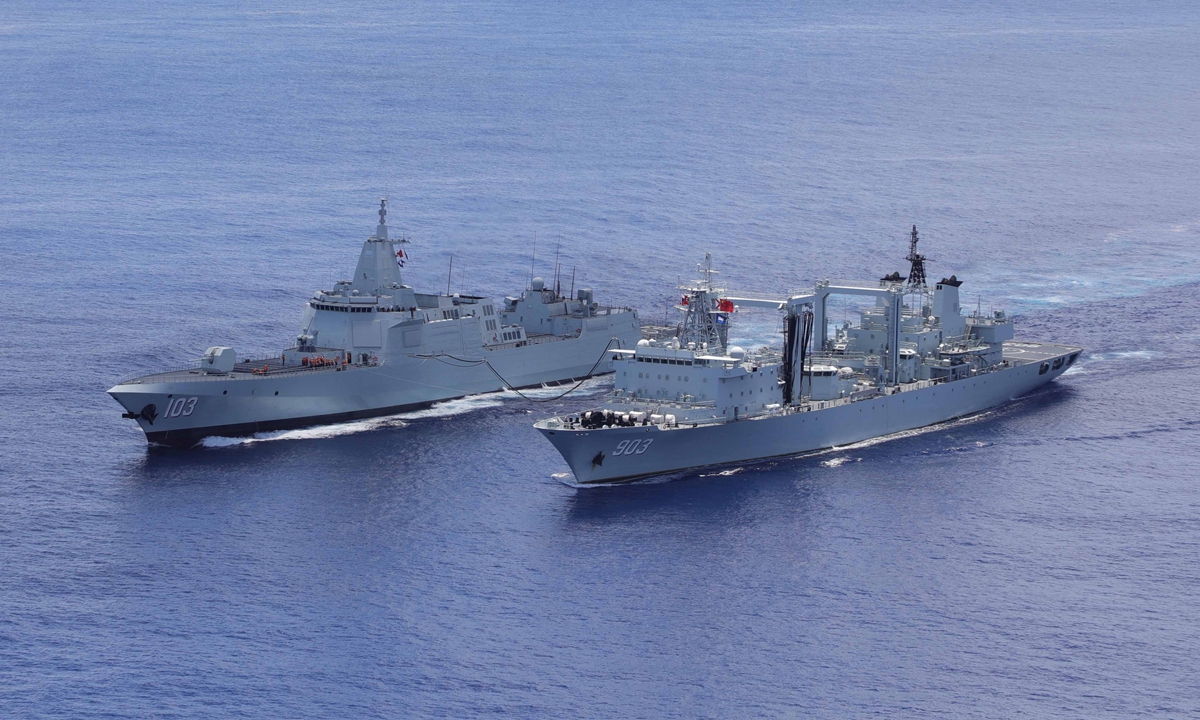
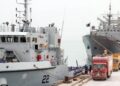
Photo released on July 29, 2026 shows Chinese naval vessels conducting an underway replenishment operation during a China-Russia joint maritime patrol on July 22, 2026. Photo: XinhuaStrategic waterways
Overall, the operation involved sailing a circuit around Japan’s main islands as well as the Ryukyu Islands, which are not part of Japan, some Chinese experts said.
This demonstrates that the notion held by Japan and the US that China can be contained by controlling key maritime chokepoints is not viable, another Chinese military affairs expert Song Zhongping noted.
“China must possess the capability to break through strategic straits and secure access to vital sea lanes, and such capabilities are an important indicator of a country’s military strength. The so-called ‘first island chain,’ promoted by the US and its allies, is intended to confine China and Russia to their near seas and coastal waters. However, China and Russia demonstrated ability to operate through these strategic waterways, which underscores the steady enhancement of their strategic capabilities,” Song said.
According to available information, the Vries Strait, which is also known as the Etorofu Strait, is located between Iturup (Etorofu) Island and Urup (Uruppu) Island, connecting the Sea of Okhotsk with the northwestern Pacific Ocean. The strait is approximately 40 kilometers (about 22 nautical miles) wide and serves as an important shipping route in the northwestern Pacific.
“The Miyako Strait, Soya Strait and Tsushima Strait are all used for international navigation as defined under international law. The passage of Chinese and Russian naval vessels through these waterways was fully consistent with the United Nations Convention on the Law of the Sea (UNCLOS) and established international practices governing maritime transit, making it lawful and compliant,” Zhang said.
Japan has hyped the China-Russia joint maritime patrol, accusing a Chinese naval vessel of conducting live-fire drills within Japan’s so-called exclusive economic zone (EEZ).
The Japanese side said the vessels had transited south between Okinawa Island and Miyako Island on July 16 before sailing northeast southwest of Okinotori, on July 19, then proceeding northeast southeast of Minami Iwo Jima and north east of Iwo Jima on July 21.
In response to Japan’s protest over the Chinese military’s live-fire exercise in its so-called EEZ during the China-Russia joint drill and maritime patrol, Lin Jian, spokesperson for Chinese Foreign Ministry, said at a regular press conference on July 21 that China has firmly rejected Japan’s baseless “protest.” Chinese authorities have made the position clear on China-Russia joint drills and maritime patrol.
Lin stressed that by UNCLOS definition, Okinotori is a rock rather than an island, and thus unfit to claim EEZ or continental shelf. Japan’s claim of an EEZ around the Okinotori violates international law. China’s activities in the high seas are fully consistent with international law and international practice.
China-Russia joint strategic patrols are no longer isolated events but have become an annual activity, some experts said.
“Safeguarding regional peace and stability, whether in the field of traditional or non-traditional security, requires overcoming unreasonable restrictions imposed by certain countries and regions, and the Chinese and Russian navies have the capability to do so,” Song said.
In the future, military cooperation between China and Russia is expected to increase in both frequency and intensity. Maritime cooperation, aerial cooperation, and joint sea-air operations are all likely to become increasingly common. The primary purpose of such regularized cooperation is to safeguard regional security, Song added.
Highlights of joint patrol
According to the MND, Chinese vessels also conducted a number of realistic combat-oriented drills by setting up scenarios based on the prevailing maritime and air situation. Regarding these details, Zhang said they demonstrate that the Chinese naval task force possesses strong capabilities in situational awareness, emergency response and dynamic operations.
During the exercise, China deployed some of the PLA Navy’s most advanced surface combatants, including a Type 055 guided missile destroyer and a Type 052D guided missile destroyer, as well as a Type 903A comprehensive replenishment ship, forming a compact but capable naval task force, Song noted.
The task force possesses strong overall combat capabilities, including integrated air and maritime defense, precision strike capabilities, and comprehensive operational support. It is capable of defending itself while transiting the first island chain and key maritime chokepoints, and also has the ability to conduct long-range strike operations independently, the expert said.
In fact, Japanese vessels have long conducted close-in surveillance of Chinese task groups and have even crossed through Chinese naval formations during their voyages, actions that themselves constitute a source of maritime tension, Chinese experts noted.
The “on-the-spot scenario setting for realistic combat training” sends a clear deterrent message that the Chinese task force conducted confrontation drills targeting various forms of maritime and aerial harassment as well as unexpected incidents at sea, Zhang noted.
“It has both the capabilities and contingency plans to respond to a wide range of maritime emergencies in surrounding waters,” he said, adding that the exercises also serve as a warning to Japan against continuing provocative close-in reconnaissance activities.