
Despite the Philippines taking the lead in maliciously attacking Chinese law enforcement personnel, the US State Department on Monday condemned what it called China’s “dangerous and aggressive” actions against Philippine personnel at Ren’ai Jiao in the South China Sea. A Chinese expert described the statement as an attempt to add fuel to the fire and exploit tensions ahead of the upcoming ASEAN Foreign Ministers’ Meeting, reflecting Washington’s concerns over its waning influence in the Asia-Pacific and among ASEAN countries.

The statement claimed that the US stands with its ally the Philippines and commend what it calls the “professionalism and restraint” shown by Philippine navy personnel in the incident.
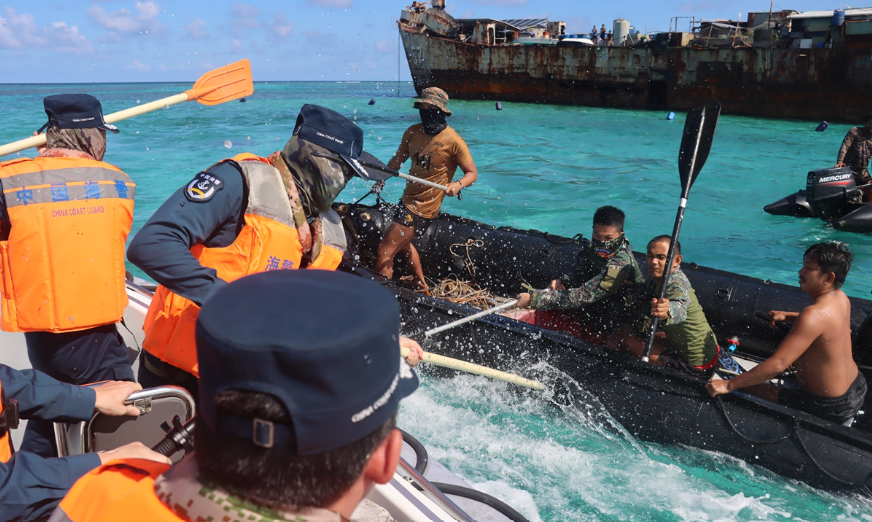
According to a video obtained by the Global Times, the Philippine warship BRP Sierra Madre – which has been illegally grounded at China’s Ren’ai Jiao – deployed two rubber boats that approached and rammed a China Coast Guard patrol vessel in a dangerous manner on Monday.
The video showed that the Philippine personnel were the first to maliciously attack Chinese law enforcement personnel with paddles, long poles and other tools, after which Chinese forces issued verbal warnings and took countermeasures in response.
Philippine Coast Guard spokesperson Jay Tarriela posted multiple statements on social media, claiming “an unarmed sailor” was hit on the head.
The Chinese Embassy in Manila later released four videos in response to the Philippines, provided a comprehensive account of footages and facts and the full context of the incident, revealing that the Philippine personnel had ignored repeated warnings from the Chinese side and deliberately stirred up trouble. “You can’t start a fight and then play the victim,” the embassy said in the post.
The Philippines’ approach of shaping narratives on the South China Sea issue “has not changed at all, Chen Xiangmiao, director of the World Navy Research Center at the National Institute for South China Sea Studies, told the Global Times on Monday, adding that the Philippines deliberately provoked the situation and attempted to drag China into the dispute.
Chen noted that the Philippine side intentionally rammed a Chinese coast guard vessel and used “cold weapons” such as sticks, while ignoring repeated warnings and attempts by China to drive it away. He said the Philippines has developed a “fixed playbook” for creating media narratives.
Meanwhile, the US statement issued at this particular moment was aimed more at making a political statement and projecting an image, Chen said.
Chen noted that as China provided a comprehensive account of the facts, the US still issued a statement that ignored the facts and hyped up the issue on behalf of the Philippines, which clearly reflects double standards. This further demonstrates Washington’s intention to interfere in the South China Sea, disrupt the regional situation and undermine stability.
He added that the US, as an external power, was “adding fuel to the fire” on the South China Sea issue and using the momentum of the ASEAN Foreign Ministers’ Meetings to create pressure on China in the international arena.
In its report on the ASEAN Foreign Ministers’ Meeting, AP News claimed that US Secretary of State Marco Rubio’s attendance at the meetings was aimed at addressing issues including “China’s actions in the disputed South China Sea.”
The US’ emphasis on the China-Philippines incident ahead of the ASEAN meetings was intended to elevate what was essentially a bilateral maritime dispute involving Philippine provocations and China’s legitimate countermeasures into an issue concerning “regional rules” and “international order,” in an attempt to weaken China’s influence in promoting the Code of Conduct (COC) negotiations and regional cooperation agenda, Ma Bo, an associate professor at the School of International Studies at Nanjing University, told the Global Times on Tuesday.
From this perspective, the US’ response to the Philippine provocation is more about exploitation, Ma said. “This exploitation is closely related to the competition for influence between China and the US among ASEAN countries.”
According to the Chinese Foreign Ministry, Foreign Minister Wang Yi will attend the China-ASEAN Foreign Ministers’ Meeting in Manila, the Philippines. From July 23 to 25, Wang will travel to Cholpon-Ata, Kyrgyzstan, to attend the Meeting of the Council of the Foreign Ministers of the Shanghai Cooperation Organization (SCO) member states and visit Kyrgyzstan.
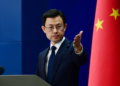
Noting that this year marks the fifth anniversary of the establishment of the China-ASEAN comprehensive strategic partnership, Chinese Foreign Ministry spokesperson Lin Jian said on Monday at a press conference that ASEAN is a friendly close neighbor, an important cooperation partner and a priority in China’s neighborhood diplomacy.
China supports ASEAN centrality in the regional cooperation architecture and hopes that flourishing East Asian cooperation will make greater contributions to stability, development and prosperity in the region and beyond, Lin said.