
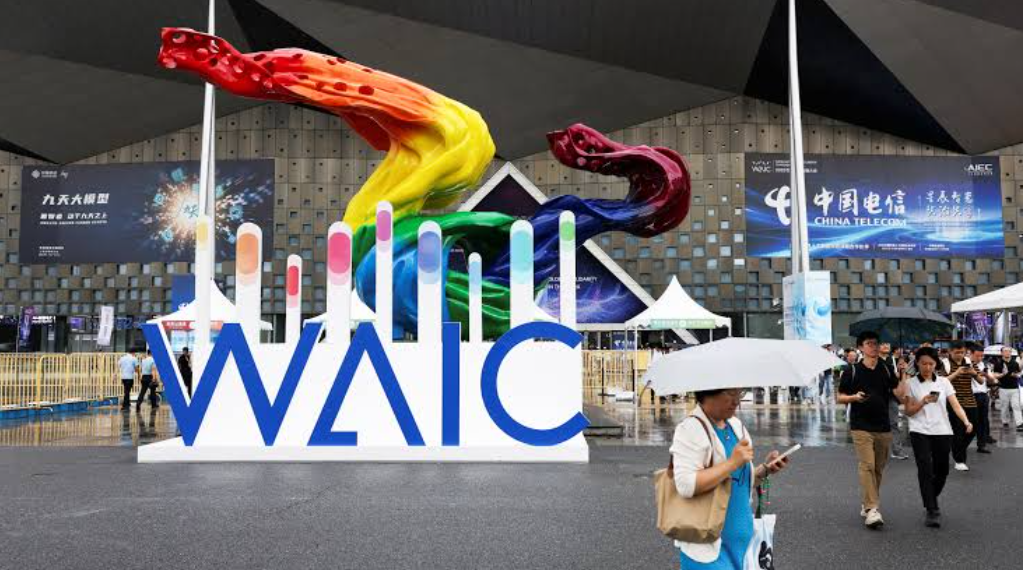
SHANGHAI: Shanghai is ushering in its major AI moment of the year with the forthcoming 2026 World AI Conference (WAIC) and High-Level Meeting on Global AI Governance, scheduled from Friday to Monday.

Themed “AI Partnership for a Brighter Future,” the event will include more than 140 forums, bringing together 1,400 guests from home and abroad, while featuring six sections: Conferences & Forums, Exhibitions & Showcases, Awards & Competitions, Application Experiences, Innovation Incubation, and Talent Attraction.
The conference will be hosted across four venues in Shanghai’s Pudong, Zhangjiang and Xuhui. Activities will include the main forum, subforums, and exhibitions of smart devices, AI plus culture and entertainment experiences, and a wide range of cutting-edge AI products.
For the first time, the exhibition area will exceed 100,000 square meters, with over 1,100 enterprises expected to participate. Organizers said exhibitors will showcase more than 3,000 products and technologies, with over 300 products making their global debuts.
Among the exhibition highlights are Huawei’s latest AI computing super node system Atlas 950, MiniMax M3 multimodal foundation model, and the world’s first agentic AI phone, alongside a range of humanoid robots and AI-powered dexterous hands.
China has hosted WAIC for eight consecutive years, with the conference serving as a platform to forge global AI partnerships to unlock AI’s benefits for all.
Since its launch, the WAIC has also become a platform for showcasing China’s tech progress, gathering leading academics and industry pioneers, and presenting a balanced, forward-looking outlook on responsible AI governance, experts said.
The event this year will be jointly hosted by six central government ministries and commissions, including the Ministry of Foreign Affairs and the National Development and Reform Commission, along with the Cyberspace Administration of China, the Chinese Academy of Sciences, the China Association for Science and Technology, and the Shanghai Municipal People’s Government.
China has ramped up investment support for AI development, and Shanghai, as one of the country’s leading AI innovation hubs, has identified the AI industry as a key driver of economic growth.
Chen Jie, deputy mayor of Shanghai, said the city has built a full-fledged development ecosystem integrating independent innovation, application-driven growth, opening-up and cooperation, coordinated industrial ecosystem development, and security governance.
Shanghai was home to 394 major AI enterprises in 2025, with their total industrial scale exceeding 637 billion yuan (about 93.7 billion U.S. dollars), representing a year-on-year increase of 39.5 percent.
A national AI industry investment fund totaling 60 billion yuan has been set up in the city, while an additional 22.5-billion-yuan AI investment fund has also been established.
Shanghai is accelerating the development of intelligent terminal industries, covering AI glasses and AI smartphones. The city’s intelligent terminal industry is expected to exceed 300 billion yuan by 2027.
A total of 14 universities in Shanghai have set up AI research institutes, and 19 universities offer AI-related majors. The city is home to nearly 300,000 AI talents, accounting for roughly one-third of the country’s total.
Meanwhile, over 150,000 models have been gathered in the city’s open-source communities, attracting more than 10 million developers worldwide.