

Islamabad : Yerzhan Kistafin, Ambassador of Kazakhstan to Pakistan, termed the visit as the opening of a “new chapter” in bilateral relations. He highlighted the joint declaration on strategic partnership, joint cultural, academic, scientific, and sports initiatives, growing business engagement, and plans for direct flights, trans-Afghan railway links, and diversified transport corridors, positioning both countries as gateways connecting Eurasia with South Asia, the Middle East, Africa, and beyond.
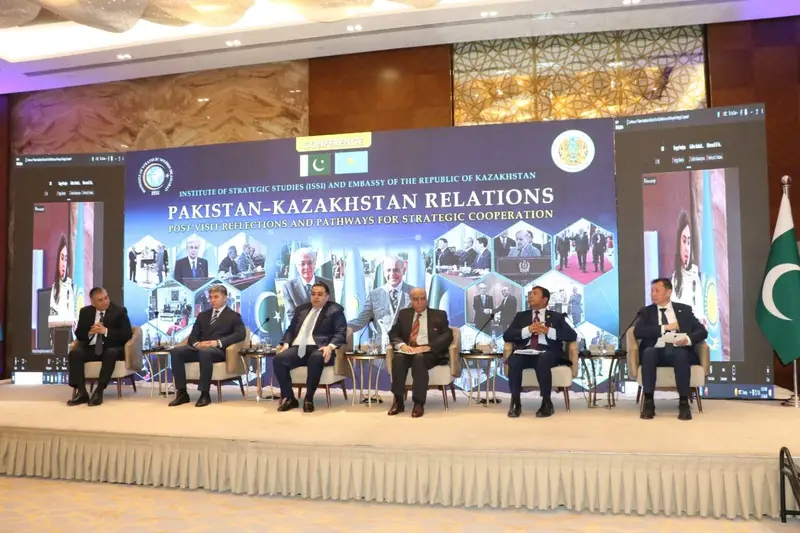
Institute of Strategic Studies Islamabad (ISSI), in collaboration with the Embassy of the Republic of Kazakhstan, hosted a conference titled “Pakistan–Kazakhstan Relations: Post-Visit Reflections and Pathways for Strategic Cooperation” at Movenpick.
The conference was organized in the context of the growing strategic convergence between Pakistan and Kazakhstan following the historic state visit of President Kassym-Jomart Tokayev to Islamabad. The conference brought together eminent diplomats, scholars, and practitioners from Pakistan and Kazakhstan for an in-depth exchange of views on bilateral relations, regional connectivity, and strategic cooperation, highlighting pathways for sustained partnership and mutual growth.
Ambassador Khalid Mahmood, Chairman Board of Governors ISSI, in his welcome remarks, highlighted that Pakistan–Kazakhstan relations are rooted in shared history, cultural affinities, and mutual respect. He described the February 2026 state visit as a milestone formally elevating bilateral relations to a strategic partnership, emphasizing convergence on regional and international issues including Jammu and Kashmir and Afghanistan.
Guest of Honor Dr. Askhat Kessikbayev, Vice President of the Turkic Academy, highlighted civilizational and cultural linkages, emphasizing academic cooperation, joint research on economic development, sustainability, water security, and regional integration. Prof. Dr. Muhammad Iqbal Choudhary, Coordinator-General, OIC-COMSTECH, praised Kazakhstan’s investments in higher education, science, and innovation, stressing sustained academic collaboration with Pakistan.
The Chief Guest of the inaugural session Fahad Haroon, Special Assistant to the Prime Minister on Digital Media, described the recent Kazakhstan–Pakistan summit as a strategic reaffirmation of mutual trust and shared regional vision. He underscored Pakistan’s view of Kazakhstan as a key partner in its broader Central Asia engagement. He stressed the importance of institutional follow-up, sustained dialogue, and public discourse to ensure that the strategic partnership delivers long-term benefits for both countries and the wider region.
The Working Session- I was moderated by Dr. Talat Shabbir, Director CPSC, ISSI. Hasan Ali Zaigham, Director General (Central Asia & ECO), Ministry of Foreign Affairs, Pakistan, described the visit as a historic milestone and highlighted Pakistan’s role as a gateway for landlocked Central Asian states. He outlined mechanisms for strategic dialogue, a five-year roadmap for trade, and the transit trade agreement, noting Pakistan’s export potential to Kazakhstan at US$1.7 billion.
Sergey Savelyev, Senior Expert, Foreign Policy Research Institute of Kazakhstan, underscored the Joint Declaration as a landmark for cooperation in politics, security, trade, transport, education, and culture, and welcomed institutional collaboration with ISSI. Ambassador Moin ul Haque highlighted connectivity as the central pillar of engagement, emphasizing CPEC, QTTA, regional energy projects, multimodal integration, regulatory harmonization, supply chain resilience, and Afghan engagement as essential for success. Dr. Yasar Ayaz, Chairman, National Center of Artificial Intelligence (NCAI) Pakistan, highlighted Pakistan’s AI, robotics, and imaging capabilities, proposing joint research, innovation, and capacity-building initiatives with Kazakhstan in emerging technologies.
The Working Session II focused on economic cooperation, regional integration, and people-to-people linkages.Engineer Khurram Dastgir Khan, was the Chief Guest for the concluding session. He described Pakistan–Kazakhstan relations as entering a decisive phase, structured across political dialogue, security, trade, transport, education, science, culture, climate cooperation, and regional coordination. He emphasized moving from concept to execution, investment in education, digital connectivity, financial linkages, youth engagement, and enhanced security cooperation.
In his vote of thanks, Ambassador Khalid Mahmood noted the joint declaration and MoUs as a practical roadmap, emphasizing effective implementation and convergence on regional security, counterterrorism, Afghanistan, and Kashmir. He thanked the Embassy of Kazakhstan, speakers, and attendees, proposing follow-up engagements to ensure the strategic partnership’s objectives are fully realized.
Earlier in his introductory remarks, Dr. Talat Shabbir, Director CPSC, ISSI highlighted the historic nature of the presidential visit, agreements across multiple sectors, regional connectivity initiatives, and the scholarly contributions of the Turkic Academy.